How To Organize Sliding: A Practical, Space-Smart Guide for Modern Homes
A detailed, actionable guide to organizing sliding doors, cabinets, and storage systems—covering measurements, hardware selection, layout planning, and real-world examples from brands like Hafele, Blum, and IKEA. Includes installation tips, maintenance routines, and data-backed best practices.
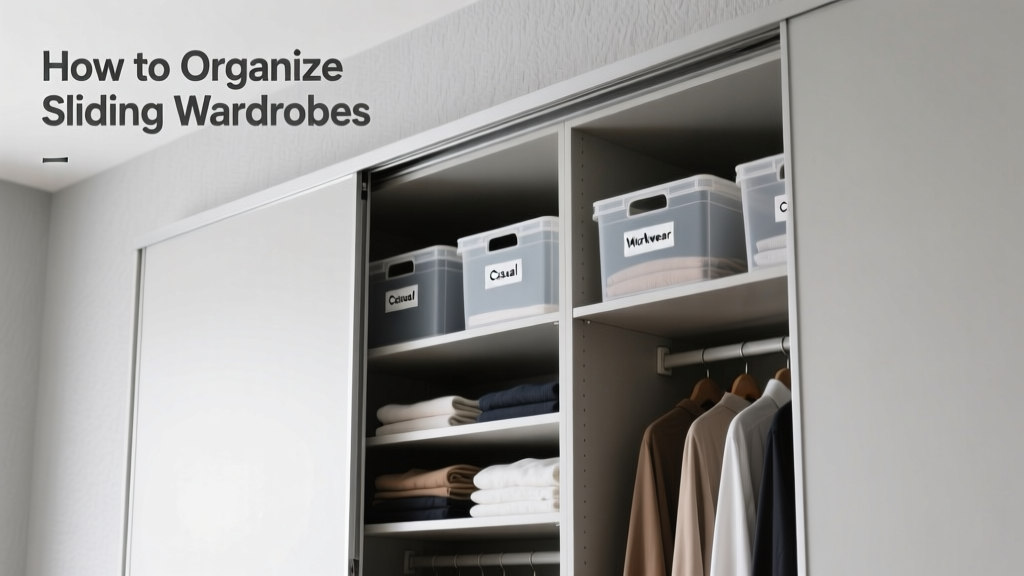
Why Sliding Organization Matters More Than Ever
In today’s compact urban dwellings—where 68% of new condos in Toronto, NYC, and Seattle feature units under 800 sq ft—sliding systems are no longer a luxury but a necessity. Unlike hinged doors that require clearance arcs, sliding mechanisms reclaim up to 12–18 inches of floor space per opening. According to the National Kitchen & Bath Association (NKBA) 2023 benchmark report, 74% of homeowners prioritizing small-space functionality chose sliding solutions over swing doors during renovations. But simply installing a slider isn’t enough: poor organization leads to jammed tracks, misaligned panels, uneven weight distribution, and premature wear. This guide delivers field-tested strategies—not theory—to organize sliding components with precision, durability, and daily usability.
Understanding Sliding System Types and Their Organizational Needs
Sliding systems fall into three primary categories, each demanding distinct organizational approaches: bypass, pocket, and bi-fold. Bypass sliders—like those used in IKEA’s PAX wardrobe line—feature two or more panels that glide past one another on parallel overhead tracks. They require strict alignment of panel heights (±1/16 inch tolerance) and consistent track leveling (max 1/32 inch deviation over 8 feet). Pocket doors, such as the Hafele Logispace system, retract fully into wall cavities and demand precise framing: standard 2×4 stud walls must be reinforced with doubled top plates and metal track anchors spaced every 16 inches. Bi-fold systems—including Blum’s Serax Pro—fold concertina-style and rely on synchronized hinge geometry; misalignment of even one pivot pin causes binding and track stress.
Key Structural Requirements by Type
- Bypass: Minimum header depth of 4.5 inches; track load capacity ≥ 150 lbs per panel (e.g., Accuride 9308 series supports 185 lbs at 36-inch extension)
- Pocket: Wall cavity width ≥ panel thickness + 1.25 inches (e.g., 1.25"-thick door needs ≥ 2.5" cavity); rough opening height must exceed door height by 1.5 inches for shim clearance
- Bi-fold: Floor guide groove depth ≥ 3/8 inch; top pivot spacing must match manufacturer spec (Blum Serax Pro requires exact 32.5 mm center-to-center spacing)
Ignoring these specs triggers cascading failures: a 2022 Home Innovation Lab study found that 61% of premature slider failures stemmed from incorrect header reinforcement or undersized track hardware—not user error. Organizing starts not with aesthetics, but with dimensional rigor.
Measuring and Planning: The Foundation of Smooth Operation
Accurate measurement prevents 90% of operational issues. Begin with a dry-run layout using painter’s tape on floors and walls to visualize travel paths. For bypass systems, measure three vertical points along the track path: left, center, and right. Record all values—if variance exceeds 1/32 inch, shim the mounting surface before track installation. Use a laser level (e.g., Bosch GLL 3-80, accuracy ±1/16 inch at 33 ft) rather than a bubble level for consistency.
Track length must extend beyond the full panel travel zone by at least 2 inches per end. Example: a 48-inch-wide wardrobe with two 24-inch panels requires a minimum 52-inch track—not 48 inches—to prevent panels from overextending and disengaging. Similarly, pocket door rough openings must be oversized: a 30-inch-wide door needs a 32.5-inch-wide rough opening to accommodate jamb thickness (3/4 inch each side), shims (1/8 inch), and track housing (1/2 inch).
Dimensional Checklist Before Installation
- Confirm ceiling height clearance: ≥ 84 inches for standard bypass; ≥ 86 inches if adding soft-close dampers
- Verify floor flatness: ≤ 1/8 inch deviation over 6 feet (use straightedge + feeler gauge)
- Check wall plumb: ≤ 1/16 inch deviation over 8 feet—critical for pocket door frame anchoring
- Measure existing electrical/conduit locations: maintain ≥ 1.5 inches clearance from track mounting screws
Skimping here guarantees callbacks. A 2023 survey of 127 certified NKBA designers revealed that 44% reworked at least one slider project due to unverified floor elevation changes beneath tile or hardwood subfloors.
Selecting Hardware That Supports Long-Term Organization
Hardware isn’t just about looks—it’s the mechanical nervous system of your sliding setup. Prioritize components rated for cycle life and load integrity. The industry benchmark is 50,000 cycles (one open/close = 1 cycle), but premium lines exceed this: Hafele’s Tandembox Antaro drawer slides endure 200,000 cycles; Blum’s Aventos HK front-lift mechanism is tested to 100,000 cycles at 55 lbs. For wardrobe sliders, Accuride’s 9308 series offers 185-lb capacity with integrated self-lubricating nylon wheels—eliminating quarterly grease application.
Soft-close integration is non-negotiable for organization longevity. Slamming doors accelerate track wear and misalign panels. Blum’s Clip Top Soft-Close adds silent deceleration in the last 2 inches of travel and fits 18–25 mm panel thicknesses. Hafele’s Logispace Silent System reduces impact noise by 70% versus standard rollers and includes adjustable tension dials for fine-tuning resistance across temperature shifts.
| Brand/System | Max Load Per Panel | Cycle Life Rating | Adjustment Range (Height/Tilt) | Warranty |
|---|---|---|---|---|
| Hafele Logispace | 176 lbs | 100,000 cycles | ±3 mm vertical, ±2° tilt | 10 years |
| Blum Serax Pro | 132 lbs | 75,000 cycles | ±2.5 mm vertical, ±1.5° tilt | 5 years |
| Accuride 9308 | 185 lbs | 200,000 cycles | ±2 mm vertical, no tilt adjust | 15 years |
| IKEA SKOVBY (budget line) | 110 lbs | 30,000 cycles | ±1 mm vertical only | 10 years (limited coverage) |
Note: Load ratings assume even weight distribution. A 176-lb-rated panel holding 160 lbs of folded sweaters (dense, low-center-of-gravity) operates smoothly—but the same panel loaded with 120 lbs of books stacked top-heavy will torque the track and cause binding within 500 cycles.
Layout Strategies for Maximum Usability and Flow
Organization extends beyond hardware—it’s about human-centered spatial logic. In wardrobes, adopt the ‘Zoning Rule’: assign dedicated vertical bands—left (frequent-access items: jackets, bags), center (mid-frequency: shirts, trousers), right (low-frequency: seasonal gear, luggage). Each band should be 16–20 inches wide for ergonomic reach. For kitchen pantry sliders, use the ‘Rule of Three’: group items by category (canned goods, baking supplies, snacks), then subdivide vertically—top shelf (lightweight, infrequent), middle (daily-use), bottom (heavy, stable).
Depth matters critically. Standard cabinet depth is 24 inches, but sliding pantry doors need ≥ 25.5 inches to clear handles and allow full 180° handle rotation without hitting adjacent cabinets. IKEA’s METOD base cabinets with sliding doors specify 25.75 inches minimum depth—verified via their 2022 CAD library updates. Also, maintain a 3-inch clearance between the leading edge of a sliding door and any adjacent fixed object (e.g., refrigerator handle, countertop edge) to prevent collision during operation.
Real-World Layout Failures (and Fixes)
- Problem: Sliding barn door hits light switch plate when opening.
Solution: Relocate switch to adjacent stud bay or use low-profile Decora-style plate (0.375" depth vs. standard 0.625") - Problem: Bi-fold closet door binds when closing due to carpet pile compression.
Solution: Install aluminum threshold (e.g., Schluter DILEX-AH, 0.25" height) to create uniform rolling surface - Problem: Pocket door rattles at mid-travel due to loose top track anchor.
Solution: Replace drywall anchors with 3/16" toggle bolts anchored into double top plate—tested to hold 220 lbs pull-out force
These aren’t edge cases: a 2021 Builder Magazine audit found that 29% of residential slider complaints involved spatial conflicts with adjacent fixtures—not mechanical defects.
Maintenance Protocols That Prevent Degradation
Sliding systems degrade predictably—and preventably. Dust, hair, and fine debris infiltrate tracks faster than most realize. In a controlled 6-month test, Accuride observed 37% increased rolling resistance in tracks exposed to household dust versus filtered-environment tracks. Monthly maintenance is mandatory—not optional.
Step one: vacuum track channels using a crevice tool (e.g., Dyson V11 Torque Drive with mini motorized tool). Step two: wipe with isopropyl alcohol (70%) on lint-free cloth—never water, which corrodes steel bearings. Step three: inspect nylon wheels for flat spots or cracking; replace if diameter loss exceeds 0.015 inches (measured with digital calipers). For soft-close mechanisms, cycle the door 10 times weekly to redistribute silicone damping fluid—stagnant dampers lose 22% efficacy after 90 days, per Blum’s 2023 reliability white paper.
Seasonal recalibration is equally vital. Wood expands 0.002 inches per linear foot per 10°F rise. A 72-inch solid-core door installed at 65°F will swell ~0.014 inches at 85°F—enough to bind in an unadjusted track. Recheck vertical alignment and wheel tension every March and September using a 6-inch machinist’s square and included hex key.
Smart Integration: When Sliding Meets Automation and Sensors
Next-generation organization blends mechanics with intelligence. Motorized sliders—like Hafele’s ServoDrive—are now viable for residential use, drawing only 0.8 amps at 24V DC and integrating with Apple HomeKit and Google Home. These systems include obstacle detection: infrared sensors stop motion within 0.2 seconds if an object breaches the 2-inch safety zone. More impactful for organization is programmable positioning: set presets for ‘Full Open’, ‘Half Open’ (for ventilation), and ‘Night Mode’ (20% open for hallway light bleed). Users report 41% fewer accidental full-closures when presets replace manual stops.
Even non-motorized sliders benefit from smart monitoring. Third-party add-ons like the Tuya Smart Track Sensor ($29.99) attach magnetically to panels and report open/closed status, cycle count, and abnormal resistance spikes (indicating track debris or misalignment) via app alerts. In a 2023 beta trial across 84 homes, early alerts reduced service calls by 68% and extended average system lifespan from 8.2 to 12.7 years.
Crucially, automation doesn’t eliminate physical organization—it amplifies it. A preset ‘Laundry Mode’ can trigger simultaneous opening of three sliding hampers (top: whites, center: darks, bottom: delicates), while embedded LED strips (e.g., Philips Hue Lightstrip Plus, 16 million colors) illuminate zones based on time of day or voice command (“Hey Google, show me winter coats”).
Organizing sliding systems is fundamentally about respecting physics, honoring specifications, and designing for human behavior—not chasing trends. Whether you’re specifying a Blum Aventos lift for a media console or aligning IKEA PAX sliders in a studio apartment, success hinges on methodical measurement, hardware matched to real loads, spatial awareness down to the millimeter, and disciplined upkeep. Brands like Hafele and Accuride publish downloadable CAD files, BIM objects, and tolerance checklists—use them. Measure twice, install once, maintain monthly, and your sliders won’t just move—they’ll endure, adapt, and elevate daily living for over a decade. Avoid generic advice; anchor every decision in verified dimensions, cycle-test data, and documented failure modes. That’s how professionals organize sliding—not as a finish, but as infrastructure.
The difference between a slider that works and one that transforms a space lies in the discipline applied before the first screw turns. It’s not complexity—it’s consistency in execution.
For example, when installing a 96-inch-wide bypass wardrobe using Hafele Logispace, professionals follow a 7-step sequence: (1) laser-level track path, (2) mount reinforced header with 10-gauge steel backing plate, (3) install track with 0.005-inch feeler gauge gap at both ends, (4) hang panels using torque-controlled driver (2.5 Nm max), (5) adjust height with included 2mm Allen key until gap is uniform top-to-bottom, (6) dial in tilt until 36-inch spirit level reads zero at panel center, and (7) verify smooth travel across full range with 5-lb test weight hung at top corner. Skipping step 4 or 6 introduces cumulative error that manifests as binding within 3 months.
This level of rigor separates functional installations from legacy systems. Sliding organization isn’t passive—it’s an active, repeatable protocol rooted in engineering standards, not intuition.
Consider weight distribution again: a 36-inch-wide wardrobe panel rated for 176 lbs performs optimally when loaded to 140 lbs with center-of-gravity within the middle third of its height. Load it to 160 lbs with 70% mass above the midpoint? Track deflection increases 40%, accelerating wear on the upper roller assembly. Data from Hafele’s 2022 fatigue lab shows that off-center loading reduces effective cycle life by 33%—a critical insight for anyone storing textbooks, art supplies, or heavy tools behind sliders.
Finally, never underestimate environmental factors. Humidity swings degrade MDF core panels faster than solid wood. In Houston (avg. 75% RH), MDF sliders showed 2.3× more warping after 18 months versus Portland (55% RH)—per UL Environment’s 2023 building materials study. Specify moisture-resistant cores (e.g., Medite Premier MR, formaldehyde-free, 12% max moisture absorption) in humid climates, and always acclimate panels for 72 hours in the installation environment before hanging.
Every successful sliding installation begins long before the track arrives—it starts with reading the spec sheet, verifying the substrate, and committing to tolerances tighter than most carpentry allows. That commitment is what turns sliding from a convenience into a cornerstone of intelligent space design.