Masonite Siding Identification, Selection, and Modern Alternatives
Technical guide to identifying legacy Masonite hardboard siding, understanding failure modes, and selecting modern engineered wood or fiber cement replacements.
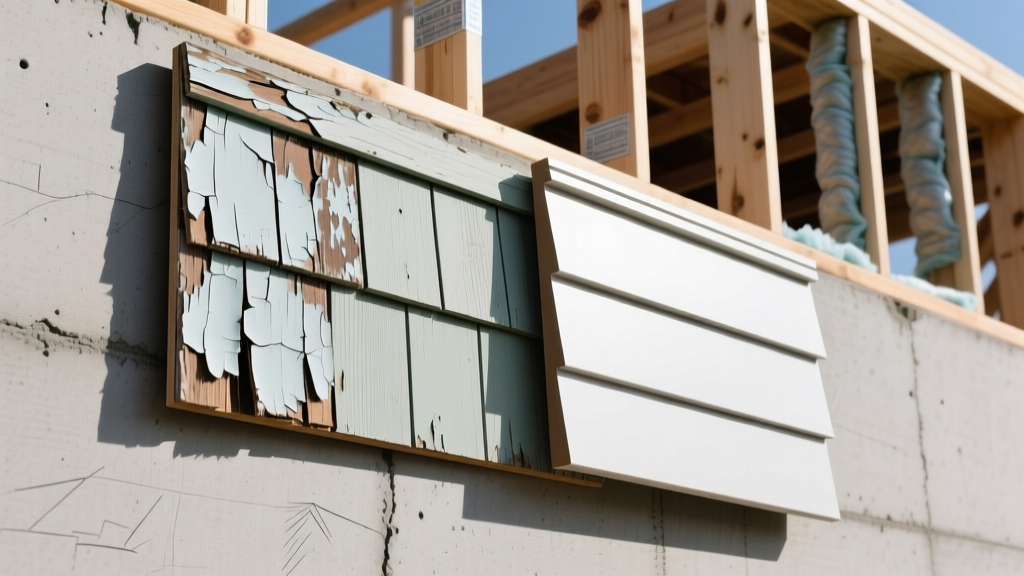
Masonite is a proprietary eponym for hardboard siding, a material that dominated residential exterior cladding from the 1970s through the mid-1990s. Manufactured by exploding wood chips with high-pressure steam and pressing them into dense sheets without added synthetic resins, true Masonite relies on the natural lignin in the wood fibers to bind the board. While it offered an affordable, uniform alternative to natural wood lap siding, its widespread installation revealed critical vulnerabilities to moisture infiltration. Today, building professionals and homeowners must navigate the complex taxonomy of legacy hardboard, diagnose specific failure modes, and select high-performance modern alternatives like engineered wood strand boards or fiber cement.
The Hardboard Taxonomy: Where Masonite Siding Fits
Within the broader siding and cladding taxonomy, Masonite falls under the Engineered Wood / Hardboard category. It is critical to distinguish wet-formed hardboard (the original Masonite process) from dry-formed medium-density fiberboard (MDF) and oriented strand board (OSB). Wet-formed hardboard is created by suspending wood fibers in water, forming a mat, and pressing it under extreme heat and pressure. This process yields a highly dense, smooth-faced panel with a distinct screen-patterned back.
Exterior-grade hardboard was typically "tempered," meaning it was impregnated with oxidized linseed oil or tung oil and baked to increase moisture resistance and surface hardness. However, this tempering only penetrates the surface and edges to a limited depth. Once the factory-applied primer or field-applied paint is compromised, the untreated inner core of compressed cellulose becomes highly susceptible to rapid moisture absorption and fungal decay.
Identifying Legacy Masonite: Key Diagnostic Markers
Accurate identification is the first step in any cladding assessment. Because the term "Masonite" is often incorrectly applied to any engineered wood product, inspectors must look for specific physical and dimensional markers to confirm true hardboard:
- Dimensional Profiles: Legacy hardboard lap siding typically measures 7/16-inch to 1/2-inch in thickness and was commonly manufactured in 120-inch (10-foot) or 144-inch (12-foot) lengths, which is shorter than modern fiber cement or engineered wood profiles.
- The Screen Backing: Flip a loose piece or check behind an electrical outlet. Wet-formed hardboard almost always features a distinct waffle-like or crosshatch screen pattern on the back, left by the wire mesh used during the pressing process.
- AHA Stamps: Look for the American Hardboard Association (AHA) certification stamp on the back of the boards, which was standard on products manufactured between 1980 and 1995.
- Edge Swelling: The most definitive visual marker is localized swelling along the bottom drip edge of the lap boards, often accompanied by a spongy texture when pressed with a thumb.
The Moisture Failure Mechanism
Hardboard siding does not fail uniformly; it fails at the intersections and edges. The primary failure mechanism is capillary action at the bottom drip edge. Unlike solid wood, which has natural cellular structures that slow water migration, the compressed, exploded fibers of hardboard act like a dense sponge when exposed to liquid water.
When installers fail to apply a factory end-sealant to cut boards, or when they drive nails too close to the bottom edge (causing micro-fractures in the tempering layer), water wicks upward into the board core. As the inner fibers absorb moisture, they expand. Because the painted surface restricts outward expansion, the board swells laterally and pushes outward, resulting in the characteristic "mushrooming" of the bottom edge. Over time, this trapped moisture drops below the surface, leading to delamination of the paint film and providing an ideal environment for wood-decaying fungi, as detailed in moisture management guidelines by the U.S. Department of Energy.
Modern Alternatives: Selecting the Right Replacement
True exterior hardboard is largely obsolete. When replacing failing Masonite, the selection taxonomy shifts to modern engineered wood strand products and fiber cement. The choice depends on structural load limits, aesthetic preferences, and regional climate zones.
| Material Type | Composition & Treatment | Moisture & Pest Resistance | Standard Warranty |
|---|---|---|---|
| Engineered Wood Strand (e.g., LP SmartSide) | Compressed wood strands bonded with exterior-grade resins; treated with zinc borate. | High. Zinc borate prevents fungal decay and termites. Requires edge sealing on cuts. | 50-year limited / 5-year 100% labor & material. |
| Fiber Cement (e.g., James Hardie) | Portland cement, sand, and cellulose fibers cured in an autoclave. | Exceptional. Inorganic matrix is impervious to rot and insects. Heavy weight requires solid nailing. | 30-year non-prorated substrate warranty. |
| Engineered Lap (e.g., TruWood) | Wood fibers and phenolic resins pressed into a lap profile with an integrated primer. | Moderate to High. Better edge density than legacy hardboard, but still requires strict paint maintenance. | 25-year limited substrate warranty. |
For homes in high-humidity zones (IECC Climate Zones 1-3) or areas with severe termite pressure, fiber cement is the definitive choice. For retrofit projects where the existing wall sheathing cannot support the 300+ lbs per square weight of fiber cement, engineered wood strand products like LP Building Solutions' SmartSide provide the necessary structural relief while offering superior impact resistance compared to brittle cement boards.
Cost Breakdown: Repair vs. Full Replacement in 2026
Deciding between localized repair and full cladding replacement requires a strict financial and structural framework. Patching hardboard is only viable if the moisture intrusion is strictly cosmetic and isolated to less than 10% of the total wall area.
| Project Scope | Material Cost (per sq. ft.) | Labor & Prep (per sq. ft.) | Total Installed Range |
|---|---|---|---|
| Targeted Hardboard Repair & Paint | $1.50 - $2.50 | $4.00 - $6.50 | $5.50 - $9.00 |
| Full Tear-Off & LP SmartSide Install | $4.50 - $6.20 | $5.50 - $8.00 | $10.00 - $14.20 |
| Full Tear-Off & Fiber Cement Install | $5.80 - $7.50 | $7.00 - $10.50 | $12.80 - $18.00 |
Note: Costs reflect 2026 national averages. Full tear-offs must include a line item for housewrap inspection and potential OSB sheathing replacement, which typically adds $2.50 to $4.00 per square foot if rot is discovered behind the legacy hardboard.
Maintenance Protocols for Existing Hardboard
If a homeowner elects to retain and maintain existing Masonite hardboard rather than replace it, a rigorous, code-compliant maintenance protocol is non-negotiable. Standard painting practices will accelerate failure if moisture is trapped within the board.
- Moisture Meter Verification: Before any surface preparation, use a pin-type moisture meter on the bottom edges of the lap boards. Readings above 19% indicate active fungal decay; these boards must be replaced, not painted.
- Edge Sealing: Any exposed bottom edges or cut ends must be sealed with a high-solids, oil-based alkyd primer (e.g., Zinsser Cover Stain) to block capillary wicking before topcoating.
- Acrylic Latex Topcoat: Apply two coats of 100% acrylic latex exterior paint. Acrylic latex remains flexible and allows microscopic vapor transmission, whereas oil-based topcoats will become brittle, micro-crack, and trap liquid water inside the hardboard core.
- Caulking Restrictions: Never caulk the bottom drip edge of hardboard lap siding to the board below it. This traps water inside the wall cavity. Only caulk vertical end joints and top-edge intersections with flashings.
"When repainting legacy hardboard, strictly enforce a Light Reflectance Value (LRV) of 55 or higher. Dark colors absorb solar radiation, heating the board surface to over 140°F. This extreme thermal cycling causes the trapped moisture inside the hardboard core to vaporize and expand, violently blistering the paint film and accelerating delamination."
Ultimately, while legacy Masonite hardboard can be maintained in the short term with meticulous moisture management, its inherent material limitations make it a depreciating asset. Transitioning to modern strand-engineered wood or fiber cement cladding eliminates the capillary vulnerabilities of wet-formed hardboard, securing the building envelope against the moisture intrusion that defined the hardboard era's most notorious failures. For comprehensive product specifications and installation tolerances, always consult the current technical data sheets provided by manufacturers like James Hardie or LP Corp prior to finalizing material selections.