Top Vinyl Siding Material Estimator Tools Compared (2026)
Compare the top vinyl siding material estimator tools for 2026. We review HOVER, EagleView, and Buildxact for accuracy, pricing, and trim calculations.

The Hidden Cost of Inaccurate Vinyl Takeoffs
Ordering vinyl siding is not as simple as calculating wall square footage and dividing by 100. Unlike fiber cement or wood, vinyl requires precise accounting for thermal expansion gaps, specific interlocking trim pieces, and profile-dependent waste factors. According to the Vinyl Siding Institute (VSI), improper estimation and installation account for the majority of post-installation warping and buckling claims. For contractors and advanced DIYers in 2026, relying on a basic length-times-width calculation guarantees material shortages or expensive overages.
A dedicated vinyl siding material estimator must account for starter strips, J-channels, undersill trims, and the specific waste factor associated with your chosen profile (e.g., Dutch lap vs. traditional clapboard). Below, we compare the leading estimation platforms to determine which delivers the most accurate takeoffs, best integration, and highest return on investment.
Head-to-Head Matrix: Top Vinyl Siding Estimators
| Platform | Best For | Pricing Model (2026) | 3D Modeling | Trim Takeoff Accuracy |
|---|---|---|---|---|
| HOVER | Sales conversions & 3D visualization | $45 - $65 per report | Yes (Photorealistic) | High (Automated) |
| EagleView | Rapid aerial measurements | $22 - $35 per report | No (2D Orthographic) | Medium (Manual adjust) |
| Buildxact | End-to-end project management | $149 - $299 / month | No | High (Formula-based) |
| Big Box Calculators | Basic DIY ballpark figures | Free | No | Low (Ignores complex trim) |
Premium 3D & Aerial Takeoff Tools
HOVER: Best for 3D Visualization and Consumer Sales
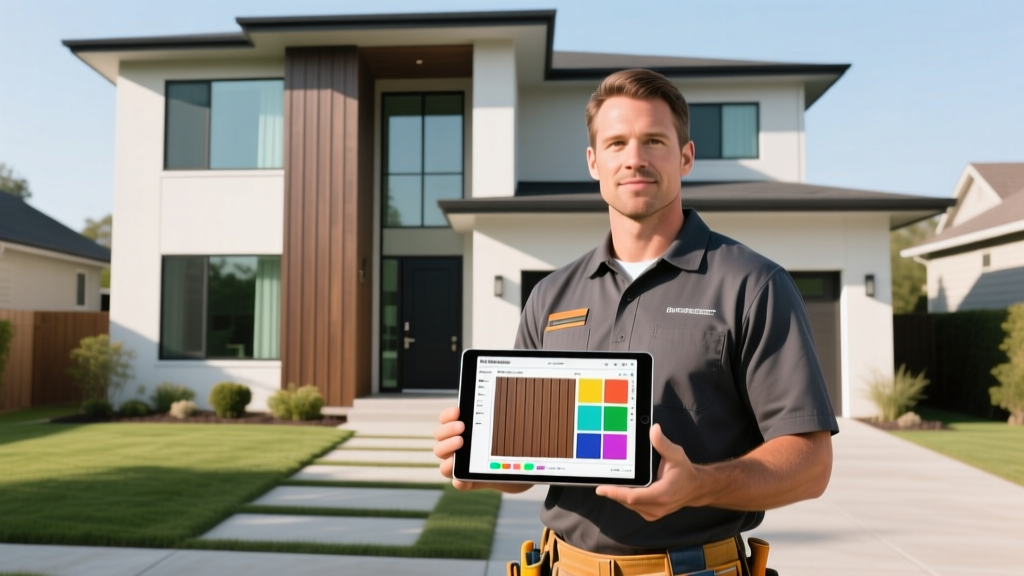
HOVER transforms smartphone photos into fully measured, interactive 3D models. For siding contractors, its primary advantage is the ability to swap vinyl siding profiles and colors in real-time while automatically recalculating the material takeoff.
- Strengths: The algorithm automatically calculates linear footage for J-channels, starter strips, and soffit based on the 3D geometry. It reduces the 'sticker shock' for homeowners by allowing them to visualize the exact CertainTeed or Alside product on their home before signing.
- Weaknesses: The per-report cost ($45-$65) eats into margins for smaller repair jobs. It also requires the user to capture photos from specific angles, which can be difficult on heavily wooded lots.
- Verdict: Essential for design-build remodelers and high-end exterior contractors who use visualization as a primary sales tool.
EagleView: Best for Rapid Aerial Measurements
EagleView remains the industry standard for aerial roof and wall measurements. While primarily known for roofing, its Siding Measurement Report provides highly accurate wall elevations, window cutouts, and gable square footage.
- Strengths: Unmatched speed. You can generate a precise wall-area takeoff without ever setting foot on a ladder. Excellent for initial bidding phases on large, multi-story commercial or residential projects.
- Weaknesses: EagleView provides the raw square footage and linear dimensions, but it does not automatically translate these into specific vinyl trim SKUs. You must manually apply your waste factors and trim formulas within your own spreadsheet or estimating software.
- Verdict: Ideal for high-volume estimators who need fast, accurate baseline square footage and already have a robust internal system for calculating trim and accessories.
Comprehensive Contractor Suites vs. Free Retail Calculators
Buildxact: Best for End-to-End Project Management
Buildxact is not a measurement tool; it is an estimating and project management suite. However, its digital takeoff and estimating module is highly regarded for siding contractors who import plans or EagleView PDFs.
- Strengths: You can build custom 'assemblies.' For example, you can create a 'Vinyl Siding Assembly' that automatically adds 1.2 boxes of siding, 15 linear feet of J-channel, and 4 feet of starter strip for every 100 square feet of wall area measured. It connects directly to supplier pricing catalogs.
- Weaknesses: Steep learning curve. Setting up the initial assemblies and waste formulas requires deep knowledge of vinyl installation standards.
- Verdict: The best choice for established contracting businesses managing multiple crews and requiring precise purchase orders.
Big Box Retailer Calculators (Home Depot / Lowe's)
The free online calculators provided by major retailers ask for your wall height and width, then output the number of siding boxes required.
Where Automated Estimators Fail: The Trim & Waste Gap
Even the most advanced vinyl siding material estimator will generate flawed purchase orders if the user does not understand the physical limitations of vinyl. According to guidelines referenced by the National Association of Home Builders (NAHB), vinyl expands and contracts significantly with temperature changes. A 12-foot panel can expand up to 5/8 of an inch. Estimators must account for this in the trim depths and overlap calculations.
Critical Variables to Manually Verify
- Profile-Specific Waste Factors: Traditional horizontal clapboard requires a standard 10% waste factor. However, Dutch lap, board-and-batten, and scalloped profiles require 12% to 15% waste due to the complex cuts needed to fit the interlocking grooves around windows and at gable peaks.
- The J-Channel Blindspot: Most basic calculators assume J-channel is only needed around windows and doors. They miss the J-channel required at the intersection of different siding materials, around exterior outlets, and at the roofline if no soffit is present.
- Starter Strip and Utility Trim: Every linear foot of the bottom course requires a starter strip. Every window and door top requires undersill trim to secure the cut panels. A 2,000 sq. ft. exterior wall typically requires 250 to 300 linear feet of combined starter, J-channel, and utility trim—a metric frequently underreported by automated tools.
- Box vs. Square Math: In the siding industry, 1 'Square' equals 100 square feet. However, vinyl siding is almost universally packaged in boxes containing 2 Squares (200 sq. ft.). Estimators that output 'Squares' instead of 'Boxes' will cause purchasing managers to accidentally order double the required material.
Decision Framework: Which Tool Fits Your Operation?
The Design-Build Remodeler
Choose HOVER. If your business model relies on closing high-ticket exterior renovations, the $50 per report is easily absorbed by the increased close rate from 3D visualizations. The automated trim takeoffs save hours of manual counting.
The High-Volume Siding Crew
Choose EagleView + Buildxact. Use EagleView for rapid, safe, and accurate baseline wall measurements. Import those PDFs into Buildxact, utilizing custom assemblies to instantly generate highly accurate, trim-inclusive purchase orders for your suppliers.
The DIY Homeowner
Choose Retail Calculators + Manual Override. Use the free big-box calculators to get a baseline box count, then manually add 15% to the total. Walk the perimeter of your home with a tape measure to calculate exact linear footage for J-channel and starter strips, purchasing those accessories separately from the main siding boxes.
Selecting the right vinyl siding material estimator is ultimately about matching the software's capabilities to your workflow. While aerial and 3D tools drastically reduce measurement time, the contractor who understands the physical mechanics of vinyl expansion, profile-specific waste, and trim geometry will always produce the most accurate and profitable bid.
Written by
Priya KapoorPriya Kapoor is a real estate market analyst and construction economics researcher with expertise in housing affordability, development feasibility, and infrastructure investment. She holds a Master of Regional Planning from Cornell University and previously worked as a senior analyst at CBRE's Investment Properties group, where she modeled returns for $4B in mixed-use development pipelines. Priya now runs an independent research practice advising developers, municipalities, and REITs on construction cost forecasting and market timing. She publishes the quarterly "BuildMat Market Pulse" report tracking material price indices across 12 commodity categories. Based in Austin, TX, Priya serves on the board of Habitat for Humanity Austin and is a marathon runner.
More from Priya Kapoor
View all
Construction Cost
Cost to Build a 1600 Sq Ft Home in 2026: Full Breakdown
Accurate 2026 cost to build a 1600 sq ft home—material, labor, and regional pricing breakdowns included. Plan your budget with real-time estimates.
Aug 11, 2026

Wood & Lumber
Name the Types of Wood for Pressure Treatment and Preservation
Learn how to name the types of wood best suited for pressure treatment. Compare species treatability, chemical retention levels, and 2026 preservation costs.
Aug 4, 2026

Stone & Masonry
Stone Veneer Suppliers Lindenhurst: 2026 Cost Analysis
Analyze 2026 stone veneer costs in Lindenhurst, NY. Compare local supplier pricing, delivery fees, and Suffolk County installation labor rates.
Aug 4, 2026