Maintain and Repair Hardie Plank Siding Material: Expert Guide
Learn how to properly maintain and repair Hardie Plank siding material. Expert tips on cleaning, patching, caulking, and repainting fiber cement boards.

The Low-Maintenance Reality of Fiber Cement
James Hardie fiber cement is widely regarded as one of the most durable exterior cladding options on the market. However, a common misconception among homeowners is that installing hardie plank siding material eliminates exterior upkeep entirely. While it resists rot, fire, and wood-boring insects, the material still requires a structured maintenance protocol to protect the factory finish, preserve joint integrity, and prevent moisture intrusion behind the weather barrier.
HardiePlank Lifecycle & Maintenance Data
- Expected Lifespan: 30 to 50 years (with proper upkeep)
- Factory Finish Warranty (ColorPlus): 15 years against fading and peeling
- Average Annual Maintenance Cost: $0.15 - $0.25 per square foot
- Repaint Cycle (Primed/Painted boards): 7 to 15 years depending on UV exposure
Routine Upkeep: The 12-Month Maintenance Protocol
Unlike wood siding, which requires annual sealing or staining, hardie plank siding material thrives on a simple, biannual inspection and cleaning routine. Executing these steps prevents minor issues from escalating into structural water damage.
1. Low-Pressure Washing
Never use a high-pressure power washer on fiber cement. Pressures exceeding 1,500 PSI can force water past the lap joints, bypassing the house wrap and saturating the sheathing. Furthermore, aggressive washing can degrade the ColorPlus factory finish. Instead, use a standard garden hose equipped with a soft-bristle, long-handled brush. Wash from the top down using a mild, non-abrasive detergent (like a diluted TSP substitute) to remove dirt, pollen, and mildew.
2. Caulking and Joint Inspection
Fiber cement expands and contracts minimally compared to wood or vinyl, but the joints where the siding meets trim, windows, and corner boards are highly susceptible to sealant failure. Inspect all vertical and horizontal terminations annually. If you notice cracking, shrinking, or loss of adhesion, remove the compromised sealant and replace it with a high-quality, paintable polyurethane or silicone-modified caulk, such as OSI QUAD Max, which is specifically formulated to handle the thermal movement of exterior building materials.
3. Clearance Verification
James Hardie strictly mandates specific clearances to prevent capillary action and wicking. During your annual walk-around, verify that the bottom edge of the siding maintains a minimum 6-inch clearance from soil and mulch, and a 2-inch clearance from roofs, decks, and steps. If landscaping has grown or soil has graded up against the siding, pull it back immediately to prevent bottom-edge swelling and delamination.
Troubleshooting Matrix: Diagnosing and Repairing Damage
When physical damage occurs, standard wood fillers and drywall compounds will fail rapidly due to exterior moisture and temperature fluctuations. Use the matrix below to identify the failure mode and apply the correct repair methodology for hardie plank siding material.
| Damage Type | Primary Cause | Exact Repair Method & Materials |
|---|---|---|
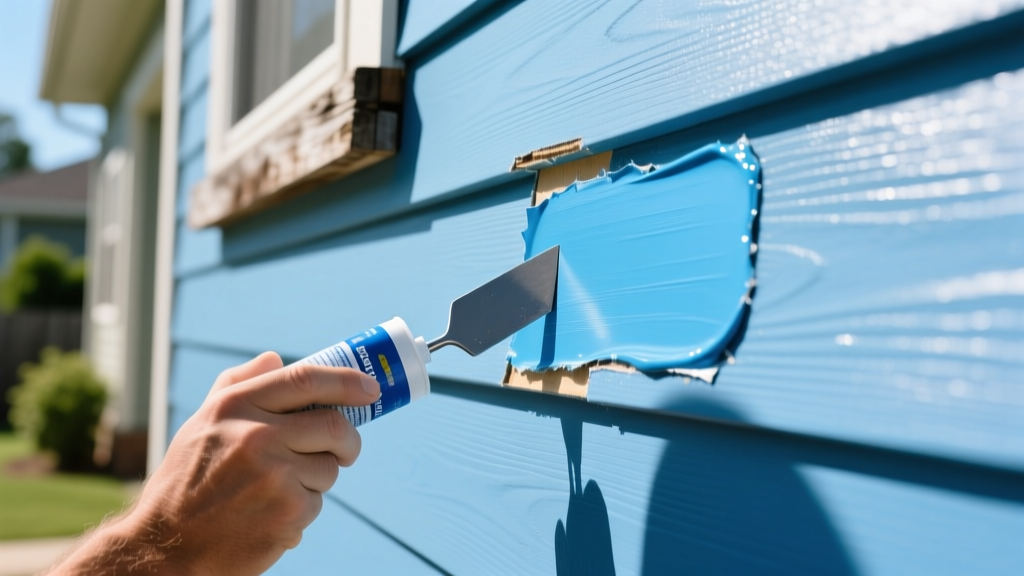
| Surface Chips & Dents | Impact from hail, landscaping equipment, or thrown debris. | Clean the area with rubbing alcohol. Apply an exterior-grade elastomeric patching compound (e.g., DAP Concrete Patch). Trowel smooth, let cure for 24 hours, sand lightly with 120-grit paper, and apply color-matched acrylic touch-up paint. |
| Bottom Edge Swelling | Capillary wicking from soil contact, roof splashback, or clogged gutters. | Swelling is irreversible. The affected board must be unzipped using a fiber cement zip tool, extracted, and replaced. Ensure the new board is primed on all six sides (including cut ends) before installation. |
| Corner Joint Separation | Thermal expansion, structural settling, or initial installation without proper gap spacing. | Rake out old caulk with a utility knife. Insert a closed-cell backer rod if the gap exceeds 1/4 inch. Apply a bead of OSI QUAD Max sealant, tool it with a wet putty knife for a concave finish, and paint once fully cured. |
| Hairline Cracking | Improper nailing (overdriven nails) or framing movement. | For cracks under 1/8 inch, flex the crack slightly and inject a high-quality exterior acrylic latex caulk. Wipe away excess. For structural cracks spanning multiple boards, consult a structural engineer to address framing deflection before replacing the siding. |
Repainting and Refinishing Guidelines
Eventually, even the most meticulously maintained hardie plank siding material will require a fresh coat of paint. Understanding your current finish dictates the prep work required.
Identifying Your Finish: ColorPlus vs. Primed
Boards installed with James Hardie's ColorPlus Technology feature a factory-applied, multi-coat baked finish. When this begins to chalk or fade (usually after 15+ years), you do not need to strip it to the bare substrate. Simply wash the siding, lightly scuff-sand any heavily chalked areas, and apply a high-quality 100% acrylic latex exterior paint.
If your siding was installed primed (or if you are painting over a previous field-applied paint job that is peeling), you must scrape all loose material, power wash, and spot-prime any exposed bare fiber cement with an acrylic masonry primer before applying the topcoat. Painting over unprimed, bare fiber cement will result in rapid alkali burn and paint failure.
Preventative Measures: Stopping Damage Before It Starts
The most cost-effective repair is the one you never have to make. Implementing these preventative measures will drastically extend the life of your cladding system.
- Redirect Sprinkler Systems: Hard water from lawn sprinklers will leave severe mineral deposits on fiber cement that are nearly impossible to remove without acid washing, which damages the finish. Adjust all sprinkler heads to ensure zero direct spray on the siding.
- Install Gutter Guards and Downspout Extensions: Roof runoff is the primary enemy of exterior cladding. Ensure downspouts discharge at least 5 feet away from the foundation to prevent splashback from saturating the lower courses of the siding.
- Manage Vegetation: Trim back all tree branches and climbing vines. Vines trap moisture against the surface, accelerating mildew growth and degrading the paint film, while branches can scrape the finish during high winds.
- Protect Cut Ends During Modifications: If you are adding exterior fixtures (like hose bibs, light sconces, or HVAC lines) that require drilling into the siding, always seal the penetrations with a compatible exterior sealant and use flashing blocks to prevent water from tracking behind the board.
By adhering to these targeted maintenance and repair protocols, you ensure that your investment in fiber cement cladding continues to protect and beautify the structure for decades. Proper care transforms a great building material into a lifelong exterior shield.
Written by
Marcus ChenMarcus Chen is a licensed structural engineer (PE) and building materials analyst with over 12 years of experience across residential, commercial, and industrial construction. He holds a Master of Science in Civil Engineering from UC Berkeley and spent six years at Thornton Tomasetti before transitioning to independent consulting and technical writing. Marcus specializes in material selection for seismic-prone regions, concrete reinforcement strategies, and lifecycle cost analysis. His work has been cited by the American Concrete Institute (ACI) and the Structural Engineers Association of California (SEAOC). When he is not on a job site or at his desk, you will find him hiking the Sierra Nevada or restoring a 1920s craftsman bungalow in Oakland, CA.
More from Marcus Chen
View all
Construction Cost
How Much Did the Eiffel Tower Cost to Build?
How much did the Eiffel Tower cost to build in 1889? We adjust for inflation and compare its budget to modern skyscraper construction.
Aug 4, 2026

Fire Resistance
What Is a Fire Resistant Material? Testing & Certification Guide
Discover what is a fire resistant material through ASTM and UL testing. Learn how fire ratings, certifications, and assemblies work in construction.
Aug 4, 2026

Construction Cost
How Much Did the Burj Khalifa Cost to Build?
How much did the Burj Khalifa cost to build? We break down the $1.5B project and extract 5 money-saving strategies for your next build.
Jul 30, 2026