2026 Vinyl Siding Material Cost vs. Weather Resistance
Analyze 2026 vinyl siding material cost tiers against weather resistance. Discover how thickness, insulation, and UV coatings impact extreme climate durability.

The Core Metric: Thickness, Impact Modifiers, and Price
Evaluating vinyl siding material cost requires looking past the base price per square foot and analyzing the chemical and physical engineering that dictates weather survivability. In 2026, the price gap between builder-grade and premium vinyl siding is driven by three factors: panel thickness (measured in mils), the concentration of titanium dioxide (TiO2) for UV resistance, and the inclusion of acrylic impact modifiers. Cheap vinyl relies heavily on calcium carbonate fillers, which reduce material costs but make the panels brittle and highly susceptible to cracking during freeze-thaw cycles and hail events.
Premium vinyl siding utilizes a higher ratio of pure polyvinyl chloride (PVC) resin combined with acrylic rubber modifiers. This chemical alteration allows the material to flex under high-velocity wind and blunt impact rather than shatter. When budgeting for exterior cladding, contractors and homeowners must align the material cost tier with the specific meteorological threats of their region.
- Builder Grade (.040" - .042"): $2.50 – $3.40 per sq. ft.
- Standard Residential (.044" - .046"): $3.80 – $5.20 per sq. ft.
- Premium Heavy-Duty (.048" - .050"): $5.50 – $7.00 per sq. ft.
- Insulated Premium (.048"+ with EPS foam): $7.50 – $9.50 per sq. ft.
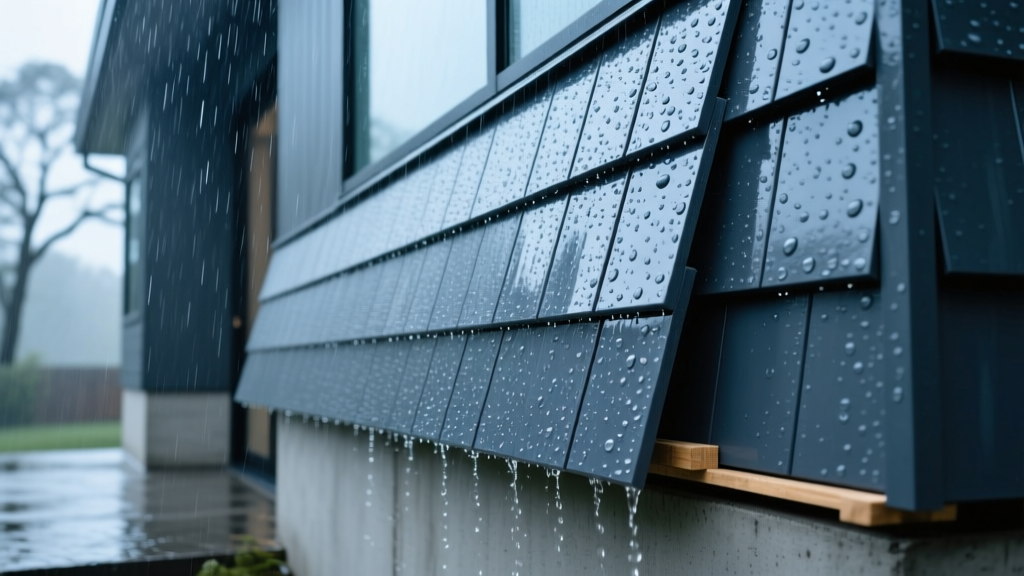
Weather Threat Matrix: Performance by Cost Tier
The following matrix illustrates how vinyl siding material cost correlates with specific weather resistance thresholds, governed by ASTM D3679 (Standard Specification for Rigid Polyvinyl Chloride Siding) and ASTM D4226 (Impact Resistance) testing protocols.
| Weather Threat | Builder Grade ($2.50-$3.40) | Premium Grade ($5.50-$7.00) | Insulated Premium ($7.50-$9.50) |
|---|---|---|---|
| High Wind (110+ mph) | Fails; single nailing hem tears out | Survives; double nailing hem holds | Excels; foam backing reduces flutter |
| Hail Impact (Cold Weather) | Shatters due to high filler content | Dents but rarely fractures | Absorbs and disperses kinetic energy |
| UV Degradation | Chalks and fades within 5-7 years | Retains color for 20+ years (TiO2) | Retains color; foam prevents warping |
| Thermal Expansion | Buckles if nailed too tightly | Requires precise 1/32" gap management | Foam stabilizes panel against wall |
Wind Load and Structural Integrity
Wind resistance in vinyl siding is not just about the panel thickness; it is heavily dictated by the nailing hem design and the interlocking mechanism. According to FEMA's Building Science branch, cladding failures during hurricanes and severe derechos often originate at the fastener points. Builder-grade vinyl typically features a single-layer nailing hem. When subjected to uplift pressures exceeding 110 mph, the fastener pulls through the thin PVC, causing a cascading failure where entire wall sections detach.
The Double Hem Advantage
Premium vinyl siding justifies its higher material cost by incorporating a rolled or double-layer nailing hem. This effectively doubles the thickness of the PVC at the fastener point, allowing the siding to withstand wind loads up to 160 mph or more, which is critical for coastal and high-wind corridors. Furthermore, premium panels utilize deeper interlocking weathertight joints that prevent wind-driven rain from infiltrating the weather-resistive barrier (WRB) behind the siding.
UV Degradation and Thermal Expansion
Polyvinyl chloride is inherently vulnerable to ultraviolet radiation, which breaks down the polymer chains, leading to chalking, fading, and severe embrittlement. To combat this, manufacturers blend titanium dioxide (TiO2) into the PVC matrix. The vinyl siding material cost is directly proportional to the concentration and quality of the TiO2 used. Builder-grade siding often uses minimal TiO2 and relies on surface-level coatings that wear off, whereas premium siding utilizes co-extruded capstocks loaded with high-grade UV inhibitors throughout the top layer.
The Dark Color Premium
Historically, dark-colored vinyl siding was a liability because it absorbed excessive heat, causing extreme thermal expansion and subsequent warping. In 2026, advanced infrared-reflective pigments (similar to those used in cool-roof coatings) allow for dark hues like charcoal, navy, and forest green without the thermal penalty. However, these specialized acrylic capstocks (often ASA - Acrylonitrile Styrene Acrylate) add roughly 15% to 22% to the base material cost. If you are installing dark siding in high-sun exposure zones, this premium is non-negotiable to prevent structural distortion.
Hail and Cold-Weather Impact Resistance
Vinyl becomes significantly more brittle as temperatures drop. A panel that flexes under a hail strike in July may shatter like glass during a spring hailstorm in April when ambient temperatures are near freezing. This is where ASTM D4226 impact testing becomes a critical purchasing metric.
To maintain flexibility in sub-zero conditions, premium manufacturers blend acrylic modifiers into the PVC resin. These modifiers act as microscopic shock absorbers. While this chemical engineering increases the vinyl siding material cost by up to $2.00 per square foot compared to unmodified builder-grade products, it prevents catastrophic impact failures. Homeowners in regions prone to spring hailstorms (such as the Great Plains and Midwest) must specify impact-modified vinyl to avoid post-storm replacement cycles.
Insulated Vinyl Siding: The Freeze-Thaw Solution
Insulated vinyl siding features a permanently attached expanded polystyrene (EPS) foam backing that contours to the wall sheathing. While it is the most expensive tier in terms of vinyl siding material cost, it offers distinct weather-resistance advantages that standard hollow-back siding cannot match.
"The continuous EPS backing eliminates the hollow void behind the siding, drastically reducing the 'flutter' effect during high winds and providing a thermal break that mitigates the extreme temperature swings driving freeze-thaw moisture damage to the underlying sheathing."
— Building enclosure principles outlined by the U.S. Department of Energy
By filling the void between the siding and the wall, insulated vinyl prevents wind-driven rain from swirling behind the panels. The foam also adds an R-value of R-2.0 to R-5.0, which keeps the wall assembly closer to the interior temperature, reducing condensation risks on the back of the siding during rapid winter temperature drops.
Regional Cost Adjustments and Specifications
To optimize your budget, align the vinyl siding material cost with your specific regional weather threats. Over-specifying in mild climates wastes capital, while under-specifying in extreme climates leads to premature failure.
- Gulf Coast & Southeast (Hurricane/Driving Rain Zones): Prioritize wind-load ratings over insulation. Specify .048" premium siding with double nailing hems and deep weather-stripping interlocks. Expect material costs around $6.00/sq. ft.
- Midwest & Great Plains (Hail & Tornado Corridors): Prioritize cold-weather impact resistance. Acrylic-modified PVC is mandatory. Insulated vinyl is highly recommended to absorb kinetic energy from golf-ball-sized hail. Budget $8.00 - $9.50/sq. ft.
- Southwest & High-Altitude (Extreme UV Zones): Prioritize UV inhibitors and thermal stability. Lighter colors or specialized infrared-reflective dark capstocks are required. Standard .044" thickness is acceptable if the TiO2 concentration is verified. Budget $4.50 - $6.00/sq. ft.
- Pacific Northwest (Chronic Moisture & Freeze-Thaw): Prioritize moisture management and dimensional stability. Insulated vinyl with integrated drainage channels or premium hollow-back with a robust rainscreen gap is required. Budget $7.00/sq. ft.
For comprehensive installation and durability standards, always cross-reference product specifications with the certification programs maintained by the Vinyl Siding Institute. Ensuring your chosen material meets or exceeds ASTM D3679 for physical properties and ASTM D4226 for impact resistance is the only reliable way to guarantee that your material investment will withstand the specific meteorological extremes of your environment.
Written by
Priya KapoorPriya Kapoor is a real estate market analyst and construction economics researcher with expertise in housing affordability, development feasibility, and infrastructure investment. She holds a Master of Regional Planning from Cornell University and previously worked as a senior analyst at CBRE's Investment Properties group, where she modeled returns for $4B in mixed-use development pipelines. Priya now runs an independent research practice advising developers, municipalities, and REITs on construction cost forecasting and market timing. She publishes the quarterly "BuildMat Market Pulse" report tracking material price indices across 12 commodity categories. Based in Austin, TX, Priya serves on the board of Habitat for Humanity Austin and is a marathon runner.
More from Priya Kapoor
View all
Construction Cost
Cost to Build a 1600 Sq Ft Home in 2026: Full Breakdown
Accurate 2026 cost to build a 1600 sq ft home—material, labor, and regional pricing breakdowns included. Plan your budget with real-time estimates.
Aug 11, 2026

Wood & Lumber
Name the Types of Wood for Pressure Treatment and Preservation
Learn how to name the types of wood best suited for pressure treatment. Compare species treatability, chemical retention levels, and 2026 preservation costs.
Aug 4, 2026

Stone & Masonry
Stone Veneer Suppliers Lindenhurst: 2026 Cost Analysis
Analyze 2026 stone veneer costs in Lindenhurst, NY. Compare local supplier pricing, delivery fees, and Suffolk County installation labor rates.
Aug 4, 2026