Drywall Noise Insulation Selection: STC Ratings & Acoustic Panels
Compare acoustic drywall noise insulation types, STC ratings, and costs. Select the right soundproofing panels for residential and commercial walls.
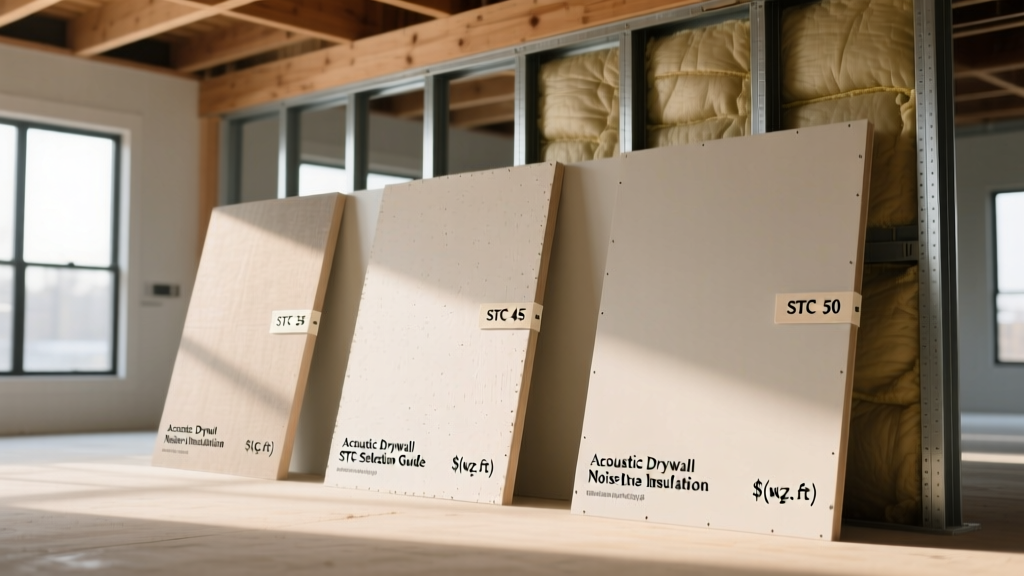
The Physics of Drywall Noise Insulation
Effective sound control in building assemblies relies on four core principles: mass, decoupling, damping, and absorption. When specifying drywall noise insulation, architects and contractors must move beyond simply adding thickness. Standard 1/2-inch gypsum board on wood framing yields a baseline Sound Transmission Class (STC) of roughly 33—adequate for basic spatial definition, but entirely insufficient for speech privacy or low-frequency impact mitigation. To achieve STC 50+ ratings required for modern multi-family and commercial demising walls, material selection must target specific acoustic failure frequencies.
The industry has shifted from relying solely on mass (multiple layers of standard Type X board) to engineered constrained layer damping (CLD) technologies. Understanding the taxonomy of acoustic gypsum products is critical for optimizing both material costs and assembly performance in 2026 construction projects.
Taxonomy of Acoustic Gypsum Boards
Acoustic drywall products are not monolithic. They fall into distinct material categories based on their core engineering and damping mechanisms.
1. Constrained Layer Damping (CLD) Boards
CLD boards represent the current standard for high-performance drywall noise insulation. These panels feature a viscoelastic polymer layer sandwiched between two thin gypsum cores. When sound waves strike the panel, the resulting shear forces cause the polymer core to flex microscopically, converting acoustic energy into trace amounts of thermal energy. This dramatically reduces resonance without requiring the extreme weight of multi-layer assemblies.
- CertainTeed SilentFX QuickCut: Engineered with a specialized viscoelastic core that allows the board to be scored and snapped like standard drywall, solving the historical challenge of cutting flexible acoustic panels. Available in 1/2-inch and 5/8-inch thicknesses.
- USG QuietRock 525: A 5/8-inch Type X fire-rated CLD panel that combines sound damping with code-mandated fire resistance, widely specified in commercial corridors and stairwells.
- National Gypsum SoundBreak XP: Integrates moisture-resistant additives with acoustic damping, making it the definitive choice for high-humidity demising walls in multi-family residential bathrooms and kitchens.
2. High-Mass & Multi-Layer Assemblies
When CLD boards are unavailable or budget-constrained, contractors utilize high-mass assemblies. This involves laminating two layers of 5/8-inch standard gypsum board using a viscoelastic compound like Green Glue. While highly effective at blocking low-frequency noise (OITC), this method increases wall thickness by 1.25 inches and significantly increases framing load and labor time.
Decoding STC vs. OITC Ratings
A common specification error is relying exclusively on STC. STC measures airborne noise attenuation (speech, television) primarily between 125 Hz and 4000 Hz. It fails to accurately represent low-frequency impact noise (bass, HVAC rumble, footfalls). For comprehensive drywall noise insulation, the Outdoor-Indoor Transmission Class (OITC) must be evaluated.
Material Selection Matrix: Assembly Performance & Costs
The following matrix outlines real-world performance data and 2026 material costs for common acoustic drywall assemblies. Labor costs vary regionally, but material baselines provide a reliable estimation framework.
| Assembly Type | Material Configuration | Est. STC | Est. OITC | Material Cost (per sq ft) |
|---|---|---|---|---|
| Baseline Partition | Single layer 1/2" standard drywall | 33 | 25 | $0.40 - $0.45 |
| Standard CLD | Single layer 1/2" SilentFX / QuietRock | 45 - 48 | 38 - 41 | $1.45 - $1.75 |
| Heavy CLD (Type X) | Single layer 5/8" SoundBreak XP / QuietRock 525 | 52 - 56 | 44 - 48 | $1.85 - $2.65 |
| Damped Double Layer | Two layers 5/8" standard + Green Glue compound | 55 - 60 | 46 - 51 | $2.10 - $2.40 |
| Decoupled CLD | 5/8" CLD board on resilient channels + mineral wool | 60 - 65+ | 52 - 56+ | $3.50 - $4.20 |
Note: Costs reflect 2026 material averages for commercial volume purchasing. Specialty fire-rated or moisture-resistant acoustic variants command a 10-15% premium.
Real-World Selection Framework
Selecting the correct drywall noise insulation requires matching the acoustic threat to the material capability. Use this decision matrix to specify panels accurately:
Scenario A: Interior Bedroom Partitions (Single Family)
Threat: Normal conversational speech, television audio.
Selection: 1/2-inch CLD board (e.g., CertainTeed SilentFX QuickCut) on standard wood studs with R-13 fiberglass batts.
Why: Achieves STC 45+ easily, requires no specialized framing, and allows standard scoring/snapping installation.
Scenario B: Multi-Family Demising Walls (Condos/Apartments)
Threat: Loud music, low-frequency bass, impact noise from adjacent units.
Selection: 5/8-inch Type X CLD board (e.g., USG QuietRock 525) mounted on resilient channels, backed by 3-inch mineral wool.
Why: Decoupling via resilient channels is mandatory to stop structural impact transfer. The 5/8-inch mass and CLD core handle low-frequency airborne OITC requirements while satisfying fire separation codes.
Scenario C: Commercial Corridors & Mechanical Rooms
Threat: HVAC rumble, elevator shaft noise, high-traffic footfall.
Selection: Damped double-layer assembly (Two layers 5/8" Type X + Green Glue) or specialized high-mass acoustic gypsum.
Why: Mechanical noise requires extreme mass to dampen low-frequency vibrations. CLD boards alone may lack the sheer physical mass required for severe OITC mitigation in these specific industrial applications.
Critical Failure Modes in Acoustic Drywall
The most expensive acoustic drywall noise insulation will fail entirely if installation edge cases are ignored. Acoustic energy behaves like water; it will exploit the path of least resistance. According to technical guidelines published by the USG Sound Control division and industry standards, the following installation errors routinely destroy STC ratings:
- Unsealed Perimeters: A continuous 1/4-inch gap at the floor or ceiling plate can reduce an STC 55 wall to STC 40. All perimeters must be sealed with non-hardening acoustic caulk (not standard latex painter's caulk, which cracks and opens air paths).
- Back-to-Back Electrical Boxes: Installing receptacles directly opposite each other on a demising wall creates a massive flanking path. Boxes must be staggered by at least 24 inches horizontally and wrapped in acoustic putty pads.
- Rigid Penetrations: HVAC ducts, plumbing stacks, or structural bracing that touch both the drywall and the framing create mechanical bridges. All penetrations require isolation hangers and flexible acoustic sealant collars.
- Improper Resilient Channel Fastening: When using decoupled assemblies, drywall screws that are driven too deep and "bottom out" into the wood stud bypass the resilient channel entirely, rendering the decoupling useless. Screw depth must be strictly controlled.
Moisture and Acoustic Intersections
In wet areas, standard CLD boards will degrade if exposed to prolonged humidity. For bathroom demising walls or commercial kitchen partitions, specifiers must utilize hybrid panels. National Gypsum's SoundBreak XP line utilizes a moisture-resistant core and facing paper that prevents mold growth and structural degradation without sacrificing the viscoelastic damping properties required for noise control. Attempting to use standard acoustic board in high-humidity zones leads to core delamination and catastrophic acoustic failure within 18 to 24 months.
Final Specification Directives
When drafting project specifications for drywall noise insulation, avoid vague language such as "install soundproof drywall." Instead, specify the exact assembly: "Provide 5/8-inch Type X Constrained Layer Damping gypsum board, STC 52 minimum, installed over 1/2-inch resilient channels spaced 24 inches on center, with perimeter sealed using non-hardening acoustical sealant." This level of granularity ensures the material taxonomy matches the acoustic physics required for the space, eliminating costly change orders and post-occupancy acoustic remediation.
For further technical data on assembly testing and fire-rated acoustic combinations, refer to the CertainTeed SilentFX technical literature and the Gypsum Association's comprehensive sound control treatises.