Standard Gypsum Board Selection Guide: Thickness, Sizes & Uses
Select the right standard gypsum board for your project. Compare thicknesses, weights, sizes, and 2026 pricing for USG, CertainTeed, and GP panels.
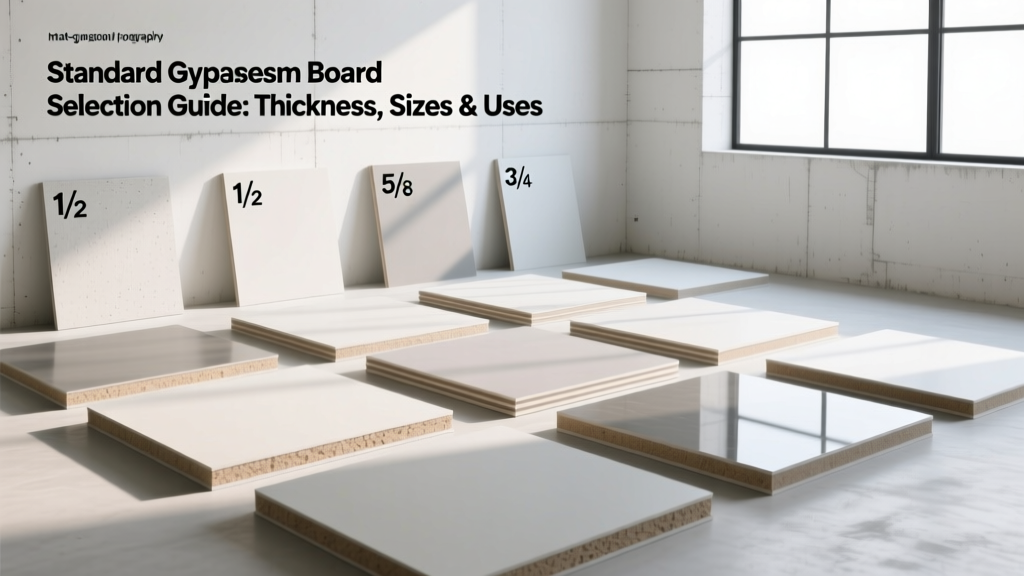
Decoding ASTM C1396: What Defines Standard Gypsum Board?
When contractors and architects refer to 'regular' or 'white board,' they are specifying standard gypsum board. Governed by the ASTM C1396 specification, this material consists of a non-combustible, naturally occurring or synthetic gypsum core encased in an ivory-colored face paper and a gray liner back paper. Unlike Type X (fire-rated) or green/purple boards (moisture-resistant), standard gypsum board contains no specialized chemical additives for extreme environmental resistance. According to the Gypsum Association, standard panels are engineered strictly for interior walls and ceilings in dry, climate-controlled environments where building codes do not mandate enhanced fire or moisture ratings.
Selecting the correct standard panel requires matching the board's physical properties—specifically thickness, weight, and dimensions—to your framing spacing and finishing labor constraints. Making the wrong choice leads to ceiling sag, excessive taping labor, or unnecessary material costs.
The Thickness Matrix: Matching Board to Framing Spacing
The most critical selection variable is thickness. Framing spacing (on-center or OC) dictates the minimum allowable thickness to prevent structural deflection. The industry standard for maximum deflection is L/240 for walls and L/360 for ceilings.
| Thickness | Weight (per sq ft) | Max Framing Spacing | Primary Application |
|---|---|---|---|
| 1/4-inch | 1.2 lbs | N/A (Overlay only) | Curved walls, radius arches, covering damaged plaster |
| 3/8-inch | 1.4 lbs | 16 inches OC (Walls) | Remodel overlays, double-layer systems, patching |
| 1/2-inch | 1.6 lbs | 16 inches OC (Walls/Ceilings) | Standard residential and light commercial interiors |
| 5/8-inch | 2.2 lbs | 24 inches OC (Ceilings) | Commercial ceilings, high-traffic corridors, sound control |
Why 5/8-Inch is Non-Negotiable for 24-Inch OC Ceilings
A frequent and costly jobsite error is hanging 1/2-inch standard gypsum board on ceiling joists spaced 24 inches apart. While 1/2-inch board is perfectly adequate for 16-inch OC ceiling framing, spanning 24 inches with 1/2-inch material will inevitably cause visible sagging between joists over time, especially if insulation is laid above the drywall or if the space experiences minor humidity fluctuations before the HVAC system is fully balanced. Always specify 5/8-inch board for 24-inch OC ceiling framing to maintain rigidity.
Panel Dimensions and Edge Profiles: Minimizing Finishing Labor
Standard gypsum board is manufactured in 48-inch widths, but lengths vary from 8 to 16 feet. The edge profile is universally tapered on the long edges to accommodate joint compound and tape, creating a flush surface.
For residential construction with 9-foot ceilings, ordering 4x10 or 4x12 panels hung vertically eliminates horizontal butt joints. Butt joints (where two non-tapered ends meet) require significantly more joint compound, wider taping, and skilled finishing to hide. Eliminating them reduces finishing labor costs by up to 15%.
For commercial spaces or large open-plan residential builds, 54-inch wide panels are available. These are specifically designed to align perfectly with standard 8-foot and 9-foot ceiling heights when hung horizontally, further minimizing off-cuts and waste.
Standard Weight vs. Lightweight: The Jobsite Reality
The drywall industry has largely transitioned to lightweight formulations for standard gypsum board. Traditional 1/2-inch board weighs approximately 57 pounds per 4x8 sheet. Modern lightweight equivalents, achieved through optimized core aeration and starch binding agents, weigh roughly 41 pounds per 4x8 sheet.
OSHA and Ergonomic Impact: The 16-pound weight reduction per sheet drastically reduces installer fatigue and the risk of musculoskeletal injuries. For ceiling installations, lightweight boards allow two hangers to maneuver and fasten sheets without requiring a mechanical panel lift for every single piece, accelerating installation speed by an estimated 10-15%.
Unless you are matching an existing traditional-weight wall for a small patch, always specify lightweight standard gypsum board for new construction and full-room renovations.
Top Brand Models and Current Pricing Benchmarks
Pricing for standard gypsum board fluctuates with raw material and freight costs. As of 2026, expect the following baseline pricing for standard, non-fire-rated, lightweight panels at commercial supply yards (retail big-box pricing will be 15-25% higher):
- USG Sheetrock UltraLight Panels: The market leader. Exceptional score-and-snap characteristics and high sag resistance. 1/2-inch 4x8: $13.50 - $15.00 | 5/8-inch 4x8: $17.00 - $19.50
- CertainTeed Regular Gypsum Board: Known for consistent core density and smooth face paper that takes primer exceptionally well. 1/2-inch 4x8: $12.80 - $14.50 | 5/8-inch 4x8: $16.50 - $18.50
- Georgia-Pacific (GP) ToughRock: Features a patented mold-resistant core treatment even in their standard line, offering a slight edge in pre-dry-in environments. 1/2-inch 4x8: $13.00 - $14.80 | 5/8-inch 4x8: $16.80 - $19.00
For exact specifications on lightweight core formulations, refer to the USG Sheetrock UltraLight technical data sheets.
Fastener Selection and Spacing Requirements
Selecting the correct board is only half the equation; fastening it properly prevents nail pops and screw dimples. For standard gypsum board attached to wood framing, use coarse-thread drywall screws. For light-gauge steel framing (20-gauge or thinner), use fine-thread, self-drilling drywall screws.
| Board Thickness | Minimum Screw Length | Wall Fastener Spacing | Ceiling Fastener Spacing |
|---|---|---|---|
| 1/2-inch | 1-1/4 inches | 16 inches OC | 12 inches OC |
| 5/8-inch | 1-5/8 inches | 12 inches OC | 12 inches OC |
Ensure the screw head breaks the face paper and sits slightly below the surface without tearing the paper. A torn paper face provides zero holding power, requiring the installer to drive a second screw two inches away.
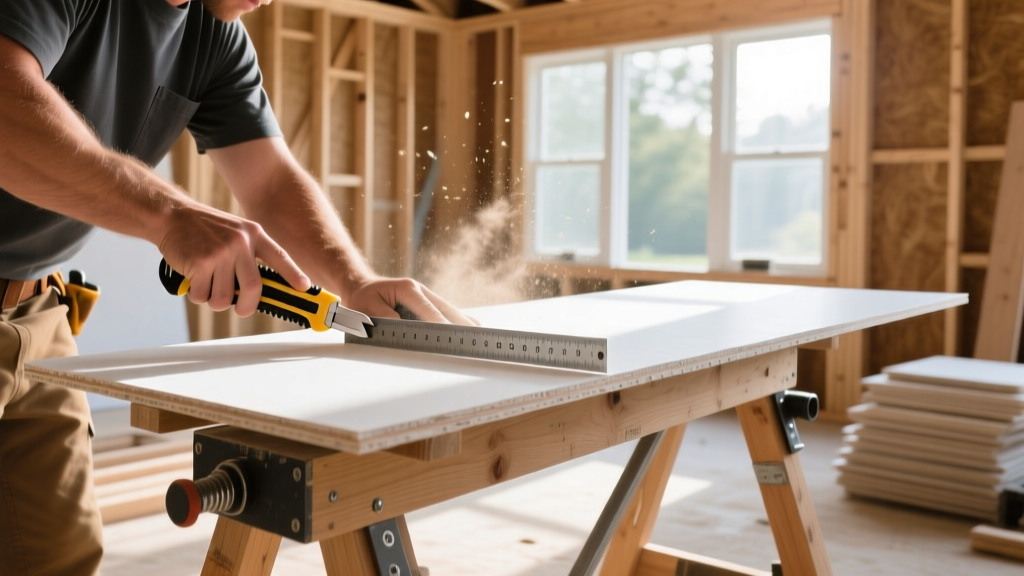
Common Selection Mistakes and Failure Modes
- Using Standard Board in High-Humidity Zones: Standard gypsum board will wick moisture, leading to core degradation and mold growth. Never use standard board in full bathrooms, saunas, or unconditioned garages. Upgrade to fiberglass-faced glass mat gypsum or moisture-resistant (green/purple) board for these zones.
- Ignoring Acoustic Requirements: Standard 1/2-inch board provides an STC (Sound Transmission Class) of roughly 33 when installed on standard wood studs. If the room requires privacy (e.g., bedrooms, home offices), standard board alone is insufficient. You must pair it with acoustic insulation, resilient channels, or upgrade to specialized sound-damping board.
- Storing Panels Flat on Concrete: Standard gypsum board is highly susceptible to ground moisture. Storing sheets flat on a concrete slab before installation will wick moisture into the bottom edge, causing the paper to delaminate and the core to crumble. Always store panels flat on raised dunnage in a climate-controlled environment.
Written by
Elena RodriguezElena Rodriguez is a civil engineer and technical writer specializing in concrete technology, masonry systems, and ASTM/ACI compliance. She earned her B.S. in Civil Engineering from Texas A&M University and spent a decade at a materials testing laboratory, performing over 2,000 concrete compressive strength tests and masonry prism evaluations. Elena is an ACI-certified Field Testing Technician (Grade I) and a member of ASTM Committee C12 on Natural Building Stone. She currently consults on forensic engineering cases involving concrete failures and moisture intrusion. Based in San Antonio, TX, Elena is a proud member of the Society of Women Engineers (SWE) and coaches her daughter's FIRST Robotics team.
More from Elena Rodriguez
View all
Walls & Panels
Cost Analysis: Light Gauge Steel Framing Advantages and Disadvantages
Evaluate light gauge steel framing advantages and disadvantages through a strict cost analysis lens, comparing material, labor, and lifecycle expenses.
Aug 4, 2026

Walls & Panels
Gypsum Board Types: Exact Specifications, Thickness & Dimensions
Compare standard, Type X, and moisture-resistant gypsum board types. Get exact specifications, thicknesses, dimensions, and ASTM standards for your project.
Aug 4, 2026

Fire Resistance
Best Fire-Resistant Outdoor Decking Materials: 2026 Buyer Guide
Discover the best fire-resistant outdoor decking materials for 2026. Compare Class A PVC, aluminum, and hardwood options for WUI compliance and safety.
Aug 4, 2026