How Long Does Drywall Spackle Last? Durability & Failure Analysis
Discover how long drywall spackle lasts, why patches crack, and the chemical differences between setting compounds and pre-mixed pastes for permanent repairs.
Spackle vs. Joint Compound: The Durability Distinction
The term 'drywall spackle' is frequently misused as a catch-all for any white paste applied to gypsum board. However, from a materials science perspective, true spackle and joint compound possess fundamentally different chemical structures, which directly dictate their lifespan and failure rates. True spackle is typically a vinyl-based or acrylic-based paste designed for small, localized repairs (like nail pops or doorknob dents). Joint compound, conversely, is a gypsum- or limestone-based material engineered for taping, embedding mesh, and skimming wide seams.
Understanding this distinction is the first step in analyzing patch longevity. Applying a vinyl-based spackle over a 12-inch drywall seam will result in catastrophic flash-cracking within months due to the material's high elasticity and lack of structural rigidity. Conversely, using standard drying-type joint compound to fill a deep, 1-inch doorknob hole guarantees severe shrinkage and depression as the water evaporates from the core. According to technical guidelines published by USG (United States Gypsum), matching the chemical properties of the patching material to the specific geometry and stress profile of the defect is the primary determinant of a repair's lifespan.
The Chemistry of Patch Longevity: Drying vs. Setting
The lifespan of drywall spackle is governed by its curing mechanism. Materials that cure via evaporation (drying compounds) are inherently susceptible to volumetric shrinkage, while materials that cure via chemical crystallization (setting compounds) maintain their exact applied volume indefinitely.
Drying Compounds (Pre-Mixed)
Pre-mixed spackles and joint compounds rely on the evaporation of water to harden. As the water leaves the matrix, the vinyl or limestone binders pull closer together. In shallow applications (under 1/8 inch), this shrinkage is negligible and easily masked by paint. In deep cavities, the surface skins over while the core remains wet, leading to a phenomenon called 'sinkage,' where the patch pulls away from the gypsum substrate and creates a visible concave depression.
Setting Compounds (Powder-Based)
Setting-type compounds, such as USG Durabond or Easy Sand, utilize calcium sulfate hemihydrate. When mixed with water, a chemical reaction occurs that recrystallizes the material into a dense, interlocking gypsum matrix. Because the water is chemically bound rather than evaporated, setting compounds exhibit virtually zero shrinkage. A patch made with a 90-minute setting compound will easily outlast the surrounding gypsum board, offering a permanent, rock-hard repair that resists structural shear and impact.
Drywall Spackle Durability Matrix
Selecting the correct material requires analyzing the trade-offs between working time, hardness, and shrinkage. The following matrix breaks down the expected lifespan and mechanical properties of the most common patching materials.
| Material Type | Shrinkage Rate | Compressive Hardness | Best Use Case | Expected Lifespan |
|---|---|---|---|---|
| Vinyl Pre-Mixed Spackle | Low (5-8%) | Soft / Flexible | Nail pops, hairline cracks, shallow dents | 10-15 Years (if painted) |
| Lightweight Joint Compound | High (10-15%) | Medium / Friable | Skim coating, final topping over tape | 20+ Years (wide seams only) |
| All-Purpose Joint Compound | Very High (15-20%) | Medium-Hard | Embedding paper tape, second coats | 20+ Years (when reinforced) |
| Setting-Type (e.g., Durabond 90) | Zero (<1%) | Extremely Hard / Rigid | Deep holes, structural seam pre-fills, water damage | Lifetime of the structure |
The 4 Primary Failure Modes of Drywall Spackle
When a patch fails prematurely, it is rarely due to the age of the material itself. Gypsum and vinyl polymers do not degrade rapidly in climate-controlled interiors. Instead, failure is almost always mechanical or environmental. The Gypsum Association identifies several substrate preparation errors that lead to premature patch failure.
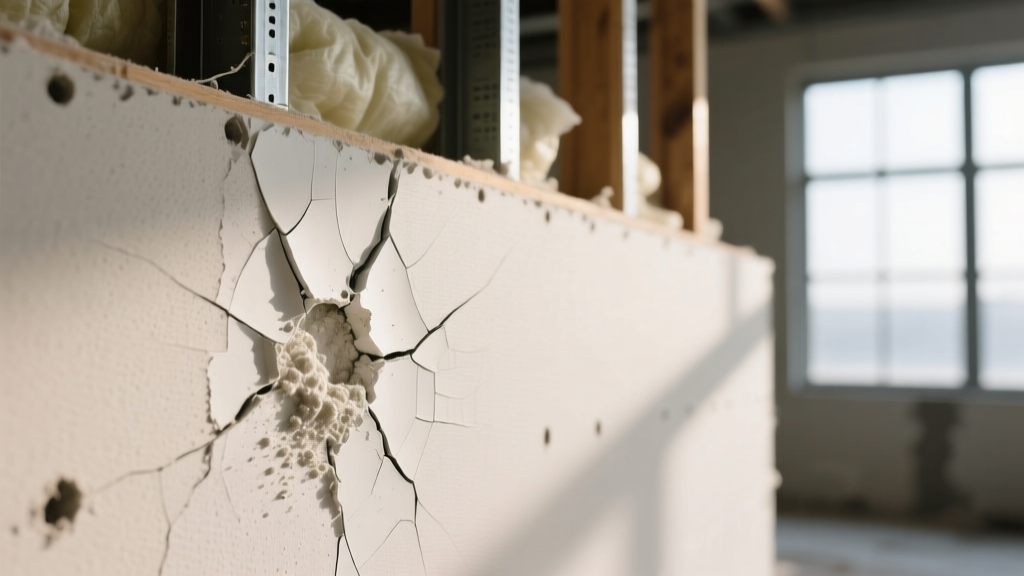
Applying drying-type spackle thicker than 1/4 inch in a single pass traps moisture beneath a hardened surface skin. As the trapped moisture eventually forces its way out, it creates micro-fissures known as flash cracks. Fix: Deep holes must be pre-filled with a setting compound or built up in 1/8 inch layers, allowing 24 hours of drying time between coats.
The exposed gypsum core and torn paper face of a drywall hole are highly porous. If pre-mixed spackle is applied directly to raw, unsealed gypsum, the substrate instantly wicks the moisture out of the spackle. This premature drying prevents the vinyl binders from forming a cohesive film, resulting in a chalky, weak patch that delaminates under the tension of drying paint. Fix: Always seal raw drywall edges with an oil-based primer or a dedicated PVA sealer before applying any drying compound.
Standard drywall spackle is highly hygroscopic. In high-humidity environments (bathrooms, basements), unprimed spackle will absorb ambient moisture, swell, and lose adhesion. Furthermore, if the patch bridges a minor roof or plumbing leak, the spackle will wick water, bringing dissolved gypsum salts to the surface as a white, powdery efflorescence that ruins paint finishes.
Houses expand and contract with seasonal temperature shifts. If a rigid setting compound is used to bridge a butt joint between two sheets of drywall without fiberglass mesh reinforcement, the seasonal shear force will snap the rigid patch cleanly down the seam. Setting compounds provide compressive strength, but lack tensile flexibility.
Environmental Degradation and Humidity Cycling
Over a 10 to 20-year lifespan, interior walls undergo thousands of humidity and temperature cycles driven by HVAC systems. Pre-mixed lightweight spackles contain microscopic vinyl bubbles that make them easy to sand, but these same bubbles create a highly porous matrix. In homes where winter humidity drops below 20% and summer humidity spikes above 60%, this porous matrix continuously absorbs and releases moisture.
While the spackle itself will not dissolve, this continuous swelling and contracting can cause 'picture framing' or 'flashing' through the paint layer. The patch absorbs paint differently than the surrounding paper-faced gypsum board. To ensure a 20-year aesthetic lifespan, the spackle must be sealed with a high-solids PVA primer specifically designed to equalize the porosity of the patch and the surrounding wall before the final topcoat is applied.
Step-by-Step Protocol for a 20-Year Patch
To achieve maximum durability for a deep impact hole (e.g., a doorknob puncture), follow this material-specific protocol. This method eliminates shrinkage, prevents delamination, and ensures the patch is harder than the surrounding wall.
- Substrate Preparation: Use a utility knife to bevel the edges of the hole at a 45-degree inward angle. This creates a mechanical 'key' for the patching material to lock into, preventing it from being pushed through the wall cavity.
- Seal the Core: Brush a liberal coat of oil-based stain-blocking primer (such as Kilz Original) onto the exposed gypsum core and torn paper edges. Allow 1 hour to dry. This prevents the raw gypsum from stealing moisture from your patch.
- The Structural Fill: Mix a 90-minute setting-type compound (e.g., USG Durabond 90) to a thick, peanut-butter consistency. Press it firmly into the beveled cavity using a 3-inch taping knife, leaving it slightly proud (1/16 inch above the wall surface). Allow it to cure completely (approx. 90 minutes). It will not shrink.
- The Skim Coat: Setting compounds are notoriously difficult to sand. Once the Durabond is rock hard, apply a paper-thin skim coat of pre-mixed lightweight topping compound over the patch to blend it into the surrounding wall texture.
- Precision Sanding: Sand the lightweight topping compound using a 220-grit sanding sponge in a circular motion. Stop sanding the moment the patch is flush with the wall; sanding into the Durabond core will dull your sandpaper instantly and ruin the flat plane.
- Porosity Equalization: Prime the patched area with a dedicated PVA drywall sealer before applying your architectural topcoat. This guarantees the paint sheen will remain uniform over the next two decades.