Best Fire Resistant Drywall Brands & Product Lines for 2026
Compare top fire resistant drywall brands for 2026. Deep dive into USG, National Gypsum, and CertainTeed product lines, fire ratings, and costs.
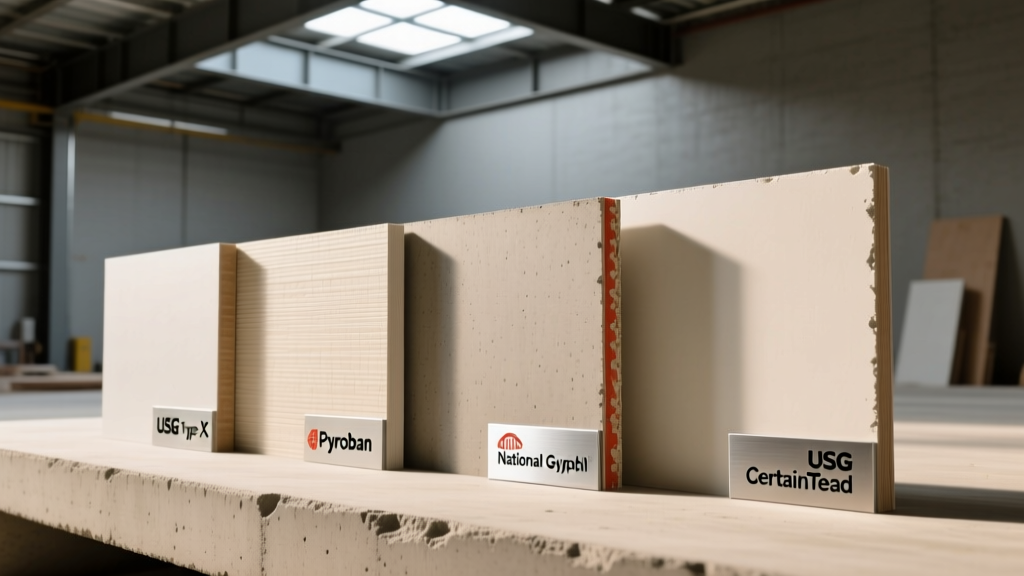
The Anatomy of Fire Resistant Drywall: Type X vs. Type C
Fire resistant drywall is not simply a thicker version of standard gypsum board; it is a highly engineered composite designed to delay structural failure during a blaze. The core of standard drywall contains chemically combined water (calcium sulfate dihydrate). When exposed to fire, this water vaporizes in a process called calcination, which occurs at 212°F (100°C). This phase change absorbs massive amounts of heat, keeping the unexposed side of the wall below 250°F for a designated period.
To achieve enhanced ratings, manufacturers introduce specific additives into the gypsum core:
- Type X: Incorporates glass fibers (typically 1% to 2% by weight) that act as a structural matrix. As the gypsum calcines and shrinks, the glass fibers hold the brittle core together, preventing it from cracking and falling off the framing. A single layer of 5/8-inch Type X on each side of a wood or metal stud wall typically yields a 1-hour fire rating.
- Type C: An enhanced formulation containing significantly more glass fibers and often vermiculite. Vermiculite expands when heated, compensating for the natural shrinkage of the calcined gypsum. Type C is essential for multi-layer assemblies, shaft walls, and areas requiring 2-hour to 4-hour fire resistance ratings.
According to the Gypsum Association, selecting between Type X and Type C depends entirely on the specific Underwriters Laboratories (UL) design number specified by the architect. Substituting Type X for Type C in a 2-hour rated shaft wall will result in a failed inspection and a critical life-safety hazard.
Brand Deep-Dive: USG Sheetrock Firecode Line
USG Corporation remains the dominant force in commercial fire-rated assemblies. Their Sheetrock Brand Firecode line is the industry benchmark, frequently referenced directly in architectural specifications.
Product Spotlight: Sheetrock Brand Firecode X & C
The standard Sheetrock Firecode X (5/8-inch) weighs approximately 74 pounds per 4x8 sheet. It is the default choice for 1-hour rated partitions and ceiling membranes. For projects demanding higher ratings or reduced weight, USG offers Sheetrock UltraLight Panels Firecode X. By replacing traditional heavy aggregates with lightweight perlite and specialized polymers, USG reduced the weight of a 4x8 sheet to roughly 50 pounds—a 30% reduction that drastically lowers installer fatigue and speeds up hanging times on large commercial jobs.
For 2-hour and 3-hour assemblies, Sheetrock Firecode C is required. Its proprietary core formulation includes a higher density of glass fibers and vermiculite, allowing it to maintain structural integrity even after the gypsum has completely calcined.
Always verify the exact UL design number (e.g., U305, U419) on your project's architectural drawings. The Underwriters Laboratories (UL) Product iQ database specifies the exact brand, thickness, fastener type, and spacing required. Using a competitor's board in a USG-specified assembly voids the fire rating unless the manufacturer provides an approved equivalency letter.
Brand Deep-Dive: National Gypsum Gold Bond Fire-Shield
National Gypsum’s Gold Bond line is the primary competitor to USG, favored by many contractors for its consistent core density and excellent screw-holding capabilities.
Product Spotlight: Gold Bond Fire-Shield & XP Fire-Shield
Gold Bond Fire-Shield (Type X) and Fire-Shield C (Type C) mirror the performance of USG’s Firecode line, meeting the same ASTM C1396 standards for physical properties and ASTM E119 for fire testing. National Gypsum's 5/8-inch Type X board is renowned for its rigid core, which minimizes snapping during scoring and cutting.
Where National Gypsum truly differentiates is with Gold Bond XP Fire-Shield. This product combines the fire-resistant core of their Type X board with a moisture- and mold-resistant facing and backing (identifiable by its purple paper). This is the mandatory specification for 1-hour rated walls in high-humidity commercial environments, such as hospital corridors, commercial kitchens, and indoor pool enclosures, where standard fire resistant drywall would degrade from ambient moisture.
CertainTeed and Georgia-Pacific: The Heavy-Duty Alternatives
While USG and National Gypsum hold the lion's share of the commercial market, CertainTeed and Georgia-Pacific (GP) offer robust alternatives that often provide better regional availability and pricing leverage.
CertainTeed Firestop gypsum boards are engineered with a dense, glass-fiber-reinforced core. CertainTeed’s Type X board is particularly noted for its smooth face paper, which requires fewer skim coats to achieve a Level 5 finish in high-end commercial lobbies. GP ToughRock Fireguard X utilizes a unique core formulation that offers superior moisture resistance compared to standard Type X boards, making it a versatile choice for multi-family residential construction where bathroom walls share shafts with living spaces.
Head-to-Head Product Comparison Matrix
The following matrix breaks down the core specifications for the most widely specified 5/8-inch fire resistant drywall products in 2026. Pricing reflects national average commercial bulk rates.
| Brand & Product | Type | Weight (4x8 Sheet) | Core Tech | Est. Price/Sheet |
|---|---|---|---|---|
| USG Firecode X | Type X | ~74 lbs | Glass Fiber | $18.50 - $21.00 |
| USG UltraLight Firecode X | Type X | ~50 lbs | Perlite + Glass Fiber | $22.00 - $25.00 |
| USG Firecode C | Type C | ~76 lbs | Vermiculite + Glass | $26.00 - $30.00 |
| Gold Bond Fire-Shield | Type X | ~73 lbs | Glass Fiber | $18.00 - $20.50 |
| Gold Bond XP Fire-Shield | Type X + MR | ~75 lbs | Glass + Moisture Core | $28.00 - $33.00 |
| CertainTeed Firestop | Type X | ~72 lbs | Glass Fiber | $17.50 - $20.00 |
Installation Realities: Where Fire-Rated Assemblies Fail
Purchasing the correct fire resistant drywall is only half the battle. The NFPA 101 Life Safety Code and local building inspectors routinely fail commercial projects due to installation errors that compromise the assembly's integrity. Fire ratings apply to the entire system, not just the board.
Using standard drywall screws or standard pre-mixed joint compound in a fire-rated assembly will void the rating. Heat causes pre-mixed compound to shrink and crack, opening pathways for fire and toxic gases.
The 3 Most Common Installation Failures
- Incorrect Fastener Length and Spacing: For a single-layer 5/8-inch application on metal studs, you must use 1-1/4-inch Type S (fine thread) screws spaced exactly 8 inches on center along the edges and 12 inches in the field. For double-layer assemblies, the base layer requires 1-5/8-inch screws, while the face layer requires 2-1/2-inch screws. Over-driving screws (breaking the face paper) destroys the board's structural grip, leading to early pull-through during a fire.
- Improper Joint Treatment: UL designs almost universally mandate the use of setting-type joint compound (e.g., 45-minute or 90-minute Durabond) for the taping and first coat. Setting compounds undergo a chemical cure rather than a drying process, eliminating the shrinkage that creates micro-cracks at the seams. Standard all-purpose pre-mixed compound is only permitted for the final skim coat in specific designs.
- Unsealed Penetrations: Electrical boxes, HVAC ducts, and plumbing pipes penetrating a fire-rated wall create massive vulnerabilities. You must install fire-rated putty pads over electrical boxes and use UL-listed intumescent firestop caulk around pipes. Intumescent materials expand up to 10 times their volume when heated, choking off the penetration and maintaining the fire barrier.
Pricing and Procurement Strategy for 2026
As of early 2026, supply chain stabilization has brought fire resistant drywall prices down from their 2022 peaks, but regional freight costs remain a significant factor due to the heavy weight of 5/8-inch boards. A standard 5/8-inch Type X sheet costs between $18 and $22 at commercial distributors. However, procuring Type C or specialized moisture-fire combinations (like XP Fire-Shield) can push costs to $30+ per sheet.
For projects exceeding 5,000 square feet of fire-rated partitions, contractors should bypass big-box retailers and negotiate direct mill-direct or distributor-direct pricing. Furthermore, specifying lightweight Type X (like USG UltraLight) can offset the 15-20% premium in material costs by reducing hanging labor time by up to 25% and lowering worker compensation claims related to back and shoulder strain.
Frequently Asked Questions
Can I use 1/2-inch Type X instead of 5/8-inch to save money?
While 1/2-inch Type X fire resistant drywall exists, it is rarely used in commercial framing. It is primarily designed for residential applications or specific ceiling assemblies where weight is a critical constraint. For standard 1-hour rated wall partitions on 16-inch or 24-inch on-center framing, 5/8-inch is the code-mandated standard to prevent bowing and ensure the structural matrix performs correctly under thermal stress.
Does painting fire resistant drywall affect its fire rating?
Standard interior latex or acrylic paints do not negatively impact the fire rating of the board. However, applying multiple layers of high-build, combustible textures or specialized acoustic coatings can alter the surface burning characteristics. Always ensure that any applied coatings meet ASTM E84 Class A flame spread and smoke developed indices.
What is the difference between fire resistant drywall and cement board for fireproofing?
Gypsum-based fire resistant drywall relies on calcination (water vaporization) to absorb heat and delay temperature transfer. Cement board (like Durock or HardieBacker) is non-combustible and will not calcinate, but it lacks the insulating thermal break of gypsum. In commercial shaft walls, cement board is sometimes used on the exterior face for impact and moisture resistance, but the interior layers must be Type C gypsum to provide the actual time-rated thermal insulation required by the UL design.