Mold Guard Gypsum Board: IRC Code Compliance & Installation Rules
Ensure your mold guard gypsum board installation meets IRC and IBC moisture codes. Learn ASTM standards, required locations, and approved product specs.

Navigating building codes for moisture-prone environments requires a precise understanding of material specifications. While standard gypsum board fails rapidly when exposed to sustained humidity, mold guard gypsum board is engineered with treated cores and specialized facers to inhibit fungal growth. However, simply purchasing a mold-resistant product does not guarantee code compliance. The Authority Having Jurisdiction (AHJ) evaluates the entire assembly—from the specific ASTM test scores of the board to the fastener spacing and joint treatment used during installation.
Code Compliance Snapshot
- Primary Codes: IBC Section 2509 (Gypsum Board in Wet Areas) & IRC Section R702.3.8.
- Core Standard: ASTM C1396 (Gypsum Board Specification) & ASTM D3273 (Mold Resistance).
- Minimum Mold Score: 10 (no observable growth) for high-performance compliance.
- Crucial Distinction: Mold resistance (ASTM D3273) is not the same as water resistance (ASTM C1396 Section 7).
Decoding the Codes: Where Mold Guard Gypsum Board is Mandated
The International Building Code (IBC) and International Residential Code (IRC) do not universally mandate mold guard gypsum board for every interior wall. Instead, they establish baseline requirements for water-resistant (WR) gypsum backing board in specific wet areas, while leaving mold-resistant (MR) specifications to local amendments, floodplain regulations, and voluntary green building programs.
IBC Section 2509 and IRC Section R702.3.8
Under IBC Section 2509 and IRC Section R702.3.8, water-resistant gypsum backing board is strictly required as a base for tile or wall panels in bathtub and shower compartments. However, standard paper-faced WR board (commonly known as green board) is increasingly being phased out of direct-splash zones in favor of glass-mat gypsum or cementitious backer units. Mold guard gypsum board with a water-resistant core is code-compliant for the surrounding bathroom walls, laundry rooms, and basement furr-outs where direct water impact is not expected but ambient humidity remains high.
Flood Hazard Areas (ASCE 24)
In flood-prone regions, buildings must comply with ASCE 24, which dictates that all materials below the Base Flood Elevation (BFE) must be flood-resistant. Standard gypsum board absorbs water and harbors mold within 24 to 48 hours of a flood event. Mold guard gypsum board, particularly fiberglass-faced variants, is frequently specified in these zones because it can be dried in place and sanitized without immediate demolition, satisfying the durability requirements of local floodplain administrators.
ASTM Standards: Proving Mold Resistance for Code Approval
To be legally classified and stamped as mold-resistant, gypsum panels must undergo rigorous laboratory testing. The AHJ will look for third-party certification marks (such as UL or Intertek) verifying compliance with the following standards:
| ASTM Standard | Scope of Test | Compliance Threshold |
|---|---|---|
| ASTM D3273 | Resistance to Growth of Mold on the Surface of Interior Coatings in an Environmental Chamber. | Score of 10 (no growth under 10x magnification after 4 weeks). |
| ASTM C1396 | Standard Specification for Gypsum Board (includes water absorption limits for WR boards). | Max 5% water absorption by weight after 2-hour immersion (for WR classification). |
| ASTM D6329 | Guide for Developing Methodology for Evaluating Ability of Paints to Resist Microbial Growth. | Often used in conjunction with D3273 for primed/painted mold guard assemblies. |
According to the EPA's guidelines on mold and moisture control, preventing indoor fungal growth requires managing liquid water and condensation. Mold guard drywall addresses the material vulnerability, but it must be paired with proper vapor retarders and mechanical ventilation to satisfy the holistic intent of the building code.
Approved Product Specifications & Model Numbers
Not all mold-resistant boards are manufactured equally. When submitting plans for commercial or high-end residential permits, specifying the exact manufacturer and product line prevents rejection during the plan review phase. Below is a matrix of code-compliant, industry-standard mold guard products currently dominating the market:
| Manufacturer / Product | Face Material | Core Treatment | ASTM D3273 Score |
|---|---|---|---|
| USG Sheetrock Mold Tough | Treated 100% Recycled Paper | Silicone & Antimicrobial additives | 10 |
| Georgia-Pacific DensArmor Plus | Fiberglass Mat (Inorganic) | Moisture-resistant Gypsum Core | 10 |
| CertainTeed M2Tech | Treated Paper | Proprietary Mold-Resistant Core | 10 |
Expert Note: For areas subject to direct water exposure (like the interior of a tiled shower niche), neither paper-faced nor standard glass-mat mold guard board is sufficient. You must transition to a cementitious backer board (ASTM C1325) or a foam-core tile backer board.
Installation Compliance: Fasteners, Joints, and Clearances
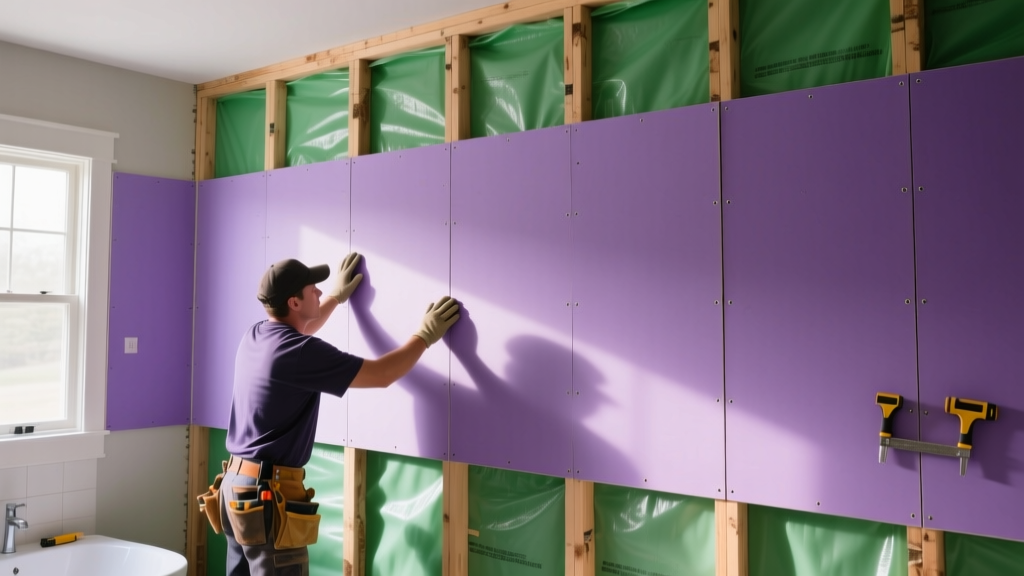
Installing a code-compliant mold guard board with non-compliant accessories voids the system's fire and moisture ratings. The Gypsum Association's GA-216 Application Guide outlines the strict parameters for hanging and finishing these panels.
Fastener Specifications
For 1/2-inch mold guard boards applied to wood framing, use 1-1/4 inch Type S (fine-thread) or Type W (coarse-thread) bugle-head drywall screws. In high-humidity zones like indoor pool enclosures or commercial laundry facilities, code requires hot-dipped galvanized or ceramic-coated fasteners to prevent rust bleeding and subsequent fastener head degradation, which compromises the holding power of the board.
- Ceiling Spacing: Maximum 7 inches on center (o.c.) along framing.
- Wall Spacing: Maximum 8 inches o.c. along framing.
- Edge Distance: Minimum 3/8 inch from edges and ends to prevent blowouts.
Joint Treatment and Taping
Standard paper drywall tape is an organic cellulose product that serves as a primary food source for mold spores. Using paper tape in a moisture-prone environment is a frequent code violation.
⚠ Critical Code Violation Warning
Never use standard paper tape or all-purpose pre-mixed joint compound in wet or high-humidity areas. Pre-mixed compounds retain moisture for days during the drying process, creating an incubator for mold behind the paint layer. You must use alkali-resistant fiberglass mesh tape paired with a setting-type joint compound (e.g., USG Durabond 45 or 90), which cures via chemical reaction rather than evaporation, eliminating the prolonged dampness that triggers fungal growth.
Clearances and Capillary Breaks
Mold guard gypsum board must never touch the concrete subfloor or slab. Building codes require a minimum 1/2-inch gap at the floor line to prevent capillary action (wicking) from drawing slab moisture into the gypsum core. This gap is later covered by baseboard trim. In shower pans, the board must stop 1/4 inch above the shower pan flange to allow water to drain behind the board and into the weep system, rather than being trapped against the drywall edge.
Cost Analysis: Standard vs. Mold Guard Drywall
While mold guard gypsum board carries a premium over standard white board, the cost of remediation following a mold event far outweighs the initial material investment. Below is a current pricing breakdown for material and professional installation costs per square foot.
| Material Type | Panel Cost (per 4x8 Sheet) | Installed Cost (per Sq. Ft.) | Best Application |
|---|---|---|---|
| Standard 1/2" White Board | $12.00 - $15.00 | $1.50 - $2.20 | Living rooms, bedrooms, hallways |
| Mold Guard (Paper-Faced) | $18.00 - $24.00 | $2.30 - $3.10 | Bathroom perimeters, basements |
| Mold Guard (Glass-Mat Faced) | $25.00 - $34.00 | $3.20 - $4.50 | Flood zones, commercial restrooms |
Inspector Checklist: Passing the Final Drywall Inspection
Before scheduling your final drywall inspection with the local building department, verify the assembly against this compliance checklist. Inspectors will actively look for these specific details in moisture-prone zones:
- Product Stamping: Are the UL or Intertek certification marks and ASTM D3273 scores visible on the back or edge of the installed panels? (Inspectors often check the attic or unfinished utility closet where the board ends are exposed).
- Fastener Corrosion Resistance: In designated high-humidity zones, are galvanized or ceramic-coated screws utilized?
- Joint Compound Verification: Are setting-type compound buckets (e.g., Durabond) present on-site, proving pre-mixed all-purpose mud was not used in wet areas?
- Bottom Clearances: Is there a visible 1/2-inch gap between the bottom of the gypsum board and the subfloor prior to baseboard installation?
- Vapor Retarder Continuity: If a Class I or II vapor retarder is required by your specific climate zone (per IRC Table R702.7.1), is it properly integrated behind the mold guard board without being punctured excessively?
By strictly adhering to the material specifications, ASTM testing thresholds, and installation clearances outlined above, contractors and architects can ensure their mold guard gypsum board assemblies will pass municipal inspections, mitigate long-term liability, and provide a durable, healthy interior environment.
Written by
James ThorntonJames Thornton is a construction industry veteran with 25 years of hands-on experience in wood framing, lumber grading, and residential building codes. He started as a framing carpenter in rural Oregon, earned his ICC Residential Building Inspector certification, and eventually became a senior plan reviewer for the City of Portland Bureau of Development Services. James holds a B.S. in Wood Science & Technology from Oregon State University and is a certified lumber grader through the West Coast Lumber Inspection Bureau (WCLIB). He has inspected over 3,000 residential construction sites and authored the city's internal guide on advanced framing techniques (2x6 at 24" O.C.). James lives in Bend, OR, where he builds custom timber-frame cabins and competes in lumberjack sports.
More from James Thornton
View all
Insulation
Best Home Insulation Materials: Complete 2026 Guide
Compare top home insulation materials for 2026. Find R-values, installed costs per square foot, and best uses for fiberglass, spray foam, and mineral wool.
Aug 4, 2026

Sustainable Building
Certify Your Green Building Material for LEED and WELL
Step-by-step guide to certifying a green building material for LEED v5 and WELL v2. Master EPDs, HPDs, and VOC limits for 2026 project specifications.
Aug 4, 2026

Stone & Masonry
Veneer Stacked Stone Panels: Interior Design & Style Showcase
Discover how veneer stacked stone panels transform interiors. Explore modern design profiles, material pairings, and technical installation specs.
Aug 4, 2026