How Gypsum Board Price Affects Drywall Repair Quality in 2026
Discover how chasing the lowest gypsum board price causes ceiling sag, mold, and fire code failures. Expert troubleshooting and 2026 repair cost data.

The Hidden Cost of Chasing the Lowest Gypsum Board Price
When a drywall patch fails, homeowners and contractors rarely blame the material. Yet, a significant percentage of recurring repair issues—sagging ceilings, popping fasteners, and moisture degradation—trace directly back to the initial purchasing decision. Driven by the desire to secure the lowest gypsum board price, many repair professionals inadvertently select materials that are structurally or environmentally mismatched for the specific repair zone. In 2026, while supply chain bottlenecks have largely resolved, regional transport costs and raw material variations mean that the gap between budget-tier and premium-tier gypsum products is more pronounced than ever.
The core issue is not simply about spending more money; it is about understanding the physics of gypsum cores and paper facers. Budget boards often utilize lower-density synthetic gypsum or thinner paper liners to hit an attractive price point. According to technical guidelines published by the Gypsum Association, variations in core density directly impact edge crush resistance, nail pull strength, and sag resistance. When you compromise on these metrics to save a few dollars per sheet, the repair becomes a liability.
Expert Insight: A $3 savings per sheet on a 10-sheet ceiling repair totals $30. If that budget board sags within 18 months due to inadequate tension strength across 24-inch joist spacing, the callback labor will cost upwards of $450. The true cost of a repair is measured in callbacks, not initial material invoices.
Diagnostic Matrix: Repair Failures Caused by Downgrading Materials
Before tearing into a failed drywall patch, diagnose whether the root cause was a material mismatch driven by price-shopping. Use the troubleshooting matrix below to identify the symptom and determine the correct material upgrade.
| Repair Symptom | Likely Material Mistake (Price-Driven) | Technical Cause | Correct Material Specification |
|---|---|---|---|
| Patch sagging between ceiling joists | Used standard 1/2" wall board to save $2-$4 per sheet. | Standard wall board lacks the fiberglass mesh reinforcement needed for 24" on-center ceiling framing. | 1/2" Ceiling-specific board (e.g., USG Sheetrock UltraLight Ceiling) or 5/8" standard. |
| Seams cracking repeatedly after mudding | Purchased off-brand or "cull" pile gypsum with weak paper facers. | Low-tensile paper facers delaminate under the shrinkage tension of drying joint compound. | ASTM C1396 compliant 1/2" board with high-tensile 100% recycled paper facers. |
| Mold growth behind bathroom vanity patch | Bought standard white board instead of moisture-resistant to save $6 per sheet. | Standard gypsum core acts as a sponge, wicking ambient humidity and feeding mold spores. | ASTM C1396 Type MR (Green/Purple board) or fiberglass-faced glass mat board. |
| Edge crumbling during small cutouts | Sourced ultra-cheap imported boards with poor core adhesion. | Stucco-to-gypsum ratio is off, causing the core to pulverize when scored with a utility knife. | Domestically manufactured lightweight panels with proprietary polymer binders. |
| Fire marshal fails garage ceiling patch | Used standard 1/2" board instead of Type X to avoid the $5 premium. | Standard board lacks the glass fibers required to maintain structural integrity during a fire. | 5/8" Type X Firecode Core board (per IRC Section R302.6). |
Troubleshooting Specific Repair Scenarios
Scenario A: The Sagging Ceiling Patch
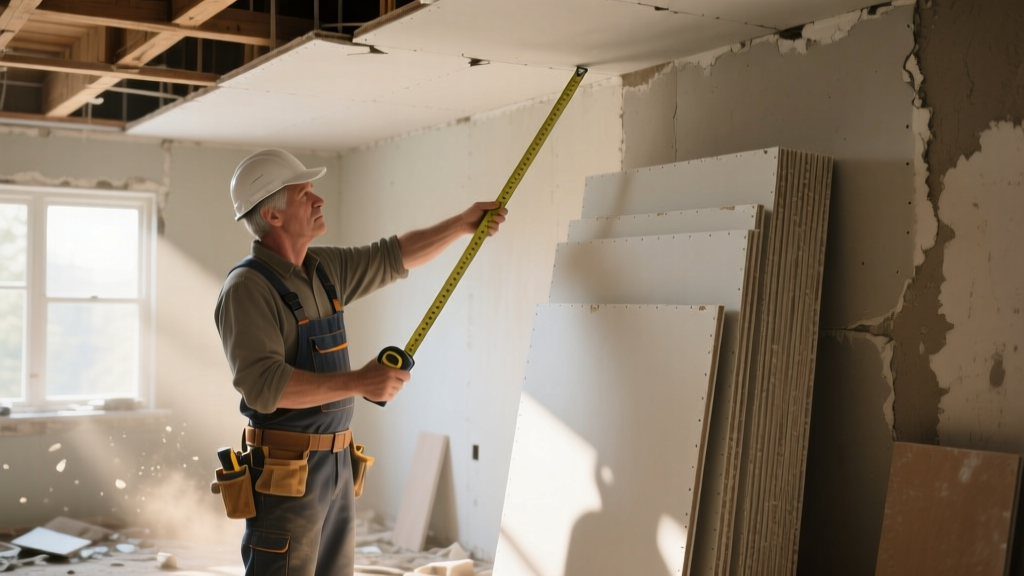
Ceiling repairs are the most common victim of aggressive price-cutting. Many contractors assume that all 1/2-inch gypsum boards are interchangeable. However, standard wall board is engineered for 16-inch on-center vertical stud spacing. When installed horizontally across ceiling joists spaced 24 inches apart, the long-term pull of gravity combined with seasonal humidity fluctuations will cause the board to bow between the joists.
The Fix: Remove the sagging patch. Upgrade to a 1/2-inch ceiling-specific lightweight panel. These boards incorporate a specialized fiberglass mesh within the core that increases span strength without adding the heavy weight of 5/8-inch board, making overhead installation significantly easier while eliminating sag.
Scenario B: The Moldy Bathroom Seam
Bathroom repairs frequently fail when contractors prioritize a low gypsum board price over environmental resistance. Standard gypsum is highly hygroscopic. Even if the bathroom is painted with high-gloss moisture-resistant paint, ambient steam eventually penetrates micro-cracks and seams. Once the standard gypsum core reaches a moisture content of just 1%, it becomes a breeding ground for Aspergillus and Penicillium mold strains.
The Fix: For high-splash zones (showers, tub surrounds), standard water-resistant green board is no longer sufficient in 2026. Upgrade to a fiberglass-mat faced gypsum panel (such as CertainTeed ToughRock Mold-Guard or Georgia Pacific DensArmor). These products completely eliminate the paper facing that mold feeds on, offering superior moisture management for a marginal increase in material cost.
2026 Gypsum Board Price Breakdown by Grade and Application
To budget accurately for repairs, contractors must understand the current pricing tiers. The national average gypsum board price varies based on thickness, core treatment, and facing material. The data below reflects Q1 2026 pro-desk pricing at major national suppliers for standard 4x8 sheets.
| Board Type | Thickness | Primary Use Case | 2026 Avg. Price (4x8 Sheet) | ROI for Repairs |
|---|---|---|---|---|
| Standard White | 1/2" | Interior walls, 16" OC framing | $12.50 - $14.00 | High (Baseline) |
| Lightweight Ceiling | 1/2" | Ceilings, 24" OC joist spacing | $15.50 - $17.00 | Critical (Prevents callbacks) |
| Fire-Rated Type X | 5/8" | Garages, furnace rooms, stairwells | $18.00 - $21.00 | Mandatory (Code compliance) |
| Moisture Resistant (MR) | 1/2" | Bathroom walls, kitchen backsplashes | $17.50 - $19.50 | High (Prevents mold remediation) |
| Glass Mat (Paperless) | 1/2" | Wet areas, high-humidity commercial | $24.00 - $28.00 | Excellent (Long-term durability) |
| Foil-Backed | 1/2" | Exterior-facing walls, vapor barriers | $22.00 - $25.00 | High (Thermal/moisture sealing) |
Strategic Sourcing: Optimizing Your Gypsum Board Price
Securing a competitive gypsum board price does not require sacrificing material integrity. Professional repair crews utilize several strategies to lower costs without resorting to sub-par products:
- Buy "Seconds" for Non-Critical Zones: Many distributors sell "blemished" or "seconds" boards at a 20% to 30% discount. These boards have cosmetic defects on the paper facing (scuffs, minor tears) but possess perfectly intact, code-compliant cores. They are ideal for garage repairs, attic access panels, or basement utility rooms where the board will be painted with heavy primer or left exposed.
- Consolidate Thicknesses: If your repair requires Type X fire-rated board for a garage ceiling, consider running 5/8" Type X throughout the adjacent interior walls. While the per-sheet price is higher, the increased mass provides superior soundproofing (STC ratings) and impact resistance, allowing you to charge a premium for the upgraded repair package.
- Avoid the "Cull" Pile: Big box stores often discount damaged sheets from the cull pile for 50% off. Never use these for structural repairs. Moisture exposure in the store's lumber yard can compromise the core integrity of these discarded sheets, leading to premature fastener pop and seam failure.
- Leverage Pro-Desk Volume Tiers: According to market analysis by the National Association of Home Builders, material costs fluctuate based on regional distribution loads. Establishing a commercial account with a dedicated drywall supplier (rather than a general big-box retailer) often unlocks tiered pricing that drops the per-sheet cost of premium boards down to the retail price of standard boards.
Code Compliance and Fire Ratings
When troubleshooting a repair in a fire-separation zone, the gypsum board price must be secondary to legal compliance. The International Code Council (ICC) and local building codes strictly mandate the use of 5/8-inch Type X gypsum board in areas such as the ceiling of an attached garage, the walls enclosing a furnace, and multi-family dwelling separation walls.
Type X boards are manufactured with glass fibers integrated directly into the gypsum core. When exposed to the extreme heat of a fire, the standard gypsum calcines (releases its chemically bound water), but the glass fibers hold the brittle core together, preventing the board from collapsing and buying critical evacuation time. If a contractor patches a garage ceiling with standard 1/2-inch board to save money, they are not only violating the International Residential Code (IRC Section R302.6), but they are also assuming massive liability in the event of a property fire. Always verify the fire-rating requirements of the specific repair zone before finalizing your material order.
Written by
Elena RodriguezElena Rodriguez is a civil engineer and technical writer specializing in concrete technology, masonry systems, and ASTM/ACI compliance. She earned her B.S. in Civil Engineering from Texas A&M University and spent a decade at a materials testing laboratory, performing over 2,000 concrete compressive strength tests and masonry prism evaluations. Elena is an ACI-certified Field Testing Technician (Grade I) and a member of ASTM Committee C12 on Natural Building Stone. She currently consults on forensic engineering cases involving concrete failures and moisture intrusion. Based in San Antonio, TX, Elena is a proud member of the Society of Women Engineers (SWE) and coaches her daughter's FIRST Robotics team.
More from Elena Rodriguez
View all
Walls & Panels
Cost Analysis: Light Gauge Steel Framing Advantages and Disadvantages
Evaluate light gauge steel framing advantages and disadvantages through a strict cost analysis lens, comparing material, labor, and lifecycle expenses.
Aug 4, 2026

Walls & Panels
Gypsum Board Types: Exact Specifications, Thickness & Dimensions
Compare standard, Type X, and moisture-resistant gypsum board types. Get exact specifications, thicknesses, dimensions, and ASTM standards for your project.
Aug 4, 2026

Fire Resistance
Best Fire-Resistant Outdoor Decking Materials: 2026 Buyer Guide
Discover the best fire-resistant outdoor decking materials for 2026. Compare Class A PVC, aluminum, and hardwood options for WUI compliance and safety.
Aug 4, 2026