How Long Does Gypsum for Soil Last? Durability & Lifespan Analysis
Analyze the durability and lifespan of gypsum for soil applications. Learn dissolution rates, subgrade stabilization longevity, and reapplication timelines.
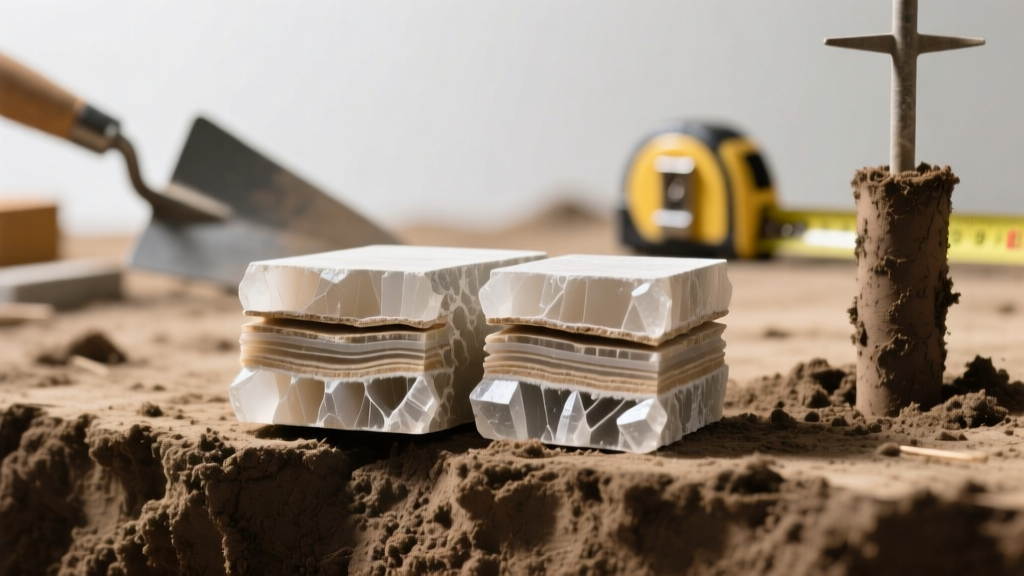
The Solubility Mechanics of Calcium Sulfate in Soil Matrices
When evaluating gypsum for soil applications—whether for agricultural amendment, erosion control, or construction subgrade stabilization—understanding its degradation timeline requires a shift in perspective. Unlike organic amendments that decompose via microbial action, or synthetic polymers that degrade via UV exposure, gypsum (calcium sulfate dihydrate, CaSO4·2H2O) is governed entirely by aqueous solubility and ion exchange dynamics.
Gypsum is moderately water-soluble, dissolving at a rate of approximately 2.0 to 2.5 grams per liter at standard ambient temperatures (20°C to 25°C). In a soil matrix, this translates to a depletion rate heavily dictated by hydrological throughput. According to data from the USGS National Minerals Information Center, the physical particle size of the applied gypsum is the primary variable controlling its functional lifespan. Pulverized agricultural gypsum (100% passing a 100-mesh sieve) will fully dissolve and leach below the active root or subgrade zone within 6 to 12 months under moderate rainfall. Conversely, coarsely ground or pelletized gypsum (SGN 200-250) extends the dissolution curve to 18-36 months, providing a sustained release of calcium ions (Ca2+) and sulfate (SO4 2-).
Lifespan Matrix by Application Scenario
The durability of a gypsum application is not a single metric; it fluctuates based on the engineered goal of the site. Below is a structural breakdown of expected lifespans across common use cases.
| Application Scenario | Typical Application Rate | Expected Functional Lifespan | Primary Depletion Mechanism |
|---|---|---|---|
| Construction Subgrade Stabilization (Sodic Clays) | 2.0 - 4.0 tons/acre | 24 - 48 months | Downward leaching below the compacted base layer |
| Agricultural Sodic Soil Reclamation | 1.0 - 3.0 tons/acre | 12 - 24 months | Crop uptake, surface runoff, and deep percolation |
| Turf & Landscaping (Clay Soil Flocculation) | 50 - 100 lbs/1,000 sq ft | 8 - 14 months | Irrigation volume and localized drainage |
| Erosion Control (Silt Logs/Berms) | Variable (High concentration) | 6 - 18 months | Direct surface water dissolution and physical washout |
Deep Dive: Subgrade Stabilization for Concrete Slabs
In commercial construction, expansive and sodic clay soils pose a severe risk to concrete slab-on-grade foundations. Sodium ions cause clay particles to disperse, leading to swelling, heaving, and catastrophic structural failure. Applying raw rock gypsum to the subgrade initiates cation exchange: the calcium from the gypsum replaces the sodium on the clay's exchange sites, causing the soil to flocculate (clump together) and dramatically increasing its load-bearing capacity and permeability.
For a 4-inch thick concrete slab, a 3-ton/acre application of 60-mesh gypsum typically stabilizes the top 6 to 8 inches of subgrade. Based on USDA NRCS guidelines for sodic soil management, this stabilization lasts approximately 3 to 4 years before the calcium is entirely leached by precipitation. However, because the concrete slab acts as an impermeable cap, the hydrological throughput beneath the slab is drastically reduced. In this specific micro-environment, the gypsum's functional lifespan can extend to 10+ years, effectively outlasting the critical curing and initial settlement phases of the foundation.
While gypsum stabilizes soil, excessive unincorporated surface applications near exposed concrete footings can lead to localized sulfate accumulation. If soil sulfate concentrations exceed 0.2% by weight, it can trigger delayed ettringite formation (DEF) in adjacent Portland cement structures, leading to expansion and cracking. Always incorporate gypsum into the top 4 inches of soil and maintain a 2-foot buffer from exposed concrete edges.
Environmental Factors Accelerating Gypsum Depletion
To accurately forecast the lifespan of your gypsum application, you must calculate the site-specific hydrological and chemical drag factors. The following variables will shorten the functional durability of the amendment:
- Annual Precipitation & Irrigation Volume: Gypsum depletion is directly proportional to water throughput. Sites receiving over 40 inches of annual rainfall, or heavily irrigated sports turf, will leach a standard 2-ton/acre application in under 12 months.
- Soil Cation Exchange Capacity (CEC): High-CEC soils (heavy clays with high organic matter) hold onto calcium ions more tightly, slightly extending the localized presence of the amendment. Sandy soils (low CEC) offer minimal retention, resulting in rapid vertical leaching.
- Slope and Surface Runoff: On gradients exceeding 5%, unincorporated pelletized gypsum is highly susceptible to physical displacement during heavy storm events before it has the opportunity to dissolve and infiltrate the soil profile.
- Initial Exchangeable Sodium Percentage (ESP): Soils with an ESP above 15% (strongly sodic) will consume the applied calcium rapidly as the ion exchange reaction reaches equilibrium, effectively 'using up' the gypsum faster than mildly sodic soils.
Diagnostic Testing: Framework for Reapplication
Relying on a fixed calendar schedule for reapplication is inefficient and risks structural or agronomic failure. Instead, utilize quantitative soil diagnostics to determine exactly when the gypsum has been depleted.
Step 1: Electrical Conductivity (EC) Testing
Because gypsum dissociates into charged ions (Ca2+ and SO4 2-), its presence in the soil solution directly increases the soil's Electrical Conductivity. Extract a soil sample from the target depth (typically 0-6 inches for turf, 6-12 inches for subgrade) and create a 1:1 soil-to-water slurry. Measure the EC using a calibrated digital meter.
- EC > 2.0 dS/m: Sufficient soluble salts/gypsum remain in the profile. No reapplication needed.
- EC 1.0 - 2.0 dS/m: Depletion is underway. Schedule a half-rate maintenance application within 60 days.
- EC < 1.0 dS/m: The gypsum has fully leached or reacted. Immediate full-rate reapplication is required for sodic soils.
Step 2: Exchangeable Sodium Percentage (ESP) Verification
For construction subgrades and agricultural reclamation, EC alone is insufficient because other salts can skew the reading. A laboratory soil test measuring the ESP is mandatory. If the ESP rebounds above 10-12%, the flocculating effect of the original gypsum application has failed, and the soil is reverting to its dispersed, unstable state.
Comparative Durability: Gypsum vs. Agricultural Lime
A common point of confusion in site preparation and soil management is conflating gypsum with agricultural lime (calcium carbonate, CaCO3). Their durability profiles and chemical behaviors are fundamentally distinct.
| Material Property | Gypsum (CaSO4·2H2O) | Ag Lime (CaCO3) |
|---|---|---|
| Primary Soil Function | Flocculation, calcium addition, sodium displacement | pH elevation (acid neutralization), calcium addition |
| Solubility in Water | Moderate (2.4 g/L) | Very Low (0.015 g/L) |
| Average Functional Lifespan | 1 to 3 years | 5 to 10+ years |
| Reaction Speed | Rapid (days to weeks) | Slow (months to years) |
| Impact on Soil pH | Neutral (does not alter pH) | Alkaline (raises pH) |
Because lime is highly insoluble, it acts as a long-term, slow-release buffer in the soil matrix. Gypsum, by contrast, is a highly soluble, short-to-medium-term structural amendment. If your site requires both pH correction and clay flocculation, they must be applied as separate treatments with the understanding that the gypsum will require reapplication long before the lime is depleted.
Strategic Procurement and Cost Considerations for 2026
When budgeting for long-term soil stabilization, factor in both material and logistics costs. As of early 2026, bulk raw agricultural gypsum (mined and pulverized) typically ranges from $35 to $55 per ton, depending on regional proximity to gypsum deposits or synthetic byproduct sources (such as flue-gas desulfurization gypsum from power plants). Application costs via specialized spreader trucks add an additional $15 to $25 per ton.
For high-value construction sites where subgrade failure carries massive financial liability, specify synthetic FGD (Flue-Gas Desulfurization) gypsum. FGD gypsum is chemically identical to mined gypsum but boasts a higher purity (often >95% CaSO4·2H2O) and a more uniform, fine particle size. This ensures a faster, more predictable ion exchange reaction in the critical top 6 inches of the subgrade, providing immediate structural stability for heavy equipment traffic during the building phase.