How Much Does Gypsum Board Cost? 2026 Material & Labor Pricing Guide
Discover exactly how much gypsum board costs in 2026. Compare material prices for standard, Type X, and moisture-resistant drywall plus labor rates.

The True Cost of Gypsum Board: Material vs. Labor
When calculating how much does gypsum board cost for a residential or commercial project, contractors must separate raw material expenses from the highly variable labor rates associated with hanging and finishing. As of 2026, the national average for a fully installed, Level 4 finished drywall system ranges from $2.15 to $3.85 per square foot. However, this baseline fluctuates wildly based on board thickness, fire-rating requirements, ceiling heights, and regional union labor agreements.
Raw gypsum board (drywall) typically accounts for only 25% to 35% of the total project budget. The remaining 65% to 75% is consumed by labor, joint compound, tape, fasteners, and equipment rentals like scaffolding or drywall lifts. Understanding this split is critical for accurate bidding and preventing budget overruns on mid-to-large-scale builds.
Base Material Pricing by Board Type
Material costs are generally quoted per 4x8 foot sheet (32 square feet) or per 4x12 foot sheet (48 square feet). The table below outlines current 2026 wholesale and retail pricing for the most common gypsum board categories.
| Board Type | Thickness / Dimensions | Cost Per Sheet (4x8) | Cost Per Sq.Ft. | Primary Application |
|---|---|---|---|---|
| Standard White Board | 1/2" x 4' x 8' | $13.50 - $16.00 | $0.42 - $0.50 | Interior walls, standard ceilings |
| UltraLight Standard | 1/2" x 4' x 12' | $22.00 - $26.00 | $0.45 - $0.54 | Large residential ceilings, reducing sag |
| Type X (Fire-Rated) | 5/8" x 4' x 8' | $17.50 - $22.00 | $0.54 - $0.68 | Garages, multi-family separations, shafts |
| Moisture-Resistant (Green) | 1/2" x 4' x 8' | $19.00 - $24.00 | $0.59 - $0.75 | Bathroom walls, kitchen backsplashes |
| Paperless / Glass Mat | 5/8" x 4' x 8' | $38.00 - $48.00 | $1.18 - $1.50 | Tile backer boards, high-humidity zones |
| Sound-Damping (Acoustic) | 1/2" x 4' x 8' | $42.00 - $55.00 | $1.31 - $1.71 | Home theaters, bedroom partitions |
The Labor Variable: Hanging vs. Finishing
Labor is where drywall budgets are most frequently miscalculated. According to the Bureau of Labor Statistics, median wages for drywall and ceiling tile installers vary significantly by metropolitan area, with unionized markets (like New York, Chicago, and Seattle) commanding rates up to 60% higher than non-union markets in the Southeast and Midwest.
Breaking Down the Labor Phases
- Hanging (Fastening): $0.45 to $0.85 per sq.ft. This includes measuring, cutting, and screwing the boards to wood or metal framing. Metal stud framing requires fine-thread drywall screws, while wood framing requires coarse-thread screws. Ring-shank nails are rarely used in modern commercial applications due to pop-risks.
- Taping and Mudding (Levels 1-3): $0.60 to $1.10 per sq.ft. This covers embedding paper or fiberglass mesh tape and applying the first two coats of joint compound.
- Final Finishing and Sanding (Level 4): $0.40 to $0.75 per sq.ft. The final skim coat, sanding, and preparation for paint primers.
Many architectural plans specify a Level 5 finish for walls with critical lighting (e.g., large windows or wall-washing sconces). A Level 5 finish requires a full skim coat of joint compound over the entire surface of the gypsum board. This adds $0.85 to $1.40 per square foot to the labor cost. Failing to account for this specific finish level during the estimating phase is the number one cause of drywall contract disputes.
Specialty Gypsum Boards: Cost vs. Performance Matrix
When standard boards fail to meet building codes or performance requirements, contractors must upgrade to engineered gypsum products. The Gypsum Association outlines strict parameters for fire and moisture resistance that dictate these upgrades. Below is a comparison of premium specialty boards available from major manufacturers like USG Corporation and Georgia-Pacific.
| Product Category | Example Models | Cost Premium vs Standard | Key Performance Benefit |
|---|---|---|---|
| Type C Fire-Rated | USG Sheetrock Firecode C | +25% to +35% | Contains vermiculite; maintains structural integrity longer than Type X in extreme heat. |
| Abuse-Resistant | GP ToughRock AbuseGuard | +40% to +50% | Dense fiberglass mesh core prevents punctures in high-traffic corridors and schools. |
| Moisture & Mold | CertainTeed M2Tech | +30% to +45% | Moisture-resistant core and face paper with mold-inhibiting chemicals. |
| Shaft Liner | USG Fiberock Shaftliner | +80% to +110% | 1-inch thick, heavy-duty panels designed for elevator and mechanical shafts. |
Hidden Surcharges That Inflate Drywall Budgets
Base material and standard labor rates only tell half the story. Estimators must factor in the following hidden costs to avoid margin erosion:
1. High Ceiling and Scaffolding Surcharges
Standard drywall labor rates assume wall heights of 8 to 10 feet. Once ceilings exceed 10 feet, productivity drops by roughly 20% due to the need for scaffolding, rolling towers, or mechanical drywall lifts. Expect labor rates to increase by $0.35 to $0.60 per square foot for vaulted ceilings, stairwells, and two-story foyers.
2. Demolition and Disposal Fees
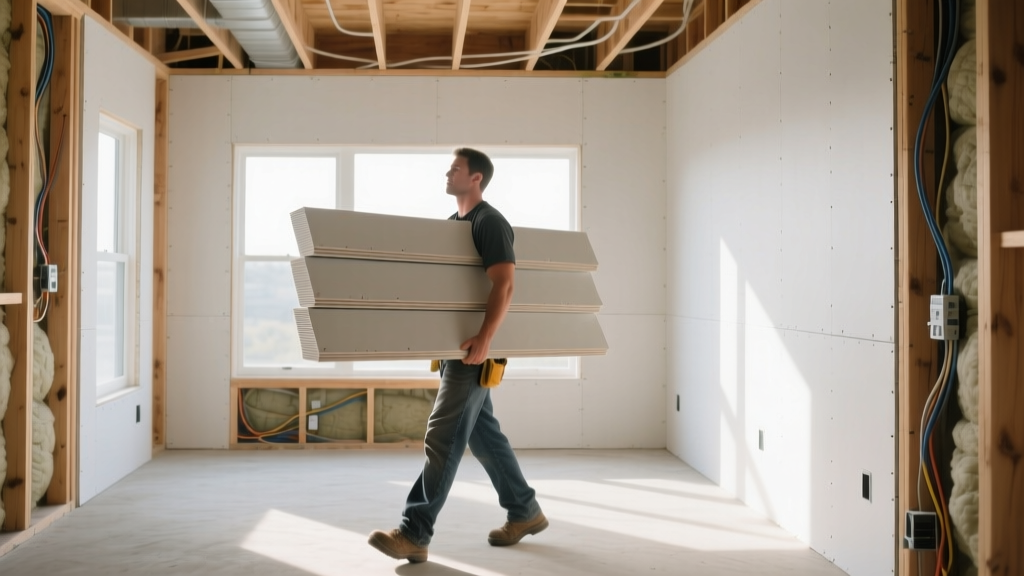
For renovation projects, tearing out existing drywall and disposing of it is a major expense. Gypsum board is exceptionally heavy, weighing approximately 1.6 pounds per square foot for 1/2" standard board. A 2,000 sq.ft. home generates over 3,000 pounds of drywall waste. Dumpsters have strict weight limits, and landfills often charge premium tipping fees for gypsum due to its sulfur content. Budget $1.25 to $2.00 per square foot for demo and haul-away.
3. Delivery and Staging Logistics
Lumber yards and building supply distributors typically charge a flat delivery fee ($75 to $150 per drop) for boom-truck delivery. However, if the site requires the driver to manually stage the boards inside the building (floor-loading), staging fees will add $0.05 to $0.10 per square foot. In high-rise commercial builds, hoisting drywall to upper floors via material elevators can add thousands in specialized rigging labor.
Calculating Material Needs and the 15% Waste Rule
Novice estimators often calculate the exact square footage of the walls and ceilings and order that exact amount of gypsum board. This guarantees a material shortage. Every cut made around windows, doors, electrical boxes, and HVAC registers creates offcuts that are too small to use.
"For standard rectangular rooms, a 10% waste factor is sufficient. However, for complex architectural layouts featuring multiple jogs, archways, bay windows, and angled ceilings, estimators must apply a 15% to 20% waste factor to prevent mid-project supply runs that stall the finishing crew."
To calculate accurately: Multiply the total wall and ceiling square footage by 1.15. Divide that number by 32 (for 4x8 sheets) or 48 (for 4x12 sheets). Always round up to the nearest whole sheet, and ensure your supplier allows returns on unopened, undamaged pallets to recoup costs on the inevitable overage.
Fastener and Compound Consumption Rates
Do not forget the ancillary materials. For every 1,000 square feet of 1/2" drywall installed on wood framing 16 inches on-center, you will need approximately:
- Screws: 10 to 12 pounds of 1-1/4" coarse-thread drywall screws.
- Joint Tape: 1,200 linear feet of paper tape (or roughly 4 rolls of 250ft).
- Joint Compound: 3 to 4 boxes (18kg each) of all-purpose or lightweight setting compound for a Level 4 finish.
By mapping out these precise material requirements alongside localized labor rates, contractors and homeowners can accurately forecast the true cost of a gypsum board installation without falling victim to the hidden variables that derail construction budgets.
Written by
Priya KapoorPriya Kapoor is a real estate market analyst and construction economics researcher with expertise in housing affordability, development feasibility, and infrastructure investment. She holds a Master of Regional Planning from Cornell University and previously worked as a senior analyst at CBRE's Investment Properties group, where she modeled returns for $4B in mixed-use development pipelines. Priya now runs an independent research practice advising developers, municipalities, and REITs on construction cost forecasting and market timing. She publishes the quarterly "BuildMat Market Pulse" report tracking material price indices across 12 commodity categories. Based in Austin, TX, Priya serves on the board of Habitat for Humanity Austin and is a marathon runner.
More from Priya Kapoor
View all
Construction Cost
Cost to Build a 1600 Sq Ft Home in 2026: Full Breakdown
Accurate 2026 cost to build a 1600 sq ft home—material, labor, and regional pricing breakdowns included. Plan your budget with real-time estimates.
Aug 11, 2026

Wood & Lumber
Name the Types of Wood for Pressure Treatment and Preservation
Learn how to name the types of wood best suited for pressure treatment. Compare species treatability, chemical retention levels, and 2026 preservation costs.
Aug 4, 2026

Stone & Masonry
Stone Veneer Suppliers Lindenhurst: 2026 Cost Analysis
Analyze 2026 stone veneer costs in Lindenhurst, NY. Compare local supplier pricing, delivery fees, and Suffolk County installation labor rates.
Aug 4, 2026