Mold Resistant Drywall: Scenario Matching & Application Guide
Match mold resistant drywall to the right moisture scenarios. Compare top brands, costs, and ASTM standards to prevent costly water damage failures.
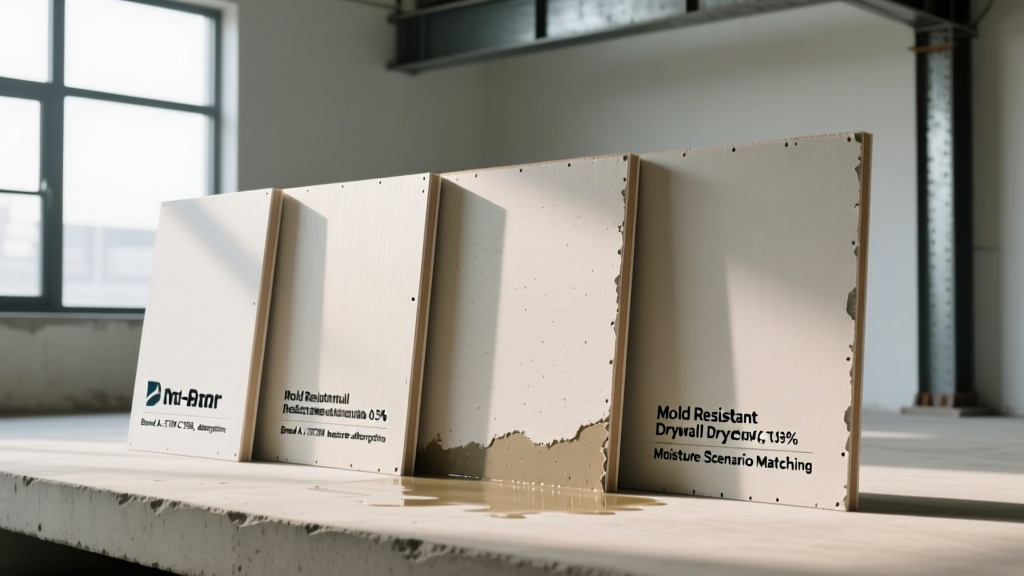
The Moisture Spectrum: Where Mold Resistant Drywall Actually Fits
Mold resistant drywall—frequently identified by its purple, green, or blue facing—is engineered specifically for high-humidity ambient environments, not direct water immersion. According to the EPA's guidelines on mold and moisture, controlling indoor humidity and preventing condensation are the primary defenses against fungal growth. MR board addresses the condensation and ambient humidity side of the equation by utilizing a silicone-treated or wax-integrated gypsum core paired with a fiberglass or heavily treated paper facing.
Scenario Matching Matrix: Standard vs. MR vs. Cement Board
Selecting the correct substrate requires matching the material to the specific moisture profile of the room. Over-specifying wastes budget; under-specifying guarantees remediation costs.
| Scenario | Ambient Humidity | Direct Water Risk | Recommended Material | Core Reasoning |
|---|---|---|---|---|
| Living Room / Bedroom | Low | None | Standard 1/2" Gypsum | Cost-effective; no moisture risk to justify premium. |
| Bathroom Vanity Wall | High | Low (Splashes) | Mold Resistant Drywall | Handles steam from showers; resists surface condensation. |
| Unfinished Basement | High | Moderate (Seepage) | MR Board + Furring | Resists ambient dampness; must be kept off concrete floor. |
| Shower / Tub Surround | 100% | High (Direct) | Cement Board + Membrane | MR drywall core will dissolve under continuous water exposure. |
| Kitchen Backsplash | Moderate | Low (Splashes) | Standard or MR | Standard is fine if tiled; MR adds insurance behind cabinets. |
Top Product Lines & Specification Breakdown
Not all MR boards are identical. The Gypsum Association categorizes these under specific performance metrics, primarily testing facing and core resistance via ASTM D3273. A score of 10 on this scale indicates zero fungal growth after a 4-week controlled incubation period.
USG Sheetrock Mold Tough
Available in 1/2" and 5/8" (Type X fire-rated) thicknesses, this line features a silicone-treated core and a 100% recycled mold-resistant facing. It consistently scores a 10/10 on ASTM D3273. The 5/8" Type X variant is mandatory for attached-garage firewall applications that also experience seasonal humidity. Current material cost hovers around $0.62 to $0.68 per square foot.
CertainTeed M2Tech
CertainTeed's differentiator is that the moisture and mold resistance is integrated directly into the gypsum core chemistry, not just the facing paper. If a contractor scores and snaps M2Tech, the exposed inner core still actively resists mold colonization. This makes it highly forgiving during complex cut-outs for plumbing fixtures. Cost: ~$0.70 per square foot.
National Gypsum XP
Recognizable by its distinct purple paper facing, XP offers excellent impact resistance alongside its mold and moisture defense. It is heavily specified in commercial hospitality (hotels and multi-family housing) where both physical abuse and high humidity from guest showers are compounding factors. Cost: ~$0.58 per square foot.
Installation Edge Cases: How Builders Compromise the System
Buying the correct board is only 50% of the battle. Building Science Corporation emphasizes that moisture management is a systemic assembly issue. If you install MR drywall but fail at the detailing, the board will still grow mold.
- The Joint Compound Trap: Standard pre-mixed joint compound contains organic binders (starch and cellulose) that mold feeds on. Fix: Use setting-type compounds (e.g., USG Durabond) or specifically labeled mold-resistant joint compounds for all taping and finishing.
- Cut Edge Vulnerability: When you score and snap MR board, you expose the untreated or less-treated gypsum core at the cut line. Fix: Seal all cut edges—especially bottom plates and pipe penetrations—with a mold-inhibiting primer or silicone caulk before installing baseboards or trim.
- Fastener Bleed-Through: Standard black phosphate drywall screws will rust in high-humidity bathrooms, creating rust spots that break the facing paper and introduce moisture directly to the core. Fix: Use zinc-coated or ceramic-coated corrosion-resistant drywall screws exclusively in MR assemblies.
- Bottom Plate Wicking: Drywall acts like a sponge if it touches a concrete slab. Fix: Maintain a strict 1/2-inch gap between the bottom edge of the MR drywall and the subfloor. Fill the gap with flexible polyurethane sealant, never joint compound.
Below-Grade Basements: The Capillary Break Requirement
Applying mold resistant drywall in basements requires a fundamentally different framing approach than above-grade bathrooms. MR drywall will not stop hydrostatic pressure or capillary action from concrete foundation walls. If you frame a basement wall with standard 2x4s directly against the concrete and apply MR drywall, trapped moisture will eventually overwhelm the board's chemical treatments.
The correct assembly requires a continuous rigid foam insulation layer (minimum XPS or polyiso, R-10 or higher) against the concrete to act as a capillary break and thermal condensation plane. The wood framing must be held 1 inch away from the foam, creating an air gap. Only then should the mold resistant drywall be applied to the interior face of the wood studs. This assembly ensures that any minor moisture vapor driving through the concrete condenses on the warm side of the foam, never reaching the gypsum core.
Cost Analysis: Is the Premium Justified?
Current Material Pricing (Per Square Foot)
- Standard 1/2" Drywall: $0.35 - $0.45
- Mold Resistant 1/2": $0.55 - $0.75
- Mold Resistant 5/8" Type X: $0.85 - $1.05
- Cement Board 1/2": $0.90 - $1.20
For a standard 5x8 bathroom (approximately 120 square feet of wall space), upgrading from standard to MR drywall adds roughly $30 to $45 in raw material costs. Considering professional mold remediation costs average between $1,500 and $4,000, the ROI on the material premium is immediate and undeniable. However, do not waste budget installing MR drywall on ceilings in non-humidified hallways, living rooms, or bedrooms. Reserve the premium strictly for kitchens, bathrooms, laundry rooms, and below-grade basements to optimize your construction budget.