Drywall Self-Drilling Anchors: Brand Deep-Dive & Load Tests
Compare top drywall self-drilling anchors from Hillman, ITW, and Cobra. Includes exact load capacities, failure modes, and 2026 pricing data.
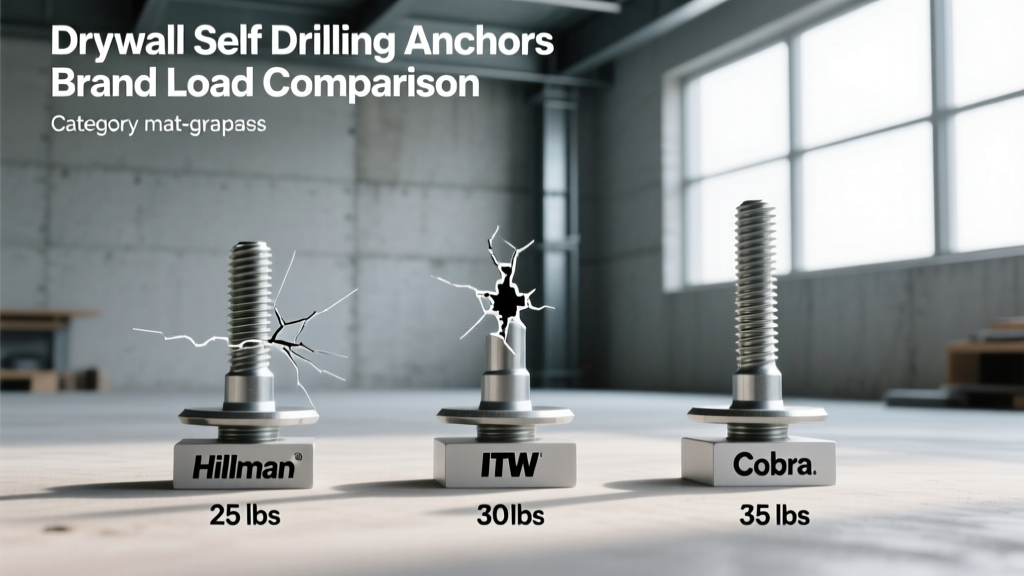
The Mechanics of Self-Drilling Drywall Anchors
Self-drilling drywall anchors eliminate the need for pre-drilling pilot holes by utilizing an aggressive, wide-pitch thread geometry that acts as a male tap. As the anchor rotates, the sharp leading edge cuts into the paper facing and the calcium sulfate dihydrate core of the gypsum board. The success of any drywall self-drilling anchor relies entirely on the friction and mechanical interlock between the anchor's threads and the compressed gypsum matrix.
Standard 1/2-inch regular-weight drywall has a core density of approximately 40 to 45 pounds per cubic foot, while 5/8-inch Type X fire-rated board is denser, often exceeding 50 pounds per cubic foot due to the inclusion of fiberglass and other non-combustible reinforcements. According to baseline thickness and density specifications outlined by the Gypsum Association's technical documents, this density variance directly dictates the pull-out strength of threaded anchors. An anchor that holds 50 lbs in 5/8-inch Type X board may catastrophically fail at 30 lbs in standard 1/2-inch board due to core crumbling.
Brand Deep-Dive: Hillman vs. ITW vs. Toggler
The market for drywall fasteners is dominated by three primary manufacturers, each taking a distinct engineering approach to thread design, material composition, and load distribution.
Hillman E-Z Ancor Line
Hillman's E-Z Ancor product line is the most ubiquitous in retail environments. Their flagship self-drillers are available in two primary materials: zinc die-cast and glass-filled nylon (plastic).
- Zinc Die-Cast (#8-10 and #10-12): These feature a deep, sharp cutting thread. The zinc alloy provides high shear strength, preventing the anchor from snapping under lateral loads. However, the rigid metal lacks flexibility, meaning over-torquing will strip the gypsum core rather than deforming the anchor.
- Glass-Filled Nylon: Hillman's plastic variants use a slightly wider flange to distribute the clamping load across a broader surface area of the drywall paper. The nylon material offers slight elasticity, which helps absorb dynamic loads (like a door stop hitting a wall), but UV exposure and extreme temperature fluctuations in unconditioned spaces can make the plastic brittle over time.
ITW Brands / Cobra Threaded Anchors
ITW Construction Products (often branded under Cobra or Tapcon) engineers their drywall self-drilling anchors with a focus on professional installation speed. The Cobra threaded zinc anchors feature a proprietary 'start-point' geometry that reduces the initial axial force required to penetrate the paper facing.
Unlike standard straight-flank threads, Cobra utilizes a slightly curved thread profile. This design compresses the gypsum core upward into the thread valleys rather than pulverizing it into dust. This compaction effect increases the local density of the gypsum immediately surrounding the anchor, yielding a 10-15% higher pull-out resistance in field tests compared to standard straight-cut threads.
Toggler Heavy-Duty Metal Self-Drillers
While Toggler is famous for their toggle bolts, their self-drilling metal anchors are engineered for high-shear applications. Toggler's self-drillers feature a deeper thread pitch (fewer threads per inch) which creates a thicker 'root' diameter for the anchor itself. This makes the anchor highly resistant to bending when mounting heavy shelving brackets where the load is applied perpendicular to the wall surface (shear load).
Load Capacity & Failure Mode Matrix
The following data reflects 2026 retail averages and tested load limits. Pull-out loads represent axial tension (pulling straight out of the wall), while shear loads represent weight hanging downward against the wall face. Testing standards referenced by the ICC Evaluation Service require a safety factor of 3:1 or 4:1 for allowable loads; the values below represent ultimate failure points.
| Brand / Model | Material | Ultimate Pull-Out (1/2'') | Ultimate Pull-Out (5/8'') | Avg. Price / Unit | Primary Failure Mode |
|---|---|---|---|---|---|
| Hillman E-Z Ancor #10-12 | Zinc Die-Cast | 45 lbs | 65 lbs | $0.55 | Core stripping (spin-out) |
| Hillman E-Z Ancor #8-10 | Glass-Filled Nylon | 30 lbs | 40 lbs | $0.28 | Flange shear / head snap |
| Cobra Threaded Zinc | Zinc Alloy | 52 lbs | 72 lbs | $0.62 | Core stripping (spin-out) |
| Toggler Heavy-Duty | Carbon Steel | 48 lbs | 68 lbs | $0.85 | Gypsum face tearing |
Real-World Installation: Avoiding the 'Spin-Out'
The most common failure in drywall self-drilling anchor installation is 'coring' or 'spin-out.' This occurs when the anchor's threads pulverize the surrounding gypsum into a fine powder, destroying the mechanical interlock and leaving the anchor spinning freely in an oversized hole.
Never use a standard high-speed drill setting. Set your cordless drill's torque clutch to setting 3 or 4 (out of 15), and limit the trigger speed to 1,200 RPM. If using an impact driver, ensure it is in 'precision' or low-torque mode. The goal is to let the sharp threads cut the gypsum, not to burn through it with high rotational friction.
Step-by-Step Installation Framework
- The Pilot Indentation: Do not use a nail to punch a starter hole. Puncturing the paper facing tears the structural membrane of the drywall. Instead, press the sharp tip of the self-drilling anchor firmly into the wall and rotate clockwise by hand for one full turn to score the paper.
- Driving the Anchor: Insert a #2 Phillips bit. Apply steady, moderate axial pressure (pushing into the wall) while driving at low speed. Stop driving the exact moment the flange sits flush with the wall surface.
- The Flush Check: Run your fingernail across the flange. If it protrudes, the drywall paper will bunch up when you drive the mounting screw, creating a visible bulge. If it is recessed, you have over-driven it and compromised the holding power of the top thread.
- Driving the Screw: Use the exact screw diameter specified by the manufacturer. A screw that is too thin will not expand the anchor; a screw that is too thick will split a plastic anchor or strip the internal threads of a zinc anchor.
Decision Framework: When to Abandon Self-Drillers
Self-drilling anchors are engineered for static, light-to-medium duty loads. They are not a universal solution. Use the following framework to determine when to pivot to alternative fastening methods.
Scenario A: Dynamic or Eccentric Loads
If the mounted object will experience movement, vibration, or leverage (e.g., an articulating TV mount, a heavy bathroom grab bar, or a door that swings into a wall stop), self-drilling anchors will eventually fatigue the gypsum core. The micro-movements will slowly enlarge the hole. Pivot to: Strap toggles (like the Toggler Snaptoggle) which distribute the load across a 3-inch metal channel behind the drywall.
Scenario B: Moisture-Prone Environments
In bathrooms or kitchens where moisture-resistant (green board) or cement board is used, standard zinc self-drillers will corrode, and the denser core of moisture-resistant board makes driving them difficult, increasing the risk of head snap. Pivot to: Stainless steel toggle bolts or specialized cement-board anchors with carbide tips.
Scenario C: Exceeding 50 lbs on 1/2-inch Drywall
If your calculated load exceeds 50 lbs on standard 1/2-inch drywall, you are operating outside the safe safety factor for self-drillers. Pivot to: Locating the wood or metal stud using a magnetic or density stud finder, and fastening directly into the framing with #10 or #12 wood/metal screws.
Material Longevity and Environmental Factors
When specifying anchors for commercial builds or long-term residential installations, consider the environmental degradation of the materials. Zinc die-cast anchors are highly susceptible to white rust (zinc oxide) in high-humidity environments if the drywall paper facing retains moisture. For coastal properties or high-humidity zones, specify carbon steel anchors with a thick zinc-nickel plating, or opt for structural toggle bolts that rely on the back-side of the drywall rather than thread friction within the core.