Water Resistant Gypsum Board: The 2026 Buyer's Guide
Compare top water resistant gypsum board products for 2026. Get exact pricing, installation specs, and application limits for moisture-prone areas.

The Core Difference: Water Resistance vs. Waterproofing
When specifying materials for moisture-prone environments, understanding the hygroscopic nature of gypsum is critical. Standard gypsum board will absorb ambient moisture, leading to core degradation, sagging, and mold proliferation. Water resistant gypsum board (WRGB) mitigates this through two primary mechanisms: chemical core treatments and specialized facings. The gypsum core is formulated with siloxane or wax emulsions that reduce water absorption rates to less than 5% by weight when tested under ASTM C1396 standards.
However, a common and costly mistake in residential and commercial construction is conflating 'water resistant' with 'waterproof.' WRGB is designed to withstand high ambient humidity and occasional minor condensation. It is not engineered to withstand direct, continuous water exposure or hydrostatic pressure. For areas subject to direct water impact, such as shower surrounds, cementitious backer units (CBUs) or foam-based tile backer boards remain the mandatory standard.
2026 Product Comparison Matrix: Top Moisture-Resistant Panels
The market has evolved significantly beyond traditional 'green board.' While paper-faced green board is still available, fiberglass-mat panels have become the preferred specification for high-end residential and commercial projects due to their superior mold resistance. Below is a comparative analysis of the leading WRGB products available in 2026.
| Product Model | Facing Material | Mold Score (ASTM D3273) | 2026 Avg. Price (4x8 1/2") |
|---|---|---|---|
| USG Sheetrock Mold Tough | Moisture-Resistant Paper | 10 (Perfect) | $17.50 - $19.00 |
| Georgia-Pacific DensArmor Plus | Fiberglass Mat | 10 (Perfect) | $23.50 - $26.00 |
| CertainTeed M2Tech | Moisture-Resistant Paper | 10 (Perfect) | $18.00 - $20.50 |
| National Gypsum XP | Moisture-Resistant Paper | 10 (Perfect) | $16.90 - $18.50 |
Deep Dive: Paper-Faced vs. Fiberglass-Mat Facings
The facing material dictates the long-term survivability of the panel in a wet environment. Traditional green board uses a heavy, moisture-treated cellulose paper. While the treatment repels liquid water, cellulose is an organic food source for mold spores. If the ambient humidity consistently exceeds 70%, or if a minor plumbing leak occurs behind the wall, mold can colonize the paper facing even if the gypsum core remains intact.
Fiberglass-mat panels, such as GP DensArmor Plus, completely eliminate the organic food source. The inorganic fiberglass mat is inherently immune to mold consumption. According to the EPA's mold prevention guidelines, removing organic materials from damp environments is the most effective way to prevent indoor air quality degradation. For basement renovations or commercial restrooms, the 30% price premium for fiberglass-mat boards is easily justified by the drastic reduction in callback risks.
Application Decision Framework: Where to Install
Use this framework to determine if water resistant gypsum board is the correct specification for your specific building zone.
- Bathroom Walls (Outside Shower/Tub Zone): APPROVED. Ideal for areas exposed to steam and high humidity. Prime with a high-quality acrylic primer before painting.
- Kitchen Backsplashes: APPROVED. Excellent substrate for tile. Ensure the board is sealed with a liquid waterproofing membrane (e.g., RedGard) before applying thinset mortar.
- Basement Perimeter Walls: CONDITIONAL. Only approved if the wood or metal framing is kept at least 1 inch away from the concrete foundation wall, and a continuous vapor retarder is installed on the warm-in-winter side of the assembly.
- Shower and Tub Surrounds: REJECTED. Must use cement board (ASTM C1325) or extruded foam backer board. WRGB will fail under continuous direct water exposure.
- Exterior Soffits: REJECTED. Even treated gypsum will degrade when exposed to outdoor weather cycles. Use exterior-grade glass-mat sheathing or fiber cement.
Critical Installation Specifications for High-Humidity Zones
Installing WRGB requires strict adherence to manufacturer fastening and finishing protocols. Deviating from these specifications voids warranties and compromises moisture resistance.
Fastening and Framing
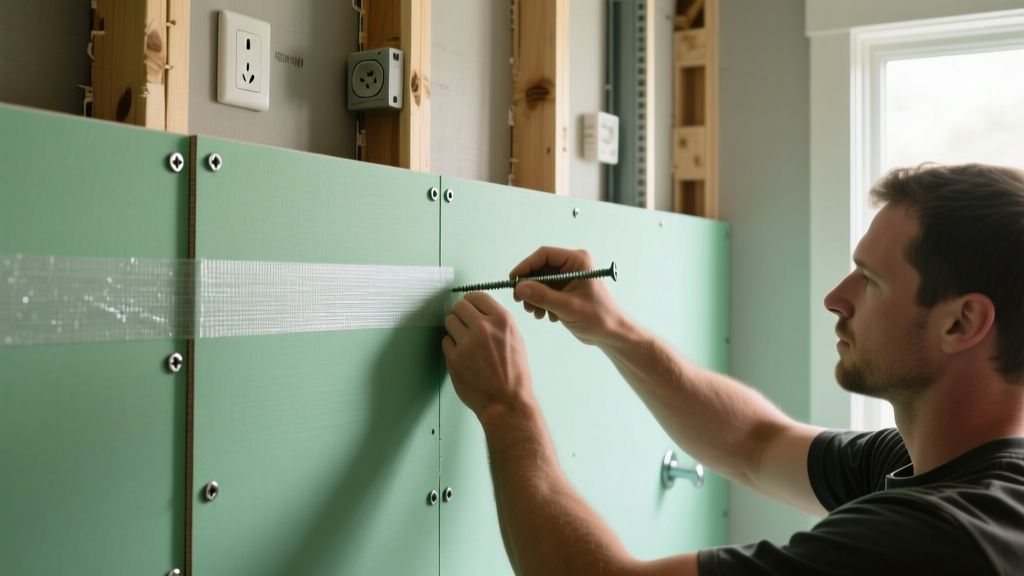
Frame walls with 20-gauge or heavier galvanized steel studs, or pressure-treated lumber for bottom plates. Fasten 1/2-inch WRGB using 1-1/4-inch Type S (fine-thread) drywall screws for metal, or Type W (coarse-thread) for wood. Maximum fastener spacing must not exceed 8 inches on center for walls and 7 inches on center for ceilings. Drive screws so the head dimples the paper facing without breaking the surface; a broken facing creates a direct pathway for moisture into the gypsum core.
Taping and Joint Compound Selection
Never use standard paper tape in moisture-prone areas. Paper tape absorbs moisture from the joint compound and can blister or harbor mold. Instead, use alkali-resistant fiberglass mesh tape. For the bedding and fill coats, utilize a setting-type joint compound (such as USG Durabond 45 or 90). Setting compounds undergo a chemical curing process that makes them highly resistant to moisture re-emulsification, unlike air-drying pre-mixed compounds which can soften when exposed to high humidity.
Expert Insight: In mixed-humidity climates, avoid using interior polyethylene vapor barriers behind WRGB in bathroom walls. This can trap moisture inside the wall cavity. Instead, specify a 'smart' vapor retarder like CertainTeed MemBrain, which adjusts its permeability based on the relative humidity inside the wall cavity, allowing the assembly to dry to the interior if necessary.
Cost Breakdown: Standard vs. Water Resistant vs. Cement Board
Budgeting accurately requires looking beyond the raw material cost of the panels. The table below outlines the fully loaded material costs per square foot for a standard bathroom wall assembly in 2026.
| Material Type | Panel Cost / Sq Ft | Fasteners & Tape | Joint Compound | Total Material / Sq Ft |
|---|---|---|---|---|
| Standard 1/2" Drywall | $0.38 | $0.05 | $0.12 | $0.55 |
| Paper-Faced WRGB | $0.58 | $0.05 | $0.18 (Setting-type) | $0.81 |
| Fiberglass-Mat WRGB | $0.78 | $0.06 | $0.18 (Setting-type) | $1.02 |
| 1/2" Cement Board | $1.15 | $0.12 | $0.25 (Thinset/Alkali tape) | $1.52 |
While fiberglass-mat WRGB costs approximately 85% more than standard drywall in raw materials, it represents a 33% savings compared to cement board, while being significantly lighter and easier to cut and finish to a Level 4 or Level 5 smooth surface.
Frequently Asked Questions
Can I use water resistant gypsum board as a tile backer?
Yes, but only in low-to-moderate moisture areas like kitchen backsplashes or bathroom wainscoting outside the wet zone. You must apply a liquid waterproofing membrane over the finished drywall before applying thinset. For shower walls, you must use cement board or a specialized foam tile backer.
Does the green color of the board affect paint adhesion?
The green dye used in the facing paper can sometimes bleed through light-colored, low-quality paints. Always apply a high-quality, stain-blocking primer (such as an acrylic or PVA primer specifically formulated for new drywall) before applying your topcoat. One coat of primer is usually sufficient to seal the facing.
What is the fire rating of water resistant drywall?
Standard 1/2-inch WRGB does not carry a specific fire rating on its own. If your building code requires a 1-hour or 2-hour fire-resistance-rated assembly in a moisture-prone area (such as a commercial bathroom adjacent to a corridor), you must specify 5/8-inch Type X water resistant gypsum board, which contains glass fibers in the core to maintain structural integrity during a fire.
For comprehensive installation standards and framing tolerances, always consult the Gypsum Association's GA-216 Application and Finishing guidelines prior to beginning your project.
Written by
Marcus ChenMarcus Chen is a licensed structural engineer (PE) and building materials analyst with over 12 years of experience across residential, commercial, and industrial construction. He holds a Master of Science in Civil Engineering from UC Berkeley and spent six years at Thornton Tomasetti before transitioning to independent consulting and technical writing. Marcus specializes in material selection for seismic-prone regions, concrete reinforcement strategies, and lifecycle cost analysis. His work has been cited by the American Concrete Institute (ACI) and the Structural Engineers Association of California (SEAOC). When he is not on a job site or at his desk, you will find him hiking the Sierra Nevada or restoring a 1920s craftsman bungalow in Oakland, CA.
More from Marcus Chen
View all
Construction Cost
How Much Did the Eiffel Tower Cost to Build?
How much did the Eiffel Tower cost to build in 1889? We adjust for inflation and compare its budget to modern skyscraper construction.
Aug 4, 2026

Fire Resistance
What Is a Fire Resistant Material? Testing & Certification Guide
Discover what is a fire resistant material through ASTM and UL testing. Learn how fire ratings, certifications, and assemblies work in construction.
Aug 4, 2026

Construction Cost
How Much Did the Burj Khalifa Cost to Build?
How much did the Burj Khalifa cost to build? We break down the $1.5B project and extract 5 money-saving strategies for your next build.
Jul 30, 2026