Self Drilling Plaster Anchors: Load Ratings and Gypsum Specs
Compare self drilling plaster anchors for gypsum board. Discover exact load ratings, zinc vs plastic specs, and torque limits for secure mounting.
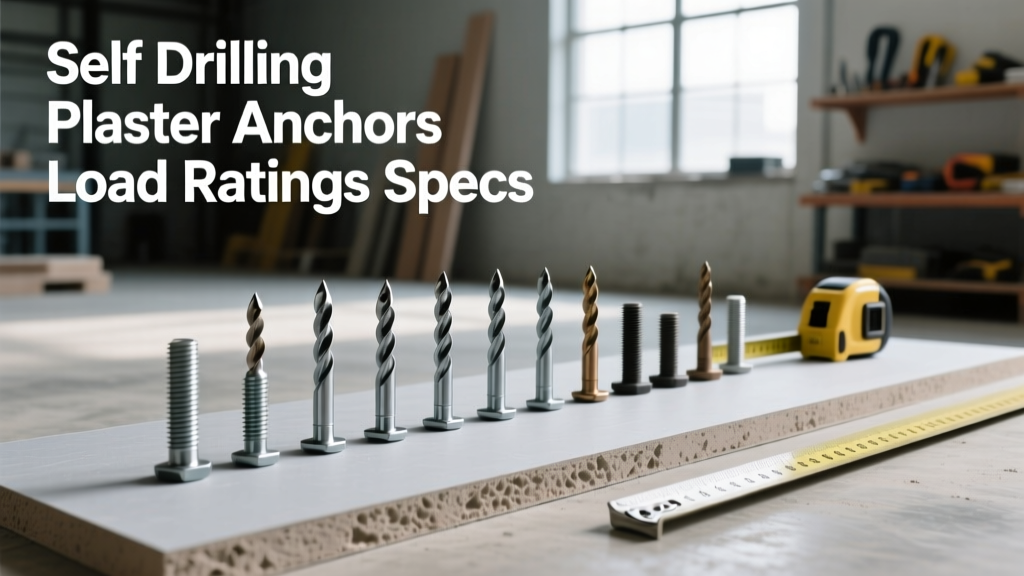
The Engineering Behind Self-Drilling Plaster Anchors
When mounting heavy fixtures to drywall, professionals rely on self drilling plaster anchors to bypass the need for pre-drilling and wall studs. Unlike traditional expansion anchors that rely on outward friction against a pre-cut hole, self-drilling variants utilize wide, aggressive external threads that cut directly into the calcined gypsum core. This creates a mechanical interlock with the crystalline matrix of the board, distributing shear and tensile loads across a much larger surface area of the gypsum.
- Core Compatibility: Standard 1/2' (12.7mm) and 5/8' (15.9mm) gypsum panels.
- Drive Interface: #2 Phillips or T20 Torx (Torx preferred to prevent cam-out).
- Maximum Drill Speed: 1,200 RPM (higher speeds cause thermal degradation of the gypsum core).
- Average Cost: $0.45 - $0.65 per unit (Zinc); $0.15 - $0.25 per unit (Polymer).
Material Metallurgy: Zinc Alloy vs. Engineered Polymer
The performance of self drilling plaster anchors is heavily dictated by their base material. The market is currently dominated by two distinct categories, each with specific structural advantages and failure thresholds.
Zinc Die-Cast Anchors (Zamak 3 Alloy)
Zinc anchors, such as the ITW E-Z Ancor Twist-N-Lock series, are manufactured using Zamak 3 die-cast alloy. This material provides exceptional rigidity, allowing the anchor's cutting tip to pierce the dense paper face of the gypsum board without snapping. Zamak 3 offers a tensile strength of approximately 41,000 psi. However, zinc is highly susceptible to hydrogen embrittlement if exposed to prolonged moisture, making these anchors unsuitable for moisture-resistant (green/purple) gypsum boards in high-humidity environments like commercial restrooms unless they feature a specialized passivation coating.
High-Density Polymer Anchors (Glass-Filled Nylon)
Engineered polymer anchors, typically molded from 30% glass-filled nylon (e.g., Cobra Triple Grip models), offer a different performance profile. While their ultimate tensile strength is lower than zinc, their elasticity allows the internal threads to deform slightly around the machine screw, creating a vibration-resistant lock. Polymer anchors do not create a thermal bridge, making them the preferred choice for exterior-facing gypsum sheathing where condensation and thermal transfer are concerns. Furthermore, they eliminate the risk of galvanic corrosion when used with stainless steel or coated decking screws.
Gypsum Board Shear and Tensile Load Matrices
Load ratings for self drilling plaster anchors are not static; they scale non-linearly with the thickness and density of the gypsum board. The following matrix outlines the verified performance thresholds based on standardized testing for 2026 commercial hardware models. Note that these ratings assume a 4:1 safety factor, meaning the ultimate failure point is roughly four times higher than the listed safe working load.
| Anchor Type & Model Example | 1/2' Standard Tensile (lbs) | 1/2' Standard Shear (lbs) | 5/8' Type X Tensile (lbs) | 5/8' Type X Shear (lbs) |
|---|---|---|---|---|
| Zinc Self-Driller (e.g., E-Z Ancor 25310) | 50 lbs | 85 lbs | 75 lbs | 110 lbs |
| Heavy-Duty Zinc (e.g., E-Z Ancor 25312) | 75 lbs | 120 lbs | 95 lbs | 150 lbs |
| Polymer Toggle (e.g., Cobra 50360) | 33 lbs | 55 lbs | 45 lbs | 70 lbs |
Data sourced from manufacturer technical data sheets and independent fastener testing labs. Always consult the specific USG drywall documentation or anchor manufacturer for project-specific engineering approvals.
Installation Torque and Failure Mode Analysis
The most common cause of anchor failure in the field is not overloading the fixture, but rather improper installation torque. Gypsum board has a relatively low compressive strength (typically 400 to 600 psi for standard 1/2' panels). When a self-drilling anchor is driven with excessive torque, two distinct failure modes occur:
- Core Crush (Mushrooming): The aggressive external threads pulverize the aerated gypsum matrix immediately surrounding the anchor. This creates a void, eliminating the mechanical interlock and causing the anchor to spin freely in the wall.
- Paper Face Delamination: The flange of the anchor is driven too deeply, breaking the bond between the paper face and the gypsum core. Because the paper face provides up to 40% of the anchor's shear resistance, delamination drastically reduces the load-bearing capacity.
Expert Warning: Never use an impact driver to install self drilling plaster anchors. The percussive rotational force of an impact driver (often exceeding 1,500 in-lbs of torque) will instantly shatter the brittle Zamak zinc alloy or strip the gypsum core. Always use a standard drill/driver with the clutch set to a low setting (typically setting 3 or 4 on an 18V platform).
Step-by-Step: Achieving Maximum Pull-Out Resistance
To ensure the anchor reaches its published load ratings, follow this precise installation sequence. This methodology minimizes core disruption and preserves the structural integrity of the gypsum panel.
- Locate and Mark: Use a stud finder to ensure you are not drilling into a wooden or metal stud, or hitting concealed electrical wiring. Mark the insertion point with a pencil.
- Set the Clutch: Adjust your cordless drill's torque clutch to a medium-low setting. Attach a fresh #2 Phillips or T20 bit to prevent cam-out.
- Drive the Anchor: Place the tip of the anchor against the wall at a perfect 90-degree angle. Apply steady, moderate forward pressure while pulling the trigger. Drive the anchor until the flange is flush with the wall surface—do not countersink it below the paper face.
- Clear the Dust: Blow out or vacuum the fine gypsum dust from the internal threads of the anchor. Accumulated dust acts as a lubricant, reducing the grip on the machine screw.
- Seat the Screw: Insert the provided machine screw through your fixture and drive it into the anchor. Stop driving the moment the fixture feels snug and the drill clutch begins to slip. Overtightening the screw will expand the anchor too aggressively, cracking the surrounding core.
Code Compliance and Fire-Rated Gypsum Assemblies
When working in commercial construction, installing self drilling plaster anchors into fire-rated gypsum assemblies (such as 1-hour or 2-hour rated walls utilizing Type X or Type C board) introduces significant code compliance challenges. According to Gypsum Association guidelines and ASTM fastener standards, any penetration through a fire-rated membrane must be properly fire-stopped to maintain the assembly's hourly rating.
Zinc alloy anchors act as thermal bridges. During a standard fire test (ASTM E119), the high thermal conductivity of the metal anchor transfers heat from the exposed side of the wall to the unexposed side. This localized heat transfer can cause the unexposed surface temperature to exceed the allowable 250°F (139°C) rise limit long before the 60-minute mark, resulting in a failed inspection.
For fire-rated assemblies, contractors must either use specialized polymer anchors that lack thermal conductivity, or apply an approved intumescent fire-stop putty pad over the metal anchor head on the unexposed side of the wall. Always verify the specific UL Design number (e.g., U305 or U419) for your wall assembly and consult the manufacturer's approved through-penetration list before selecting an anchor system for rated partitions.