Troubleshooting Drywall: How Gypsum Board Composition Affects Repairs
Understand how gypsum board composition impacts drywall failures. Learn to troubleshoot sagging, mold, and crumbling with targeted repair methods.

The Anatomy of a Drywall Panel: Core and Facers
Effective drywall repair requires more than just a trowel and joint compound; it demands a fundamental understanding of gypsum board composition. A standard gypsum panel is not merely a slab of chalk. It is a highly engineered composite material consisting of a non-combustible core primarily made of calcium sulfate dihydrate ($CaSO_4 \cdot 2H_2O$), encased in tightly bonded paper or fiberglass facers.
During manufacturing, raw gypsum is calcined (heated to approximately 350°F) to drive off about 75% of its chemically combined water, creating calcium sulfate hemihydrate. This powder is then mixed with water and specific chemical additives to rehydrate and form the interlocking crystalline structure of the final board. When troubleshooting failures like sagging, delamination, or edge crumbling, you are essentially diagnosing a breakdown in this specific chemical and physical matrix.
Quick Composition Breakdown
- Core: Calcium sulfate dihydrate (provides mass and fire resistance).
- Facers: Cellulose paper (standard) or fiberglass mats (moisture/mold-resistant).
- Binder: Starch (adheres the paper facer to the gypsum core).
- Weight Reducers: Foaming agents (create microscopic air voids in the core).
- Fire Retardants: Fiberglass strands and vermiculite (used in Type X panels).
Diagnosing Core Failures Based on Additives
The additives used in the gypsum slurry dictate how the panel behaves under stress, moisture, and heat. Misidentifying the root cause of a failure often leads to recurring repair issues. Below is a diagnostic matrix mapping common drywall failures to their compositional causes and the correct repair protocol.
| Symptom | Root Composition Cause | Targeted Repair Protocol |
|---|---|---|
| Panel Sagging (Ceilings) | High foaming agent ratio (lightweight 1/2" board) lacking structural density. | Do not skim coat. Replace with 5/8" standard density board or add 1x3 furring strips perpendicular to joists at 12" OC. |
| Edge Crumbling | Starch binder depletion at tapered edges during the manufacturing drying phase. | Prime edges with PVA or use a setting-type compound (e.g., Durabond 45) which chemically cures rather than relying on substrate starch. |
| Paper Delamination | Starch binder degradation due to prolonged high humidity or liquid water exposure. | Cut out delaminated sections. Seal exposed core with oil-based primer (Zinsser Cover Stain) before applying joint compound. |
| Impact Denting | Excessive air voids from foaming agents in ultra-lightweight panels. | Patch with setting-type compound and embed fiberglass mesh tape to redistribute impact loads across a wider area. |
Moisture and Mold: When the Gypsum Core Compromises
Standard gypsum board is highly susceptible to moisture, not because the calcium sulfate itself dissolves immediately, but because of the organic additives. The EPA notes that mold requires organic material to grow, and the starch used to bind the paper facer to the core is a prime food source. Furthermore, the cellulose paper facer itself is organic.
Repairing Water-Damaged Standard Board
If a standard white-board has been exposed to a slow leak, the core may feel firm to the touch, but the starch binder has likely hydrolyzed. If you attempt to skim coat over this area with standard drying-type joint compound, the new compound will pull on the degraded paper, causing bubbles and secondary delamination.
- Test the Core: Press a thumb firmly into the stained area. If it yields or feels spongy, the crystalline structure is compromised. Cut it out.
- Seal the Substrate: If the core is rock-hard but the paper is stained, seal the area with an oil-based or shellac-based stain-blocking primer to encapsulate the degraded starch.
- Patch and Finish: Apply a setting-type joint compound (which contains its own chemical binders) over the primed surface before finishing with standard topping compound.
When to Upgrade to Moisture-Resistant (MR) Board
Green or purple MR boards alter the standard composition by introducing wax or silicone emulsions directly into the gypsum slurry, and replacing the cellulose paper with fiberglass mats. If you are repairing drywall in a bathroom or basement that previously failed due to moisture, do not patch with standard board. Cut back to the studs and install a fiberglass-faced, moisture-resistant panel to prevent a recurrence.
Fire-Rated Type X: Repairing Without Compromising Integrity
Type X gypsum board is mandated by building codes for garages, furnace rooms, and multi-family separations. The Gypsum Association specifies that Type X panels contain a minimum of 15 to 16 ounces of fiberglass strands per 4x8 panel, mixed directly into the core. These fibers hold the calcined gypsum together when the chemically combined water boils off during a fire, preventing the ceiling or wall from collapsing.
⚠️ Critical Code Warning: Patching a fire-rated assembly with standard 1/2" drywall or standard joint compound voids the UL fire-rating of that entire wall or ceiling. The repair must match the original assembly's compositional specifications.
Step-by-Step Type X Repair Protocol
- Material Match: Always use 5/8" Type X gypsum board for patches in rated assemblies, even if the original was 1/2" Type X (which is rare but exists in older constructions).
- Fastening: Use coarse-thread drywall screws of the exact same length and spacing as the original field installation (typically 12" on center for ceilings, 16" for walls).
- Sealing Penetrations: If the repair involves a hole where a pipe or wire was removed, you cannot use standard mud. You must use an intumescent firestop sealant (e.g., 3M Fire Barrier Sealant CP 25WB+) that expands when heated to maintain the smoke and flame barrier.
Troubleshooting Facers and Edge Crumbling
The tapered edges of drywall panels are designed to hide the joint compound and tape, but they are also the most compositionally vulnerable part of the board. During the manufacturing process, the edges dry faster than the field of the board, which can result in a lower concentration of starch binder at the very edge.
"When repairing severely crushed or crumbled drywall edges, relying on standard pre-mixed joint compound is a rookie mistake. The pre-mixed compound needs a stable, starch-rich surface to adhere to. A crushed edge lacks this. You must use a chemical-setting compound like Durabond or Easy Sand, which crystallizes and locks into the porous gypsum core regardless of the surface binder."
The 'Dutchman' Patch for Blown-Out Edges
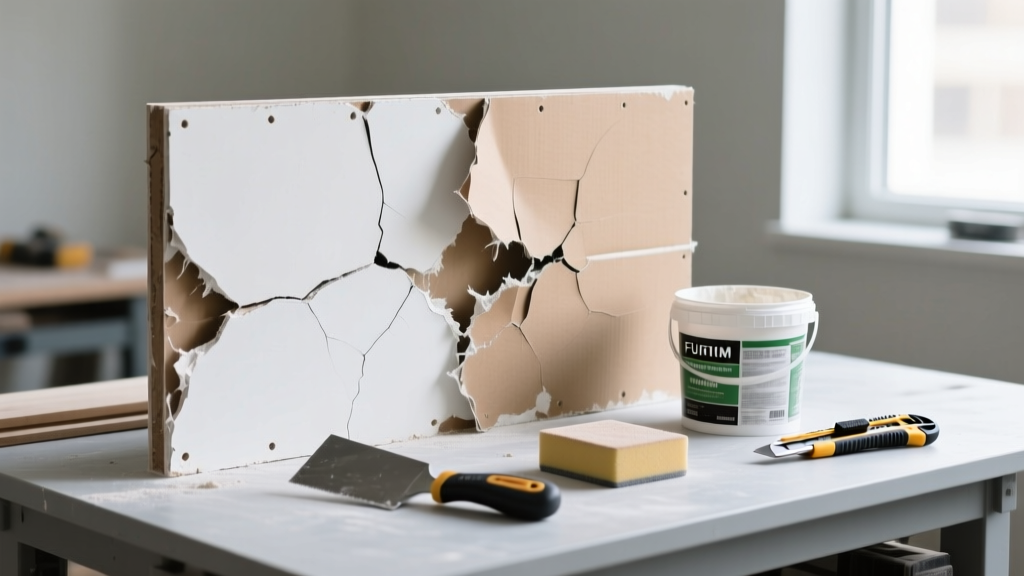
If a panel edge is completely blown out or crushed during installation or demolition: 1. Use a utility knife to cut a clean, straight line back to solid, undamaged gypsum (at least 2 inches past the damage). 2. Cut a matching strip from a scrap piece of drywall. 3. Apply setting-type compound to both the patch and the wall edge. 4. Press the patch into place and embed paper tape over the seam. Paper tape is superior to mesh here because its cellulose fibers bond chemically with the starch in the new paper facer.
FAQ: Composition-Specific Drywall Questions
Why does lightweight drywall sag more than standard drywall?
Lightweight drywall achieves its reduced mass by increasing the volume of foaming agents (surfactants) in the slurry, which creates larger and more numerous microscopic air voids in the core. While this makes the board easier to carry, it reduces the sheer density and structural rigidity of the calcium sulfate matrix, making it more prone to gravity-induced sagging on 24" on-center ceiling joists compared to standard-density board.
Can I use standard joint compound to repair a hole in cement board?
No. Cement board (like Durock or HardieBacker) lacks the paper facer and starch binder of gypsum board. Standard drying-type joint compound will not adhere properly and will crack due to the differing thermal expansion rates and moisture absorption properties. Use a polymer-modified thin-set mortar and alkali-resistant mesh tape for cement board repairs.
Does the age of the drywall affect how it takes a patch?
Yes. Over decades, the paper facer on older drywall becomes brittle, and the surface starch degrades. When sanding a repair on a wall installed in the 1970s or 1980s, the paper face may fuzz or tear easily. Always seal older, exposed gypsum cores and paper edges with a PVA primer or oil-based sealer before applying joint compound to prevent the patch from pulling the old paper off the wall.
Written by
Elena RodriguezElena Rodriguez is a civil engineer and technical writer specializing in concrete technology, masonry systems, and ASTM/ACI compliance. She earned her B.S. in Civil Engineering from Texas A&M University and spent a decade at a materials testing laboratory, performing over 2,000 concrete compressive strength tests and masonry prism evaluations. Elena is an ACI-certified Field Testing Technician (Grade I) and a member of ASTM Committee C12 on Natural Building Stone. She currently consults on forensic engineering cases involving concrete failures and moisture intrusion. Based in San Antonio, TX, Elena is a proud member of the Society of Women Engineers (SWE) and coaches her daughter's FIRST Robotics team.
More from Elena Rodriguez
View all
Walls & Panels
Cost Analysis: Light Gauge Steel Framing Advantages and Disadvantages
Evaluate light gauge steel framing advantages and disadvantages through a strict cost analysis lens, comparing material, labor, and lifecycle expenses.
Aug 4, 2026

Walls & Panels
Gypsum Board Types: Exact Specifications, Thickness & Dimensions
Compare standard, Type X, and moisture-resistant gypsum board types. Get exact specifications, thicknesses, dimensions, and ASTM standards for your project.
Aug 4, 2026

Fire Resistance
Best Fire-Resistant Outdoor Decking Materials: 2026 Buyer Guide
Discover the best fire-resistant outdoor decking materials for 2026. Compare Class A PVC, aluminum, and hardwood options for WUI compliance and safety.
Aug 4, 2026