5/8 Gypsum Board Weight & Hidden Installation Costs
Analyze how 5/8 gypsum board weight impacts 2026 installation costs, comparing standard vs. lightweight Type X panels, labor rates, and hoisting needs.

The Gravity Tax: Why Panel Weight Dictates Drywall Budgets
When estimators and project managers budget for commercial or high-end residential fire-rated assemblies, the focus typically lands on the material cost per square foot. However, this approach ignores a critical variable that heavily influences the bottom line: the physical mass of the panels. The 5/8 gypsum board weight is not just a logistical nuisance; it is a primary driver of labor fatigue, hoisting requirements, crew sizing, and overall installation speed. In 2026, with skilled drywall hangers commanding premium hourly rates, understanding the true cost implications of panel weight is essential for accurate bidding and margin protection.
Standard 5/8-inch Type X gypsum board is the workhorse of fire-rated construction, mandated by building codes for multi-family residential corridors, commercial stairwells, and garage ceilings. Yet, its density creates a "gravity tax" on every phase of installation. This analysis breaks down the direct and indirect costs associated with 5/8-inch panel weight, comparing traditional heavy-core boards against modern lightweight alternatives, and provides a data-driven framework for 2026 procurement strategies.
Standard vs. Lightweight 5/8" Board: The Raw Data
To understand the cost impact, we must first establish the baseline physics. Over the last decade, manufacturers have introduced lightweight 5/8-inch panels that maintain the same 1-hour fire rating (per ASTM E119) as standard boards but utilize a specialized aerated gypsum core. The weight differential is substantial.
| Product Type | Thickness | Weight per Sq. Ft. | Weight per 4x8 Sheet | Weight per 4x12 Sheet | Avg. Material Cost (2026) |
|---|---|---|---|---|---|
| Standard Type X (e.g., USG Firecode C) | 5/8" | 2.2 lbs | 70.4 lbs | 105.6 lbs | $14.50 - $18.00 |
| Lightweight Type X (e.g., USG Ultralight Firecode C) | 5/8" | 1.6 lbs | 51.2 lbs | 76.8 lbs | $16.50 - $21.00 |
| Standard Regular (Non-Fire-Rated) | 5/8" | 2.1 lbs | 67.2 lbs | 100.8 lbs | $13.00 - $16.00 |
At first glance, the lightweight 5/8-inch board carries a 12% to 18% material premium. However, evaluating the total installed cost requires looking past the lumberyard receipt and into the labor dynamics on the job site.
Labor Inefficiencies Driven by the 51-Pound Threshold
The most critical data point regarding the 5/8 gypsum board weight is how it interacts with human ergonomic limits. According to the National Institute for Occupational Safety and Health (NIOSH), the Recommended Weight Limit (RWL) for optimal, repetitive lifting under ideal conditions is 51 pounds.
The Crew Sizing and Hang-Rate Multiplier
While a 4x8 lightweight sheet (51.2 lbs) still generally requires two people for ceiling applications, the reduced mass allows for significantly faster maneuvering, easier scoring/snapping, and less physical strain when holding the board against studs. On wall applications, a highly skilled hanger can occasionally maneuver a 51 lb sheet solo in tight corridors, whereas a 70 lb sheet is physically impossible to control alone without risking edge damage or personal injury.
Industry time-motion studies indicate that crews hanging lightweight 5/8-inch board on complex commercial layouts (requiring extensive cutting around HVAC ducts and conduit) achieve a 15% to 22% faster installation rate compared to standard heavy-core boards. In 2026, with commercial drywall hanger labor rates averaging $65 to $85 per hour (fully burdened), a 20% increase in productivity easily eclipses the $3.00 per-sheet material premium.
Equipment, Hoisting, and Framing Overheads
The physical mass of the panels cascades into secondary cost centers that estimators frequently overlook.
1. Drywall Lifts and Hoisting
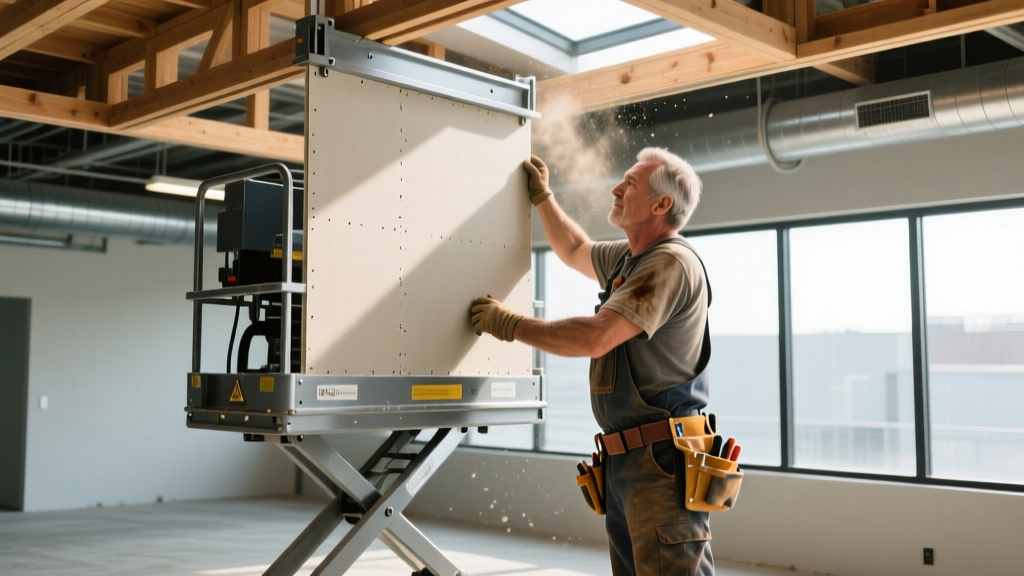
For ceiling installations, standard 5/8-inch board practically mandates the use of mechanical drywall lifts or heavy-duty T-braces. Renting a commercial-grade drywall lift costs between $45 and $75 per day in 2026. While lightweight boards also benefit from lifts, their reduced weight allows crews to utilize manual T-bracing techniques more effectively on smaller residential or tenant-improvement jobs, potentially eliminating equipment rental fees entirely.
Furthermore, in high-rise construction, the cumulative weight of 5/8-inch board impacts material hoisting. Freight elevators have strict weight capacities. A pallet of standard 5/8" 4x12 sheets weighs roughly 2,400 lbs. Switching to lightweight panels reduces pallet weight to approximately 1,750 lbs, allowing material handlers to move more square footage per elevator trip, reducing costly crane or hoist idle time.
2. Framing and Fastener Schedules
One of the primary structural advantages of 5/8-inch gypsum board is its superior sag resistance, which allows ceiling joists or furring channels to be spaced at 24 inches on-center (O.C.), compared to the 16 inches O.C. required for 1/2-inch board. The Gypsum Association confirms that both standard and lightweight 5/8-inch panels support 24-inch O.C. framing. However, the dead load placed on the framing structure is significantly lower with lightweight panels. While this rarely changes the cost of standard wood or steel stud framing, it can reduce the need for supplementary bridging or heavy-gauge steel track in specialized suspended ceiling grids.
2026 Total Installed Cost Matrix (Per 1,000 Sq. Ft.)
The following matrix models a 1,000 square foot commercial ceiling installation requiring a 1-hour fire rating. It assumes a union or high-tier non-union labor market in 2026, factoring in material, hanging labor, finishing labor, and equipment.
| Cost Category | Standard 5/8" Type X | Lightweight 5/8" Type X | Variance |
|---|---|---|---|
| Material (Panels + Fasteners) | $580 | $690 | +$110 (Material Premium) |
| Labor: Hanging (1,000 sq ft) | $1,250 | $1,020 | -$230 (18% Faster) |
| Labor: Taping & Finishing | $1,400 | $1,400 | $0 (No Change) |
| Equipment (Lifts / Scaffolding) | $150 | $150 | $0 (Assumed equal) |
| Waste Disposal (Dumpster Fees) | $85 | $60 | -$25 (Lighter scrap) |
| Total Installed Cost | $3,465 | $3,320 | -$145 (Net Savings) |
Note: Finishing labor remains constant because both panels feature identical tapered edge profiles and require the same three-coat finishing system. However, lightweight panels often yield cleaner cuts and snaps, marginally reducing edge-blowout repairs during the taping phase.
Strategic Sourcing: When to Pay the Lightweight Premium
Procuring the correct panel is about matching the job site constraints to the material properties. Use the following decision framework to determine when the 5/8 gypsum board weight justifies the lightweight premium.
- Mandate Lightweight When: The project involves multi-story walk-ups without freight elevators, complex ceiling grids requiring extensive cutting, or tight corridors where maneuvering a 70 lb sheet risks damaging adjacent finished surfaces.
- Stick to Standard Type X When: The project is a ground-level warehouse or big-box retail space with wide-open floor plans, where crews can utilize mechanical lifts for 100% of the ceiling work and forklifts for material staging. In these environments, the ergonomic penalty is minimized, and the material savings of standard board directly improve margins.
- Consider Sound-Damping Alternatives: If the 5/8-inch specification is driven by acoustic (STC) requirements rather than fire ratings, evaluate specialized sound-damping panels. While heavier, they eliminate the need for resilient channels or double-layering, fundamentally altering the labor cost equation.
Ultimately, treating drywall purely as a commodity material is a margin-killing mistake in modern construction. By quantifying the true impact of the 5/8 gypsum board weight on labor velocity and site logistics, project managers can leverage lightweight technologies to deliver faster, safer, and more profitable fire-rated assemblies.
Written by
Elena RodriguezElena Rodriguez is a civil engineer and technical writer specializing in concrete technology, masonry systems, and ASTM/ACI compliance. She earned her B.S. in Civil Engineering from Texas A&M University and spent a decade at a materials testing laboratory, performing over 2,000 concrete compressive strength tests and masonry prism evaluations. Elena is an ACI-certified Field Testing Technician (Grade I) and a member of ASTM Committee C12 on Natural Building Stone. She currently consults on forensic engineering cases involving concrete failures and moisture intrusion. Based in San Antonio, TX, Elena is a proud member of the Society of Women Engineers (SWE) and coaches her daughter's FIRST Robotics team.
More from Elena Rodriguez
View all
Walls & Panels
Cost Analysis: Light Gauge Steel Framing Advantages and Disadvantages
Evaluate light gauge steel framing advantages and disadvantages through a strict cost analysis lens, comparing material, labor, and lifecycle expenses.
Aug 4, 2026

Walls & Panels
Gypsum Board Types: Exact Specifications, Thickness & Dimensions
Compare standard, Type X, and moisture-resistant gypsum board types. Get exact specifications, thicknesses, dimensions, and ASTM standards for your project.
Aug 4, 2026

Fire Resistance
Best Fire-Resistant Outdoor Decking Materials: 2026 Buyer Guide
Discover the best fire-resistant outdoor decking materials for 2026. Compare Class A PVC, aluminum, and hardwood options for WUI compliance and safety.
Aug 4, 2026