Best Drywall with Soundproofing: Top Brand Lines Compared
Compare top drywall with soundproofing brands like QuietRock, SilentFX, and SoundBreak XP. Discover STC ratings, costs, and installation tips.
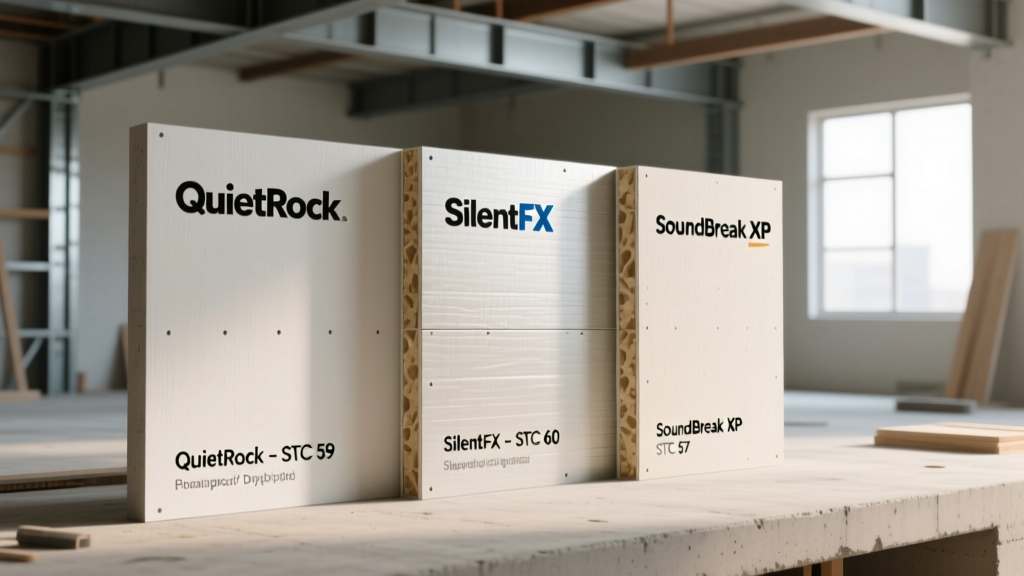
The Physics of Acoustic Gypsum: Why Standard Board Fails
When architects and builders need to mitigate airborne noise, simply adding more layers of standard 1/2-inch gypsum board yields diminishing returns. Standard drywall relies entirely on mass to block sound. While adding a second or third layer of standard board increases mass, it also introduces coincidence effect vulnerabilities at specific frequencies. Modern drywall with soundproofing solves this through Constrained Layer Damping (CLD). By sandwiching a viscoelastic polymer core between two layers of gypsum, these specialized panels convert acoustic energy into trace amounts of heat, effectively deadening sound transmission across a much broader frequency spectrum than mass alone.
According to testing standards outlined by the Gypsum Association under ASTM E90, a standard 2x4 wood stud wall with a single layer of 1/2-inch drywall on each side yields a Sound Transmission Class (STC) of roughly 33 to 35. Upgrading to specialized acoustic gypsum can push that same assembly to an STC of 50 to 60+ without increasing the wall cavity depth.
QuietRock by PABCO: The Constrained Layer Damping Pioneer
QuietRock revolutionized the acoustic drywall market by bringing CLD technology to commercial and high-end residential applications. As of 2026, their product line remains the benchmark for acoustic performance, though it comes with specific installation nuances.
QuietRock 510 vs. 525 vs. 530
- QuietRock 510 (1/2-inch): The entry-level acoustic panel. Weighs 1.9 lbs/sq ft. Delivers an STC of 50-54 on a standard single-stud wall. Ideal for interior bedroom demising walls where space is at a premium.
- QuietRock 525 (5/8-inch): The workhorse for multi-family residential and commercial. Weighs 2.3 lbs/sq ft. Achieves an STC of 54-60. Features a thicker polymer core for superior low-frequency damping (crucial for blocking bass from home theaters or mechanical rooms).
- QuietRock 530 (5/8-inch): Engineered specifically for exterior shear walls and high-impact areas. It combines acoustic damping with structural shear ratings, eliminating the need for a separate plywood shear layer behind the drywall.
CertainTeed SilentFX QuickCut: The Labor-Saver
CertainTeed entered the acoustic market with a direct response to the primary complaint about early CLD boards: they were notoriously difficult to cut. CertainTeed's SilentFX QuickCut integrates a proprietary gypsum-polymer-gypsum sandwich that explicitly allows for traditional score-and-snap installation.
SilentFX QuickCut is a 5/8-inch panel weighing approximately 2.2 lbs/sq ft. It delivers an STC of 52-56 on standard wood stud assemblies. The primary advantage here is labor cost. On a large-scale multi-family project, the hours saved by not having to double-score or use specialized saws for every cutout can offset the premium material cost of the board itself. Furthermore, SilentFX features a tapered edge that accepts standard joint compound, ensuring the finished wall looks identical to standard drywall without the ridging sometimes seen with acoustic sealants.
National Gypsum SoundBreak XP: Moisture and Acoustic Defense
Standard acoustic drywall has a critical weakness: the polymer core and standard gypsum facers are highly susceptible to moisture degradation. National Gypsum solved this with the SoundBreak XP line, which marries CLD technology with their purple XP (mold and moisture resistant) core.
SoundBreak XP is the undisputed choice for demising walls that separate wet areas—such as back-to-back bathrooms in apartment complexes or hotel corridors. The 5/8-inch panel features a moisture-resistant core, a polymer damping layer, and a moisture/mold-resistant facing paper. It achieves an STC of 50-55. While it carries a 10-15% price premium over standard acoustic boards, it eliminates the need to layer a separate moisture-resistant board over an acoustic panel in wet-zone partitions.
Head-to-Head Specification Matrix
| Brand / Model | Thickness | Weight (lbs/sq ft) | STC Range (Single Stud) | Avg Cost (4x8 Sheet) | Cut Method |
|---|---|---|---|---|---|
| QuietRock 510 | 1/2" | 1.9 | 50 - 54 | $45 - $55 | Score/Snap or Saw |
| QuietRock 525 | 5/8" | 2.3 | 54 - 60 | $55 - $65 | Score Both Sides / Saw |
| SilentFX QuickCut | 5/8" | 2.2 | 52 - 56 | $45 - $55 | Standard Score/Snap |
| SoundBreak XP | 5/8" | 2.4 | 50 - 55 | $55 - $70 | Score/Snap or Saw |
Note: Pricing reflects early 2026 national averages for single-sheet retail. Contractor bulk pricing will be 15-25% lower.
Flanking Paths: How Installation Errors Destroy STC Ratings
The most expensive drywall with soundproofing will perform no better than standard board if the installation ignores flanking paths. Sound behaves like water; it will find the weakest point in the assembly and bypass the acoustic panel entirely.
- Acoustic Sealant is Non-Negotiable: You must run a continuous bead of ASTM C920 compliant acoustic sealant (like OSI SC-175 or Tremco Acoustical Sound Sealant) at the floor track, ceiling track, and all intersecting walls. Standard joint compound cracks and transmits sound.
- Decouple the Tracks: Use a slip track or resilient channel at the ceiling. If the drywall is rigidly screwed into the ceiling joists, impact noise from the floor above will travel down the drywall surface.
- HVAC Boot Isolation: Where supply registers penetrate the acoustic wall, wrap the sheet metal boot in closed-cell foam tape or use a flexible canvas duct connector to prevent the metal from vibrating against the gypsum.
Cost-Benefit Decision Framework for 2026 Projects
When designing an acoustic assembly, builders generally choose between pre-damped acoustic drywall (the products above) or standard drywall layered with a viscoelastic compound like Green Glue. Here is how to decide:
- Choose Pre-Damped Acoustic Drywall When: Labor rates in your area are high (over $65/hour), the project schedule is compressed, or you are working in occupied spaces where the curing time and mess of liquid damping compounds are unacceptable. Pre-damped boards offer immediate, predictable STC results the moment they are hung.
- Choose Standard Board + Liquid Damping When: Material budgets are strictly capped, you require extreme low-frequency isolation (home theaters or recording studios where 3+ layers of 5/8-inch board are required), or you are dealing with highly irregular wall surfaces where the flexibility of applying liquid compound between custom-cut standard sheets is advantageous.
Ultimately, selecting the right drywall with soundproofing requires matching the specific acoustic threat (speech vs. mechanical bass), the environmental conditions (moisture exposure), and the labor realities of your job site. By leveraging the specific strengths of QuietRock, SilentFX, or SoundBreak XP, you can guarantee acoustic privacy without over-engineering the wall cavity.