1-Hour 5/8 Type X Gypsum Board Fire Rating: Selection Guide
Master the 5/8 Type X gypsum board fire rating. Learn assembly specs, UL design requirements, product models, and installation rules for 1-hour walls.

The Chemistry and Code Behind the 1-Hour Rating
Achieving a compliant 1-hour fire partition under the International Building Code (IBC) Section 703 relies heavily on the specific use of 5/8-inch Type X gypsum board. Unlike standard 1/2-inch drywall, which typically yields a 15-to-30-minute rating, 5/8-inch Type X is engineered to withstand standard fire exposure (ASTM E119) for a minimum of 60 minutes. The secret lies in the core composition and the endothermic reaction known as calcination.
Gypsum (calcium sulfate dihydrate) contains approximately 21% chemically bound water by weight. When exposed to fire, the core temperature rises to 212°F (100°C), and this water converts to steam. This phase change absorbs massive amounts of thermal energy, keeping the unexposed side of the wall below combustible thresholds. However, once the water is driven off, the remaining calcined gypsum becomes brittle. This is where the Type X designation becomes critical: the core is reinforced with a minimum of 15% glass fibers by weight. These fibers act as a structural matrix, holding the calcined core together so it remains anchored to the framing and continues to act as a thermal barrier even after the water is gone.
Decoding UL Assemblies: The System Dictates the Rating
A common and costly mistake in commercial construction is assuming the fire rating belongs to the board itself. The 5/8 Type X gypsum board fire rating actually belongs to the entire tested assembly. Deviating from the tested Underwriters Laboratories (UL) or Gypsum Association (GA) design voids the rating and will fail inspection. Below are the baseline parameters for standard 1-hour and 2-hour metal-stud wall assemblies.
| Assembly Rating | Board Layers (Per Side) | Stud Framing | Fastener Type & Spacing | Joint Treatment Requirement |
|---|---|---|---|---|
| 1-Hour | 1x 5/8" Type X | 2-1/2" or 3-5/8" 25ga Steel (16" or 24" OC) | 1-1/4" Type S screws; 8" OC ceiling, 12" OC walls | Paper tape + Setting-type compound (Base coat) |
| 2-Hour | 2x 5/8" Type X | 3-5/8" or 4" 20ga Steel (16" or 24" OC) | Base: 1-1/4" Type S (24" OC); Face: 1-5/8" Type S (12" OC) | Paper tape + Setting-type compound; Face joints offset 10" min |
The Fastener Imperative
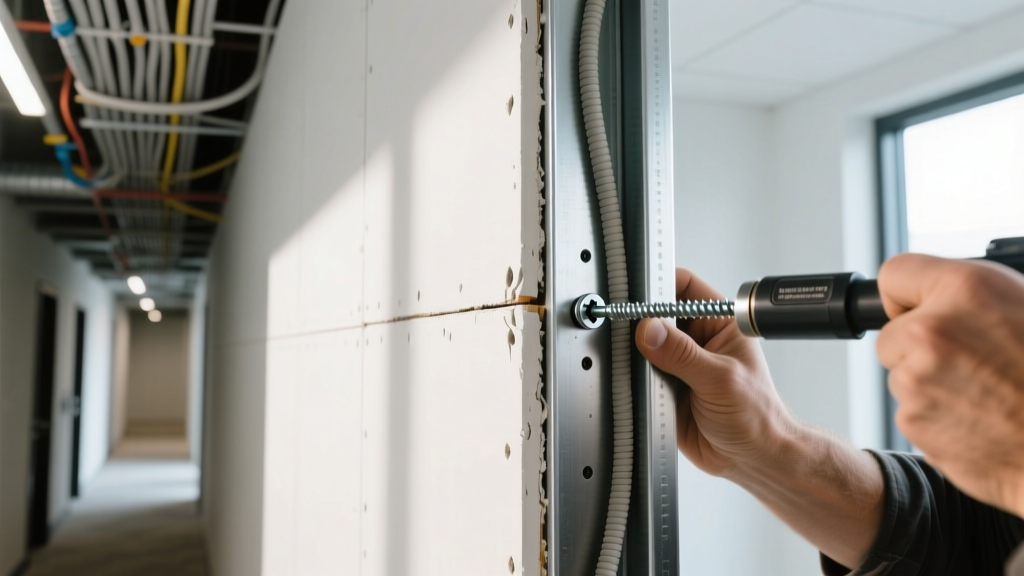
For steel framing, you must use Type S (fine-thread) drywall screws. The screw must penetrate the steel stud by a minimum of 3/8-inch. If you are attaching 5/8-inch Type X to wood framing, Type W (coarse-thread) screws are required, with a minimum 5/8-inch wood penetration. Over-driving the screw—breaking the paper face of the gypsum—destroys the holding power of the glass-fiber matrix and is an immediate failure point in a fire event.
2026 Product Landscape: Top Type X Models
While the ASTM C1396 standard governs the baseline performance of Type X, manufacturers differentiate their products through core density, edge profiling, and moisture treatments. Here is a breakdown of the primary 5/8-inch Type X options available for commercial selection.
USG Sheetrock Firecode C & Standard Firecode
USG’s standard Firecode (often labeled simply as Firecode X) is the industry baseline for 1-hour and 2-hour assemblies. However, for ceiling applications or shaft walls where board sag and core shrinkage are concerns, USG Firecode C is required. Firecode C contains a higher concentration of glass fibers and vermiculite, which compensates for the natural shrinkage of calcined gypsum under extreme heat. Expect to pay between $19.50 and $24.00 per 4x8 sheet for standard Firecode, and a 15-20% premium for Firecode C in 2026.
Georgia-Pacific ToughRock Fireguard
GP’s Fireguard line is favored for its high-density core, which offers superior impact resistance in high-traffic commercial corridors (like hospitals and schools) without sacrificing the 1-hour UL rating. It features a tightly bonded face paper that resists tearing during scoring and snapping. Pricing typically ranges from $18.00 to $22.50 per 4x8 sheet.
CertainTeed Firestop
CertainTeed offers a robust Type X board with a tapered edge profile that is slightly deeper than competitors, allowing for a wider bed of joint compound and a flatter finish on long commercial hallways. It is highly compatible with standard pre-mixed topping compounds for the final coat, though the base coat in rated assemblies must still be a setting-type material.
Standard pre-mixed all-purpose joint compound (drying-type) contains vinyl binders that melt and shrink rapidly under high heat. In a tested fire assembly, the first coat over the tape must be a setting-type compound (e.g., USG Durabond 45 or 90, or Sheetrock Easy Sand). Setting compounds undergo a chemical crystallization process that maintains structural integrity at the seams during the calcination phase. Using pre-mixed compound for the taping coat will void the UL assembly rating.
Installation Tolerances and Penetration Management
The most frequent cause of fire-rating failure during municipal inspections involves improper handling of wall penetrations. The integrity of the 5/8 Type X gypsum board fire rating relies on an unbroken thermal barrier.
- Electrical Box Cutouts: The gap between the gypsum board and the electrical box must not exceed 1/8-inch. If the cutout is too large, the fire and superheated gases will bypass the board and enter the wall cavity, igniting the studs from the inside.
- Back-to-Back Boxes: If electrical boxes are installed on opposite sides of the same stud cavity, they must be separated horizontally by at least 24 inches. If this spacing cannot be met, both boxes must be wrapped in intumescent fire putty pads to restore the thermal barrier.
- Pipe and Duct Penetrations: Any plumbing or HVAC penetration through a rated Type X wall requires an approved through-penetration firestop system (e.g., 3M Fire Barrier Sealant CP 25WB+). Standard acrylic caulk or expanding polyurethane foam will melt and combust, creating a chimney effect.
Type X vs. Type C: When to Upgrade
While 5/8-inch Type X is the workhorse for 1-hour partitions, it has limitations in multi-layer or ceiling assemblies. Type C gypsum board is an enhanced version of Type X. It contains significantly more glass fibers and includes vermiculite—an expanding silicate mineral. When exposed to fire, the vermiculite in Type C expands to fill the voids left by the calcining gypsum, preventing the core from shrinking and pulling away from the fasteners.
When to specify Type C over Type X:
- Unprotected Steel Beam Fireproofing: When wrapping structural steel columns or beams, Type C is mandatory to prevent core shrinkage from exposing the steel.
- Multi-Layer Ceiling Grids: In horizontal assemblies where gravity is working against the fasteners, Type C prevents the board from sagging and detaching during a fire.
- 3-Hour and 4-Hour Assemblies: Achieving ratings beyond 2 hours almost exclusively requires Type C boards in specific UL designs.
Frequently Asked Technical Questions
Can I use 1/2-inch Type X to achieve a 1-hour rating?
Generally, no. While a few highly specific, proprietary UL designs utilize multiple layers of 1/2-inch Type X or specialized lightweight 1/2-inch products to achieve 60 minutes, the standard, universally accepted commercial assembly for a 1-hour rating requires a single layer of 5/8-inch Type X on each side of the stud. Always verify the exact UL design number before substituting thickness.
Does the paint finish affect the fire rating?
Standard architectural latex or epoxy paints do not negatively impact the ASTM E119 fire rating of the assembly. However, if you are applying intumescent fire-retardant paint to the surface, you must ensure it is compatible with the gypsum face paper and applied at the exact mil-thickness specified by the coating manufacturer to achieve any supplementary surface-burning characteristics (ASTM E84).
How should 5/8-inch Type X be stored on a wet job site?
Type X board is highly susceptible to moisture degradation before installation. If the core absorbs ambient moisture, the chemically bound water equilibrium is disrupted, and the board can sag or lose its structural cohesion. Store boards flat, elevated off the concrete slab on 4x4 dunnage, and fully enclosed in heavy-duty polyethylene sheeting until the building envelope is completely weather-tight.
Written by
Priya KapoorPriya Kapoor is a real estate market analyst and construction economics researcher with expertise in housing affordability, development feasibility, and infrastructure investment. She holds a Master of Regional Planning from Cornell University and previously worked as a senior analyst at CBRE's Investment Properties group, where she modeled returns for $4B in mixed-use development pipelines. Priya now runs an independent research practice advising developers, municipalities, and REITs on construction cost forecasting and market timing. She publishes the quarterly "BuildMat Market Pulse" report tracking material price indices across 12 commodity categories. Based in Austin, TX, Priya serves on the board of Habitat for Humanity Austin and is a marathon runner.
More from Priya Kapoor
View all
Construction Cost
Cost to Build a 1600 Sq Ft Home in 2026: Full Breakdown
Accurate 2026 cost to build a 1600 sq ft home—material, labor, and regional pricing breakdowns included. Plan your budget with real-time estimates.
Aug 11, 2026

Wood & Lumber
Name the Types of Wood for Pressure Treatment and Preservation
Learn how to name the types of wood best suited for pressure treatment. Compare species treatability, chemical retention levels, and 2026 preservation costs.
Aug 4, 2026

Stone & Masonry
Stone Veneer Suppliers Lindenhurst: 2026 Cost Analysis
Analyze 2026 stone veneer costs in Lindenhurst, NY. Compare local supplier pricing, delivery fees, and Suffolk County installation labor rates.
Aug 4, 2026