Veneer Plaster Walls: 2026 Gypsum Base Cost Calculator
Calculate 2026 costs for veneer plaster walls over gypsum base. Get exact material quantities, blue board pricing, and labor estimates per square foot.
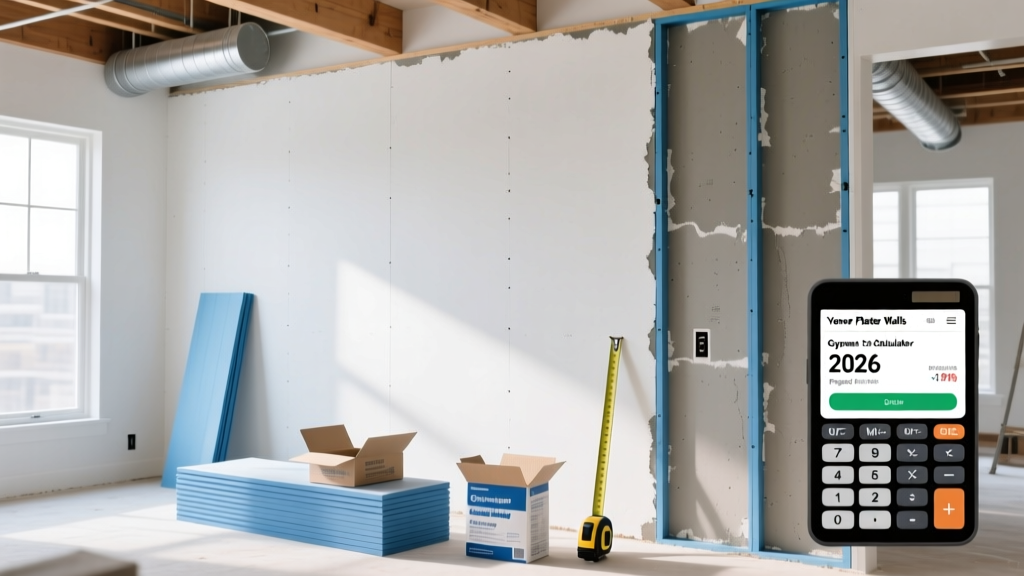
The Economics of Veneer Plaster vs. Level 5 Drywall
Veneer plaster walls represent the premium intersection of drywall installation speed and traditional plaster durability. Unlike standard drywall finishing, which relies on layers of joint compound and paper tape, a veneer plaster system utilizes a specialized moisture-resistant gypsum base (commonly referred to as 'blue board') topped with a thin, 1/16-inch to 1/8-inch coat of hard gypsum plaster. For homeowners and contractors evaluating high-end interior finishes in 2026, understanding the precise cost and material requirements of this system is critical.
While a Level 5 drywall finish provides a smooth, skim-coated surface, it remains fundamentally vulnerable to dents, abrasion, and fastener pops. Veneer plaster, by contrast, cures into a monolithic, rock-hard surface that significantly improves acoustic damping and impact resistance. However, this performance upgrade comes with a distinct cost premium, primarily driven by specialized labor and specific gypsum base materials. According to industry guidelines from the Gypsum Association, applying veneer plaster over standard white-faced drywall is a catastrophic failure point; the high moisture content of wet plaster will cause standard drywall paper to blister and delaminate. Therefore, accurate estimation must always begin with specialized plaster base boards.
Material Quantity Calculator: Gypsum Base & Plaster
Estimating a veneer plaster system requires calculating two distinct material phases: the gypsum base substrate and the plaster finish coats. Below is the framework for determining exact quantities.
Step 1: Calculating Blue Board (Plaster Base)
Plaster base boards, such as USG Imperial Base or National Gypsum Gold Bond Kal-Kore, feature a specially treated blue face paper designed to absorb moisture uniformly without degrading. These are typically sold in 4x8 ft (32 sq ft) or 4x12 ft (48 sq ft) sheets, with a standard thickness of 1/2-inch or 5/8-inch for fire-rated assemblies.
- Gross Wall Area: Measure the perimeter of the room and multiply by the ceiling height.
- Deduct Openings: Subtract the area of windows and doors only if they exceed 32 square feet individually. Smaller openings are left in the calculation to account for cutting waste.
- Waste Factor: Add 10% for standard rectangular rooms. Add 15% for rooms with complex angles, vaulted ceilings, or numerous small penetrations.
- Sheet Calculation: Divide the total adjusted square footage by 32 (for 4x8 sheets) or 48 (for 4x12 sheets), and always round up to the nearest whole sheet.
Step 2: Veneer Plaster Coverage Rates
Veneer plaster is typically applied in a single-coat or two-coat system. The most common products, detailed in USG's plaster specifications, include Imperial Veneer Finish (for a smooth, troweled look) and Diamond Veneer Finish (for a slightly textured, sand-float appearance). Coverage rates vary based on the application thickness and the specific product.
| Product Type | Standard Bag Weight | Application Thickness | Estimated Coverage per Bag |
|---|---|---|---|
| Imperial Veneer Finish (Single Coat) | 50 lbs | 1/16 inch | 400 - 450 sq ft |
| Diamond Veneer Finish (Single Coat) | 50 lbs | 1/16 inch | 350 - 400 sq ft |
| Imperial Basecoat (Two-Coat System) | 50 lbs | 1/8 inch (scratch/brown) | 200 - 250 sq ft |
| USG Plaster Weld (Bonding Agent) | 1 Gallon | N/A (Diluted 1:1) | 400 sq ft (undiluted) |
2026 Cost Breakdown: Materials vs. Labor
The financial reality of plaster walls in 2026 is heavily skewed toward labor. While material costs are relatively predictable, the shrinking pool of master plasterers commands a significant premium over standard drywall tapers. Below is the current national average cost matrix for a professional veneer plaster installation over 5/8-inch blue board.
| Cost Component | Low End (per sq ft) | High End (per sq ft) | Notes |
|---|---|---|---|
| Plaster Base Board (5/8") | $0.55 | $0.75 | Includes fasteners and joint tape |
| Veneer Plaster & Accessories | $0.20 | $0.35 | Plaster, corner bead, bonding agent |
| Specialized Plaster Labor | $2.75 | $4.80 | Highly dependent on regional union rates |
| Total Estimated Cost | $3.50 | $5.90 | Compared to Level 5 Drywall: $2.40 - $3.90 |
Do not omit corner beads and control joints from your material takeoff. Veneer plaster requires specific expanded metal or rigid vinyl corner beads designed for plaster thickness, not standard drywall bead. Furthermore, control joints (like the USG No. 0930) are mandatory in ceiling spans exceeding 30 feet or wall spans exceeding 50 feet to prevent structural cracking. Budget an additional $0.10 to $0.15 per square foot for these specialized metal trims.
Step-by-Step Estimation Framework: Real-World Example
To demonstrate how these numbers synthesize into a project bid, let us calculate the veneer plaster costs for a 2,500 square foot custom home with 10-foot ceilings and an open-concept layout.
- Calculate Surface Area: The home has 1,200 linear feet of interior wall space. At 10 feet high, the gross wall area is 12,000 sq ft. Subtracting 1,500 sq ft for large doors and windows leaves 10,500 sq ft of net wall area. Add 2,200 sq ft for flat ceilings. Total net area = 12,700 sq ft.
- Apply Waste Factor: 12,700 sq ft x 1.10 (10% waste) = 13,970 sq ft of total material coverage required.
- Gypsum Base Takeoff: 13,970 / 48 (using 4x12 sheets of Kal-Kore) = 291.04. Order 292 sheets of 5/8-inch plaster base.
- Plaster Takeoff: Using Imperial Veneer Finish (single coat, covering 400 sq ft per 50lb bag). 13,970 / 400 = 34.9. Order 35 bags of finish plaster, plus 10 bags of basecoat for the two-coat system in high-traffic hallways.
- Calculate Total Cost: 13,970 sq ft x $4.50 (mid-range total installed cost) = $62,865 total project cost.
Common Estimation Mistakes & Failure Modes
When estimating and specifying plaster walls, overlooking environmental and substrate variables can lead to massive change orders or catastrophic finish failures. Avoid these critical pitfalls:
- Skipping the Bonding Agent on Existing Surfaces: If the veneer plaster is being applied over an existing painted plaster wall (a remodel scenario), the estimator must include the cost of USG Plaster Weld or an equivalent bonding agent. Without it, the new plaster will not adhere to painted surfaces and will sheer off within months.
- Ignoring Curing Climate Control: Plaster requires specific temperature and humidity conditions to cure properly. If the HVAC system is not operational and temporary heating is required to maintain a minimum of 55°F (13°C) during the 48-hour curing window, temporary heating costs must be factored into the general conditions budget. Rapid drying from excessive heat or open windows causes shrinkage cracking.
- Misjudging Substrate Rigidity: Plaster is brittle. If the framing spacing is 24 inches on center (OC) rather than 16 inches OC, the estimator must upgrade to 5/8-inch blue board or add a layer of 1/4-inch gypsum base as a backer to prevent flexing, which will inevitably crack the plaster finish.
Frequently Asked Questions
Can I use standard drywall joint compound to skim coat over blue board instead of plaster?
No. Blue board is specifically engineered with an absorbent face paper designed to pull moisture from wet gypsum plaster, creating a mechanical and chemical bond. Standard joint compound lacks the structural integrity and chemical compatibility for this substrate, resulting in a weak, easily dented surface that defeats the purpose of buying premium plaster base boards.
How does the weight of veneer plaster affect structural framing requirements?
Veneer plaster adds approximately 1.1 to 1.5 pounds per square foot to the wall assembly. While this is heavier than standard taped drywall (which weighs roughly 0.8 lbs/sq ft for the compound and tape), it is well within the load-bearing capacity of standard 2x4 or 2x6 wood framing and light-gauge steel studs. No structural reinforcement is required solely for the weight of a single-coat veneer system.
Is veneer plaster suitable for high-moisture areas like bathrooms?
Standard veneer plaster is not inherently waterproof. For bathroom applications, estimators should specify a moisture-resistant plaster base (such as National Gypsum's XP series or equivalent green/purple board rated for plaster) and ensure the finish coat is sealed with a high-quality, vapor-permeable acrylic sealer or painted with a specialized bathroom-grade enamel to prevent moisture ingress.