Galvanized Steel Maintenance Playbook: Cleaning and White Rust Fix
Master galvanized steel maintenance with our expert playbook. Learn to clean surfaces, prevent white rust, and restore zinc coatings effectively.
The Chemistry of the Zinc Patina
Galvanized steel relies on a sacrificial zinc coating to protect the underlying carbon steel from corrosion. However, the protective mechanism is not static. When freshly galvanized steel is exposed to the atmosphere, the zinc reacts sequentially with oxygen, moisture, and carbon dioxide to form a dense, stable layer known as the zinc patina (zinc carbonate). This patina is what ultimately slows the corrosion rate to a negligible 1 to 2 microns per year in rural environments.
Maintenance and cleaning protocols must respect this chemical process. Aggressive cleaning during the first six months of exposure can strip the forming zinc carbonate layer, exposing the softer, underlying zinc-iron alloy layers to rapid degradation. Understanding the difference between dirt accumulation, harmless surface oxidation, and destructive wet storage stain (white rust) is the foundation of any galvanized steel maintenance playbook.
Routine Cleaning Protocol for Architectural and Structural Steel
For most exterior architectural cladding and structural framing, environmental dirt and biological growth (algae, mildew) are the primary cleaning targets. The golden rule for washing galvanized steel is to maintain a pH level between 6 and 12.5. Zinc is amphoteric, meaning it dissolves rapidly in both strong acids (pH below 6) and strong alkalis (pH above 12.5).
Step-by-Step Washing Procedure
- Pre-Rinse: Wet the surface with clean water to loosen surface debris and prevent scratching during the wash phase.
- Apply Cleaner: Use a mild, biodegradable detergent (such as a diluted Simple Green All-Purpose Cleaner at a 1:10 ratio with water). Apply using a soft-bristle nylon brush or a microfiber mop. Never use steel wool or stiff wire brushes, which will embed iron particles into the zinc and trigger localized galvanic corrosion.
- Dwell Time: Allow the solution to dwell for 3 to 5 minutes. Do not let the cleaner dry on the surface, as concentrated alkaline residues can etch the zinc.
- Rinse Thoroughly: Rinse with fresh water. If using a pressure washer, keep the nozzle at least 18 inches from the surface and restrict the pressure to a maximum of 1,500 PSI. Pressures exceeding 2,000 PSI can mechanically strip the pure zinc eta layer.
Diagnosing and Treating White Rust (Wet Storage Stain)
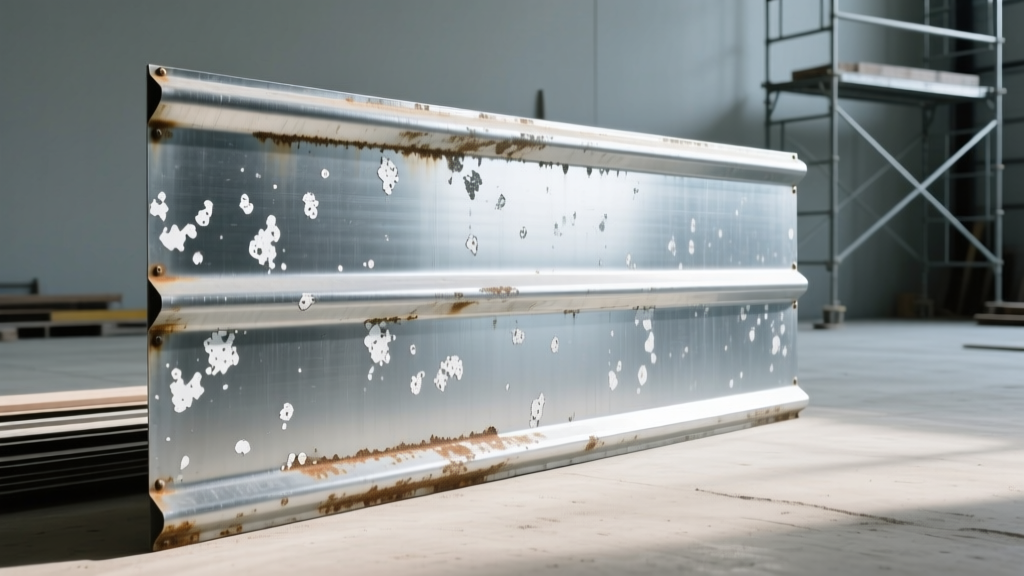
White rust is the most common maintenance issue encountered with galvanized steel. It manifests as a chalky, white, powdery deposit on the surface. According to the American Galvanizers Association, white rust (zinc hydroxide) forms when zinc is exposed to continuous moisture in environments with poor airflow, preventing the formation of the stable zinc carbonate patina. This frequently occurs when galvanized beams or panels are stacked tightly together during transport or stored on-site under tarps without ventilation.
While white rust looks alarming, it is often superficial. However, if left untreated in continuously wet conditions, it can consume the zinc layer at a rate up to 100 times faster than normal atmospheric corrosion.
White Rust Severity and Treatment Matrix
| Severity Level | Visual Indicators | Zinc Loss Estimate | Prescribed Treatment Protocol |
|---|---|---|---|
| Light | Faint white powdery film; easily wiped away with a thumb. | < 5% of coating | Scrub with a stiff nylon brush and water. Allow to dry completely in open air to promote natural patina formation. |
| Moderate | Noticeable white crust; surface feels rough; underlying zinc is visible but intact. | 5% - 20% of coating | Brush mechanically. Apply a passivating solution (e.g., 0.5% copper sulfate or 5% acetic acid) for 30 seconds, then rinse thoroughly. |
| Severe | Thick, crusty white deposits; dark spots indicating bare steel exposure; measurable pitting. | > 20% of coating | Remove all white rust via wire brushing or abrasive blasting to bright zinc/steel. Apply a zinc-rich paint (e.g., ZRC Cold Galvanizing Compound) to restore sacrificial protection. |
Mechanical vs. Chemical Restoration of Compromised Coatings
When maintenance inspections reveal that the zinc coating has been mechanically damaged (e.g., from forklift impacts, welding, or severe abrasion) or consumed by severe white rust, the exposed carbon steel must be re-protected immediately to prevent red rust from undercutting the adjacent galvanized coating.
The Steel Construction Institute recommends using high-zinc-dust-content paints for touch-ups. These are not standard rust-inhibitive primers; they must contain a minimum of 90% zinc dust in the dry film to provide galvanic (sacrificial) protection rather than just barrier protection.
- Surface Prep: Remove all red rust and white corrosion products using a wire wheel or abrasive blasting (SSPC-SP 11 standard). Feather the edges of the surrounding intact zinc coating.
- Product Selection: Use an organic zinc-rich compound like ZRC Cold Galvanizing Compound or Rust-Oleum Professional Cold Galvanizing Compound. These products meet ASTM A780 standards for repairing damaged galvanizing.
- Application Metrics: Apply via brush or aerosol to achieve a dry film thickness (DFT) equal to or slightly greater than the surrounding original galvanized coating (typically 2.0 to 4.0 mils). Allow 24 hours of curing time before exposing the repair to moisture.
Inspection Metrics: Measuring Zinc Thickness
Proactive maintenance requires verifying that the zinc coating retains adequate thickness. Structural steel galvanized to ASTM A123 standards requires specific minimum coating thicknesses based on the steel's category and thickness. For example, structural members thicker than 1/2 inch require a minimum zinc coating of 3.9 mils (100 microns).
Maintenance teams should utilize a magnetic pull-off gauge (such as an Elcometer 121) or an electronic magnetic induction gauge (like a PosiTector 6000) to measure the coating thickness annually in high-wear zones. If readings drop below 1.5 mils in critical load-bearing connections or splash zones, schedule a localized zinc-rich paint overhaul before structural integrity is threatened by section loss.
Frequently Asked Maintenance Questions
Can I paint over galvanized steel without a primer?
No. Freshly galvanized steel has a chemically active surface that will reject standard alkyd or oil-based paints, leading to peeling and flaking (a process called saponification). If painting is required for aesthetic or additional corrosion protection, you must first apply a specialized galvanized metal primer, such as a zinc-phosphate or acrylic-based primer, or use a direct-to-metal (DTM) acrylic latex formulated specifically for galvanized surfaces.
Is it safe to use de-icing salts near galvanized steel framing?
Chloride-based de-icing salts (sodium chloride, calcium chloride) are highly aggressive to zinc. While the zinc carbonate patina offers some resistance, continuous splash zones from salted roadways or pedestrian walkways will accelerate zinc consumption. In these environments, specify a duplex system (galvanizing plus a protective powder coat or paint layer) during the design phase, or implement a strict weekly freshwater rinse schedule during winter months.
How do I remove weld slag from galvanized connections?
Welding on galvanized steel burns off the zinc coating and leaves a layer of zinc oxide slag and spatter. This slag must be removed via mechanical chipping and wire brushing. Once bare steel is exposed, the area must be touched up using an ASTM A780-compliant zinc-rich paint, applying it to a thickness 50% greater than the original surrounding coating to account for the lower efficiency of paint versus hot-dip galvanizing.