Steel Stud Standard Sizes: Durability and Lifespan Analysis
Analyze how steel stud standard sizes and gauges affect structural durability, deflection limits, and the long-term lifespan of metal framing.
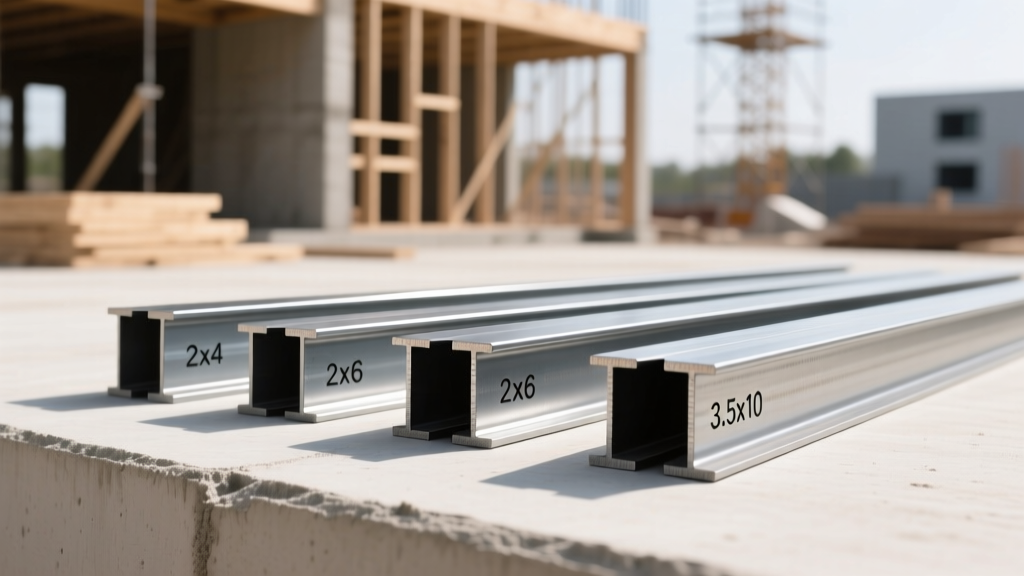
The Intersection of Dimension and Longevity
When evaluating cold-formed steel (CFS) framing, contractors often focus solely on load-bearing capacity and immediate material costs. However, the true lifecycle value of a wall assembly depends on matching steel stud standard sizes and mil thicknesses to the specific environmental and dynamic demands of the build. A framing system that meets day-one structural codes can still suffer premature functional failure—manifesting as drywall fastener pop, acoustic degradation, or localized corrosion—if the physical dimensions of the stud are mismatched to the long-term deflection and moisture profile of the structure.
According to lifespan data published by the National Association of Home Builders (NAHB), steel framing is expected to last 100 years or more. But achieving that century-long benchmark requires a rigorous understanding of how web depth, flange width, and gauge thickness interact over decades of thermal cycling, vibration, and humidity exposure.
Decoding the Nomenclature: Sizes, Flanges, and Mils
To analyze durability, we must first standardize the terminology. The American Iron and Steel Institute (AISI) and the Steel Framing Industry Association (SFIA) utilize a specific alphanumeric designation to define steel stud standard sizes. A designation like 600S162-54 breaks down as follows:
- 600: Web depth in 1/100ths of an inch (6.00 inches).
- S: Stud (indicates the member type, as opposed to 'T' for track).
- 162: Flange width in 1/100ths of an inch (1.62 inches).
- 54: Minimum uncoated steel thickness in mils (0.054 inches, roughly 16 gauge).
Standard Web Depths and Durability Profiles
| Designation Prefix | Actual Web Depth | Typical Flange Width | Primary Durability Application |
|---|---|---|---|
| 250S | 2.50' | 1.25' | Non-load-bearing soffits, low-abuse partitions. Prone to denting. |
| 350S / 400S | 3.50' / 4.00' | 1.25' / 1.62' | Standard interior partitions. High functional lifespan in stable climates. |
| 600S | 6.00' | 1.62' | Load-bearing exterior walls. Excellent resistance to shear and axial fatigue. |
| 800S / 1000S | 8.00' / 10.00' | 1.62' / 2.00' | High-load commercial shafts and parapets. Requires strict moisture management. |
| 1200S | 12.00' | 2.00' / 2.50' | Heavy structural framing. Highest lifespan but vulnerable to deep-cavity condensation. |
The Durability Matrix: How Size and Gauge Dictate Lifespan
The physical lifespan of the steel itself is virtually infinite if kept dry. The functional lifespan of the wall assembly, however, is dictated by deflection limits and vibration fatigue. This is where steel stud standard sizes and mil thicknesses must be evaluated together.
Deflection and Long-Term Structural Sag
Interior partitions are typically designed to an L/240 deflection limit (meaning the stud can bend 1 inch for every 240 inches of height). If a builder uses a 350S162-33 (20 gauge) stud for a 12-foot-tall partition to save costs, the stud will easily meet the static load code. However, under dynamic loads—such as doors slamming or heavy foot traffic on upper floors—the thinner 33-mil web will micro-deflect. Over 15 to 20 years, this repetitive flexing breaks the gypsum-to-steel friction bond, causing drywall screws to back out and seams to crack. The steel hasn't failed, but the wall assembly requires premature renovation.
Vibration and Fatigue Failure Modes
In commercial applications near elevators, HVAC mechanical rooms, or busy roadways, acoustic vibration transfers through the framing. Standard 250S and 350S sizes with 33-mil thicknesses lack the mass and geometric stiffness to dampen low-frequency vibrations. Over a 30-year lifecycle, this constant resonance can cause screw fatigue at the track connections. For high-vibration zones, upgrading to a minimum 600S web depth with a 54-mil (16 gauge) thickness provides the necessary dampening mass, effectively extending the maintenance-free lifespan of the partition by decades.
Galvanization, Moisture Trapping, and Size-Specific Corrosion
While steel does not rot, warp, or harbor termites, it is highly susceptible to oxidation. The standard protective coating for interior steel stud standard sizes is G60 (0.60 ounces of zinc per square foot). For exterior or high-moisture applications, G90 is mandated. However, the geometry of the stud size directly influences how moisture behaves within the wall cavity.
The Deep-Web Condensation Trap
When utilizing deeper steel stud standard sizes like the 1000S or 1200S for exterior load-bearing walls, the massive 10-inch or 12-inch cavity creates a unique micro-climate. In unconditioned or poorly insulated zones, warm interior air can migrate into the deep cavity and hit the cold exterior sheathing, condensing into liquid water.
Unlike a shallow 350S cavity where moisture might quickly evaporate back into the room, the deep, narrow channels of a 1200S stud can trap pooled condensation at the bottom track interface. Even with a G90 coating, chronic standing water will eventually breach the zinc layer, leading to localized galvanic corrosion. To ensure a 100-year lifespan when using deep-web studs, builders must detail the bottom track with weep holes, apply a fluid-applied flashing membrane to the track-to-concrete joint, and utilize high-density closed-cell spray foam to eliminate the convective air loop entirely.
Lifecycle Cost and Replacement Timelines
Selecting the correct steel stud standard sizes minimizes lifecycle costs by eliminating premature assembly failures. Below is a projected functional lifespan matrix based on sizing, gauge, and environmental exposure:
| Stud Size & Gauge | Application | Environment | Projected Functional Lifespan |
|---|---|---|---|
| 250S162-33 | Soffits / Furring | Conditioned Interior | 40-60 Years (Prone to physical denting) |
| 362S162-43 | Standard Partitions | Conditioned Interior | 75-100+ Years (Highly stable) |
| 600S162-54 | Exterior Load-Bearing | Exterior (G90 Coated) | 100+ Years (Requires proper flashing) |
| 800S162-68 | Shear Walls / Shafts | High-Vibration Commercial | 100+ Years (Resists fatigue and shear) |
Expert Sizing Framework for Maximum Durability
To ensure the steel framing outlasts the building's architectural finishes, follow this decision framework during the design and procurement phases:
- Calculate the L/360 Threshold: For walls receiving high-end, rigid finishes like ceramic tile, natural stone veneer, or thick plaster, do not rely on the standard L/240 deflection limit. Upgrade your steel stud standard sizes to a deeper web (e.g., moving from 350S to 600S) to achieve an L/360 or L/480 stiffness, preventing grout and plaster cracking over decades of building settlement.
- Mandate 43-Mil Minimums for Abuse Zones: In corridors, commercial stairwells, and retail spaces, 33-mil (20 gauge) studs will dent if subjected to impact from carts or equipment. Specify a minimum 43-mil (18 gauge) thickness for all 350S and 400S studs in these zones to maintain the physical integrity of the wall face.
- Detail the Track Interface for Deep Webs: If your structural engineer specifies 800S, 1000S, or 1200S sizes for exterior walls, treat the bottom track as a waterproofing detail, not just a structural anchor. Use a closed-cell foam backer rod and polyurethane sealant beneath the track to prevent capillary action from pulling slab moisture into the deep stud webs.
- Verify the Mill Certifications: Durability relies on the zinc coating. Require the supplier to provide mill certificates verifying the G60 or G90 coating weight. Visual inspection is insufficient; a stud that looks silver may have a sub-standard electro-galvanized coating that will oxidize within 15 years in a humid coastal environment.
By treating steel stud standard sizes not merely as code-minimum placeholders, but as critical variables in a long-term durability equation, builders can deliver wall assemblies that remain plumb, rigid, and corrosion-free for the entire lifecycle of the structure.