Corrosion Protection for Steel Wall Framing: G60 vs G90 Guide
Prevent corrosion in steel wall framing. Compare G60 and G90 galvanized coatings, moisture barriers, and fastener specs for durable, code-compliant builds.

The Hidden Cost of Corrosion in Metal Stud Assemblies
Steel wall framing offers unparalleled dimensional stability, non-combustibility, and speed of installation. However, its long-term structural integrity hinges entirely on corrosion protection. When cold-formed steel (CFS) studs and tracks are exposed to moisture, alkaline concrete, or dissimilar metals, the zinc coating sacrifices itself to protect the underlying steel substrate. Once that zinc is depleted, red rust compromises the stud's load-bearing capacity and fire-resistance ratings.
Specifying the correct galvanized coating, managing galvanic reactions, and detailing moisture barriers are not optional best practices—they are critical engineering requirements. This guide breaks down the exact specifications, material compatibilities, and field protocols required to ensure steel wall framing survives the lifespan of the building.
If newly delivered steel wall framing is stored outdoors under tarps without ventilation, it will develop a white, chalky oxidation known as wet storage stain. While white rust consumes the zinc coating up to 100 times faster than normal atmospheric exposure, it does not immediately compromise the steel substrate. However, framing members heavily caked in white rust must be rejected or wire-brushed and treated with a zinc-rich primer before concealment. Never install wet, tightly bundled studs directly into a wall cavity.
Decoding Galvanized Coatings: ASTM A653 Standards
The corrosion resistance of steel wall framing is dictated by the thickness of its hot-dip galvanized zinc coating, governed by ASTM A653. The 'G' designation refers to the total weight of zinc applied to both sides of the steel sheet in ounces per square foot (oz/ft²).
| Coating Designation | Total Zinc Weight | Approx. Thickness (Per Side) | Primary Application | Cost Premium |
|---|---|---|---|---|
| G60 | 0.60 oz/ft² | 0.50 mils | Interior, climate-controlled, non-load-bearing partitions. | Baseline |
| G90 | 0.90 oz/ft² | 0.75 mils | Exterior walls, high-humidity interiors (restrooms, pools), load-bearing. | + $0.04 - $0.08 / LF |
| G120 | 1.20 oz/ft² | 1.00 mils | Coastal environments, chemical storage, agricultural facilities. | + $0.12 - $0.18 / LF |
According to the Steel Framing Industry Association (SFIA), G60 is the minimum acceptable standard for interior dry environments. However, for any steel wall framing that will be embedded in concrete, exposed to weather during construction delays, or situated in high-humidity zones, G90 is the mandatory baseline. The marginal upfront cost of G90 prevents catastrophic structural remediation costs down the line.
The Galvanic Corrosion Trap in Wall Assemblies
Galvanic (bimetallic) corrosion occurs when two dissimilar metals are in electrical contact in the presence of an electrolyte (like moisture or condensation). In these scenarios, the more anodic (less noble) metal corrodes rapidly to protect the cathodic metal.
High-Risk Material Combinations to Avoid
- Steel Studs + Aluminum Flashing: Aluminum is highly anodic to steel. If moisture penetrates the cladding, the aluminum flashing will corrode rapidly, leading to water intrusion and eventual staining of interior finishes. Solution: Use heavy-duty PVC or stainless steel flashings, or isolate aluminum with a 30-mil self-adhered bituminous membrane.
- Steel Framing + Copper Piping: Copper is highly cathodic. If a copper water line sweats and touches a steel stud, the steel will pit and rust aggressively. Solution: Maintain a minimum 1-inch air gap and use closed-cell foam pipe insulation on all copper runs within steel stud cavities.
- Steel Tracks + Uncured Concrete: Fresh concrete is highly alkaline (pH 12-13) and acts as a severe electrolyte. Direct embedment of G60 tracks in green concrete will strip the zinc coating in months. Solution: Always use a continuous sill sealer and specify G90 minimum for bottom tracks on slab-on-grade.
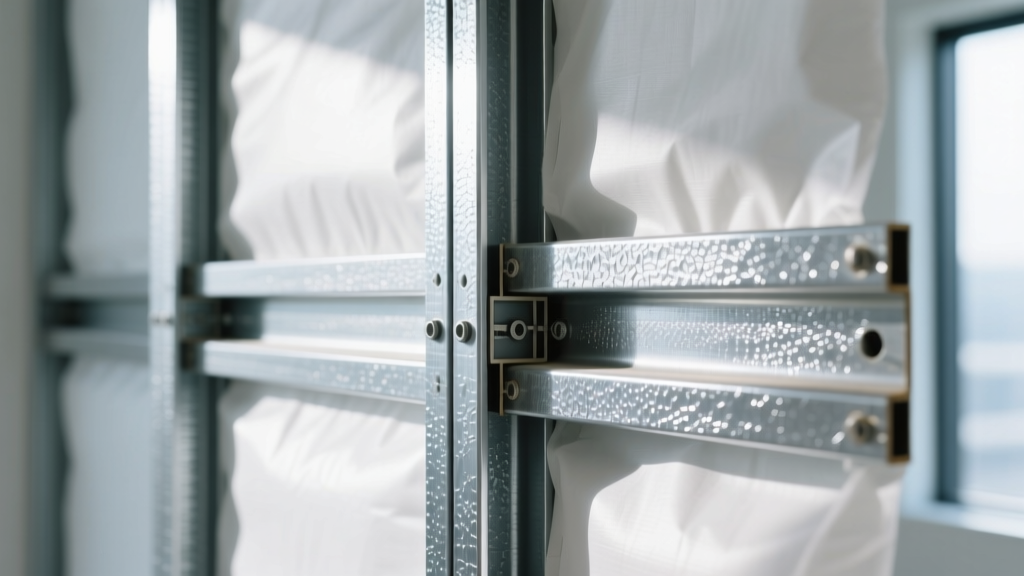
Fastener Selection and Isolation Matrix
A wall assembly is only as corrosion-resistant as its weakest fastener. Using standard phosphate-coated drywall screws to attach exterior sheathing to steel wall framing guarantees premature failure. Phosphate offers zero corrosion resistance and is intended strictly for interior gypsum board attachment.
Fastener Specification Matrix for Steel Wall Framing
| Environment | Required Fastener Coating | Approved Product Examples |
| Interior Dry (Offices, Bedrooms) | Phosphate or Standard Zinc | Standard bugle-head drywall screws |
| Interior Damp (Restrooms, Kitchens) | Zinc-Flake or Ceramic-Coated | ITW Buildex Tapcon, Simpson Strong-Tie |
| Exterior / Coastal (Behind Rainscreens) | Stainless Steel (304 or 316) | 316 SS self-drilling pancake or wafer-head |
Moisture Management at the Track-to-Slab Interface
The bottom track of steel wall framing is the most vulnerable component in the assembly. It sits directly on the concrete slab, a material that inherently wicks ground moisture via capillary action. If the bottom track rusts out, the entire wall loses its shear and lateral load-transfer capabilities.
Step-by-Step Sill Sealer Protocol
- Surface Prep: Sweep and vacuum the concrete slab. Ensure no standing water or debris remains where the track will be laid.
- Sealer Selection: Use a closed-cell polyethylene foam sill sealer (minimum 1/4-inch thick) or a rubberized asphalt membrane. Avoid open-cell foams, which can act as a sponge and hold moisture against the steel.
- Fastener Isolation: When pinning the bottom track through the sill sealer into the concrete using powder-actuated tools (PAT) or concrete screws, the fastener penetrates the moisture barrier. Seal the top of the fastener head with a dab of polyurethane sealant if the environment is classified as highly corrosive (ISO 12944 Category C4 or C5).
- Flashing Integration: For exterior steel wall framing, the bottom track must sit over a continuous Z-flashing or self-adhered peel-and-stick membrane that directs any incidental cavity moisture outward to the weep system.
Field Modifications: Cutting, Welding, and Touch-Up
No matter how perfectly the steel wall framing is manufactured, field modifications destroy the galvanized coating. Cutting studs with abrasive chop saws generates extreme heat that vaporizes the zinc at the cut line, leaving bare, highly reactive steel edges. Welding completely burns off the zinc in the heat-affected zone (HAZ).
According to technical guidelines published by manufacturers like ClarkDietrich Building Systems, all exposed bare steel edges resulting from field cuts or welds must be treated immediately. The required protocol is:
- Clean: Remove all slag, burn marks, and loose oxidation using a wire brush or abrasive pad.
- Apply: Coat the bare metal with a zinc-rich paint that meets SSPC-Paint 20 (Type I, inorganic). Products like ZRC Cold Galvanizing Compound or Rust-Oleum Cold Galvanizing Spray contain 90%+ zinc dust in the dry film, providing the same sacrificial cathodic protection as the original hot-dip process.
- Thickness: Apply to a minimum dry film thickness (DFT) of 2.0 mils to match the protection level of a G90 coating.
"The assumption that field-cut steel studs will 'heal' via the surrounding zinc coating is a dangerous myth. The sacrificial protection of hot-dip galvanizing only extends roughly 1/8 to 1/4 inch from the intact coating. Any cut wider than the stud thickness leaves the interior edge completely unprotected without a zinc-rich touch-up."
Environmental Exposure Categories (ISO 12944)
To accurately specify steel wall framing coatings, project engineers must classify the building's micro-environment using the ISO 12944 standard. This prevents both dangerous under-specifying and wasteful over-specifying.
| Category | Environment Description | Recommended CFS Coating |
|---|---|---|
| C1 / C2 | Heated interiors, offices, rural atmospheres. | G60 Minimum |
| C3 | High humidity interiors (breweries, laundries), urban atmospheres. | G90 Required |
| C4 | Coastal areas with low salinity, chemical processing plants. | G90 + Painted/Encapsulated |
| C5 | Offshore, heavy industrial, extreme coastal salinity. | G120 or Stainless Steel Framing |
By aligning the galvanization thickness with the specific hygrothermal realities of the build site, contractors ensure that steel wall framing delivers on its promise of a century-long service life without succumbing to the silent degradation of oxidation.
Written by
David NakamuraDavid Nakamura is a licensed architect (AIA) and construction technology writer focused on sustainable building methods, mass timber engineering, and high-performance building envelopes. He holds a Master of Architecture from the University of Washington and is a certified Passive House Consultant (CPHC). David spent eight years at the Seattle firm Mithun, where he led the design of three LEED Platinum projects, before founding his own practice specializing in net-zero residential design. He serves on the editorial advisory board of GreenBuilder Magazine and has authored peer-reviewed papers on cross-laminated timber (CLT) connections for the Journal of Structural Engineering. In his spare time, David teaches woodworking at Pratt Fine Arts Center and kayaks the Puget Sound.
More from David Nakamura
View all
Construction Cost
Labor Cost to Build a Deck Per Sq Ft: 2026 Installation Guide
Discover the exact labor cost to build a deck per sq ft in 2026. This installation guide breaks down contractor rates, complexity factors, and hidden fees.
Aug 4, 2026

Construction Cost
How Much Does It Cost to Build a 3 Bedroom House? Financing Guide
Learn exactly how much it costs to build a 3 bedroom house and explore 2026 financing options, construction loan types, and budget frameworks for your build.
Aug 4, 2026

Construction Cost
Cost to Build a Tennis Court: 2026 Guide
How much does it cost to build a tennis court in 2026? Breakdowns for asphalt, concrete, and synthetic surfaces plus fencing and lighting.
Jul 30, 2026