Steel Deck Framing Price: Technical Specs, Gauges & Cost Matrix
See how gauge, yield strength, and galvanization impact steel deck framing price. Includes 2026 cost matrices, ASTM specs, and structural span data.

The Engineering-Cost Intersection in Cold-Formed Steel
Calculating the accurate steel deck framing price requires moving beyond simple square-footage estimates. In commercial and high-end residential construction, the final material cost is strictly dictated by the technical specifications of the cold-formed steel (CFS) members. Variations in gauge thickness, yield strength, galvanization coating, and web depth alter the structural capacity and the price per linear foot (LF) simultaneously. Procurement teams and structural engineers must balance the moment of inertia required for specific deck spans against the material premiums of heavier sections.
According to the Cold-Formed Steel Engineers Institute (CFSEI), optimizing CFS framing requires matching the exact load-bearing requirements to the lightest possible section that satisfies deflection limits. Over-specifying a joist by a single gauge can inflate the steel deck framing price by 15% to 22% across a large commercial deck project without providing any measurable structural benefit.
Gauge, Thickness, and Base Price Matrix
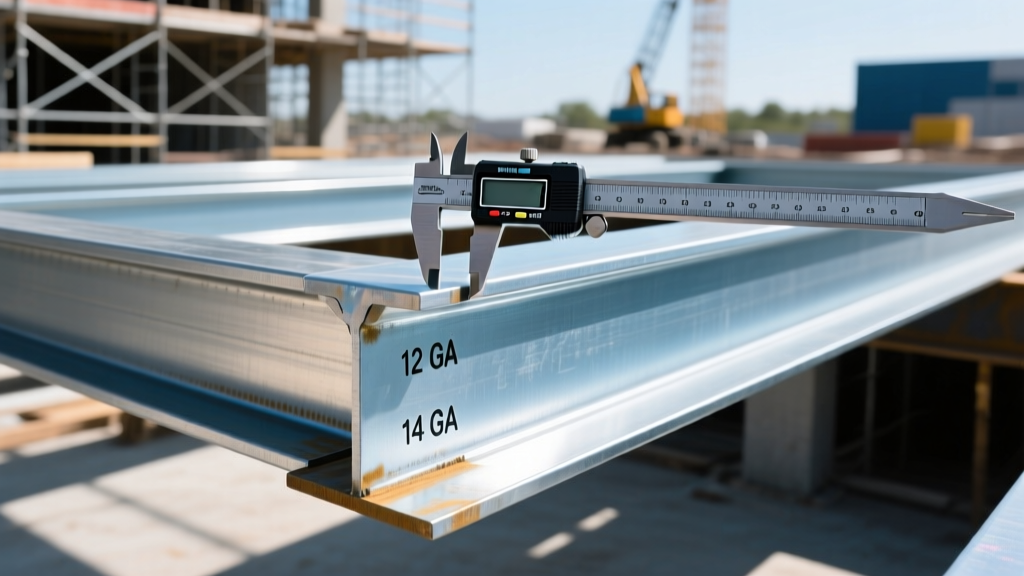
The most significant variable in the steel deck framing price is the base metal thickness, measured in mils (thousandths of an inch). While the industry still references the 'gauge' nomenclature, procurement documents must specify the minimum design thickness per ASTM A1003 to avoid receiving under-thickened material. The cost matrix below reflects Q1 2026 wholesale material pricing for standard C-Joists (16-inch on-center spacing assumptions applied to decking systems).
| Gauge | Design Thickness (mils) | Min. Yield Strength | Material Cost per LF (2026) | Typical Deck Application |
|---|---|---|---|---|
| 20 Ga. | 33 mils (0.0329") | 33 ksi | $1.15 - $1.35 | Non-load bearing partitions, short-span soffits |
| 18 Ga. | 43 mils (0.0428") | 33 ksi | $1.45 - $1.70 | Light-duty mezzanine decks, residential floors |
| 16 Ga. | 54 mils (0.0538") | 50 ksi | $1.95 - $2.35 | Standard commercial deck joists, mid-spans |
| 14 Ga. | 68 mils (0.0677") | 50 ksi | $2.75 - $3.20 | Heavy commercial decks, longer clear spans |
| 12 Ga. | 97 mils (0.0966") | 50 ksi | $4.10 - $4.85 | Industrial mezzanines, high-point-load areas |
Yield Strength and Metallurgical Premiums
The base price of steel deck framing is heavily influenced by the metallurgical properties of the coil used to roll-form the joists. The Steel Framing Industry Association (SFIA) enforces strict grading protocols that directly impact manufacturing costs.
Grade 33 vs. Grade 50 Steel
- 33 ksi (Grade 33): Standard for lighter gauges (20 to 18 gauge). This lower yield strength is sufficient for non-structural or light-load applications. It is the baseline for CFS pricing.
- 50 ksi (Grade 50): Required for structural framing (16 gauge and heavier). The steel undergoes additional cold-rolling reduction or micro-alloying to achieve higher tensile strength. Expect a 50 ksi specification to add an 8% to 12% premium to the raw material cost compared to a hypothetical 33 ksi equivalent in the same thickness.
Galvanization Coatings: G60 vs. G90
Corrosion resistance is non-negotiable for exterior deck framing or high-moisture environments. The zinc coating weight, measured in ounces per square foot (oz/ft²), alters both the lifespan and the steel deck framing price.
- G60 Coating (0.60 oz/ft²): The standard for interior, climate-controlled environments. Provides adequate protection during the construction phase and within finished building envelopes.
- G90 Coating (0.90 oz/ft²): Mandatory for exterior decks, cantilevered balconies, or areas exposed to weather before enclosure. The additional zinc application adds approximately $0.12 to $0.18 per linear foot to the material cost.
Profile Depth, Flange Dimensions, and Section Modulus
The physical geometry of the C-Joist dictates its section modulus (Sx) and moment of inertia (Ix), which govern how much load the member can carry before deflecting. Altering these dimensions to meet engineering requirements shifts the price bracket.
Web Depth Variations
Standard deck joists are available in web depths of 1-5/8", 2-1/2", 3-5/8", 5-1/2", and 8". Moving from a 3-5/8" web to a 5-1/2" web in the same 16-gauge material increases the steel deck framing price by roughly 18% due to the additional coil width required. However, the 5-1/2" depth increases the moment of inertia exponentially, allowing for wider joist spacing (e.g., moving from 12" on-center to 24" on-center), which can ultimately reduce the total linear footage required and lower the overall project cost.
Flange Returns and Torsional Resistance
Standard C-Joists feature a 1/2" flange return (lip). For decks subject to high torsional loads or uneven point loads, engineers may specify a 5/8" or 3/4" return. This custom roll-forming requirement usually incurs a 5% to 8% manufacturing surcharge and increases the overall weight of the member.
Deflection Limits and the Cost of Over-Engineering
The most common driver of an inflated steel deck framing price is the misapplication of deflection criteria. Deflection is measured as a fraction of the span length (L).
Engineering Rule of Thumb: For standard commercial deck framing supporting a concrete slab or rigid flooring, a deflection limit of L/240 under live loads is structurally acceptable and cost-efficient. Specifying an L/360 or L/480 deflection limit for the same span will force the use of a heavier gauge or deeper web, increasing the material cost by 20% to 35% without improving the ultimate load-bearing capacity of the deck.
Structural engineers must calculate the exact composite action between the steel joist and the deck sheathing (e.g., plywood, OSB, or concrete fill). Relying on composite design principles can allow for lighter, less expensive steel sections while maintaining strict deflection limits.
Hidden Cost Drivers in Technical Procurement
When finalizing the steel deck framing price for a bid, estimators must account for fabrication and logistical specifications that fall outside the base linear-foot material cost.
- Pre-Punched Web Knockouts: Standard joists come with pre-punched holes for MEP (mechanical, electrical, plumbing) routing. Specifying custom punchout sizes or non-standard spacing requires custom die setups at the roll-forming plant, adding $0.05 to $0.10 per LF.
- Cut-to-Length Tolerances: Standard mill lengths are 20, 24, or 30 feet. Requiring exact cut-to-length joists to minimize field waste and eliminate end-cuts adds a 4% to 6% fabrication premium. However, this often reduces field labor costs by up to 15%, making it a net-positive trade-off on large decks.
- Nesting and Bundling: For multi-story commercial builds, requesting that joists be nested (C-Joists nested back-to-back to form I-beams for primary girders) and pre-bundled by floor level at the factory adds logistical sorting fees but drastically reduces crane time and staging footprint.
- Freight and Minimum Order Quantities (MOQ): LTL (Less Than Truckload) shipments of heavy 12-gauge or 14-gauge steel incur severe freight penalties. The steel deck framing price per LF drops significantly when ordering full 40,000 lb truckloads directly from regional roll-formers.
Optimizing the Final Specification
Controlling the steel deck framing price requires a collaborative approach between the design team and the procurement manager. By strictly adhering to ASTM A1003 thickness tolerances, selecting the appropriate G60/G90 coating for the specific environmental exposure, and avoiding overly conservative deflection limits, project teams can optimize material spend. Always request load-span tables directly from the specific roll-former supplying the project, as minor variations in corner radii and lip returns between manufacturers can alter the allowable spans and, consequently, the most cost-effective gauge selection.
Written by
Priya KapoorPriya Kapoor is a real estate market analyst and construction economics researcher with expertise in housing affordability, development feasibility, and infrastructure investment. She holds a Master of Regional Planning from Cornell University and previously worked as a senior analyst at CBRE's Investment Properties group, where she modeled returns for $4B in mixed-use development pipelines. Priya now runs an independent research practice advising developers, municipalities, and REITs on construction cost forecasting and market timing. She publishes the quarterly "BuildMat Market Pulse" report tracking material price indices across 12 commodity categories. Based in Austin, TX, Priya serves on the board of Habitat for Humanity Austin and is a marathon runner.
More from Priya Kapoor
View all
Construction Cost
Cost to Build a 1600 Sq Ft Home in 2026: Full Breakdown
Accurate 2026 cost to build a 1600 sq ft home—material, labor, and regional pricing breakdowns included. Plan your budget with real-time estimates.
Aug 11, 2026

Wood & Lumber
Name the Types of Wood for Pressure Treatment and Preservation
Learn how to name the types of wood best suited for pressure treatment. Compare species treatability, chemical retention levels, and 2026 preservation costs.
Aug 4, 2026

Stone & Masonry
Stone Veneer Suppliers Lindenhurst: 2026 Cost Analysis
Analyze 2026 stone veneer costs in Lindenhurst, NY. Compare local supplier pricing, delivery fees, and Suffolk County installation labor rates.
Aug 4, 2026