1x4 Lumber Taxonomy: Species, Grades, and Selection Guide
Master 1x4 lumber selection with our taxonomy of wood species, grading standards, actual dimensions, and application-specific decision frameworks.
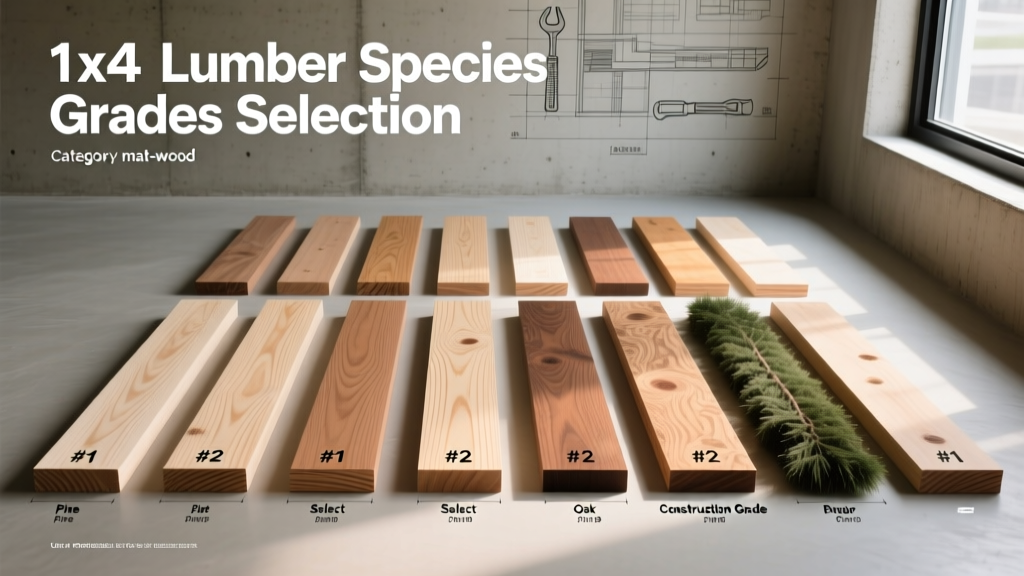
The Dimensional Reality: Nominal vs. Actual 1x4
In the building materials sector, the nomenclature of dimensional lumber is a historical artifact rather than a literal measurement. When a contractor or architect specifies '1x4 lumber', they are referencing the nominal size—the dimensions of the board before it undergoes kiln-drying and planing at the sawmill. Understanding the delta between nominal and actual dimensions is the first critical step in material taxonomy and prevents catastrophic spacing errors in finish carpentry and structural blocking.
Nominal Size: 1" x 4"
Actual Size: 0.75" x 3.5" (19mm x 89mm)
Note: If your project requires a true 1" x 4" dimension, you must order 'rough-sawn' or 'full-dimension' lumber from a specialty mill, which typically commands a 30% to 45% price premium and requires custom jointer/planer work on-site.
For finish applications like shiplap, board-and-batten siding, or baseboard layering, the 0.75-inch thickness dictates the reveal and shadow lines. When calculating linear footage for wall coverage, always use the 3.5-inch actual face width, factoring in an additional 10% to 15% waste factor for miter cuts, coped joints, and board-end defects.
Species Taxonomy and Application Matrix
Not all 1x4 boards are created equal. The species dictates the board's cellular structure, moisture tolerance, fastener retention, and finish compatibility. Below is a comparative matrix of the most common 1x4 species and engineered alternatives available in the current market.
| Material / Species | Est. Cost (8ft Board) | Moisture Resistance | Optimal Application |
|---|---|---|---|
| SPF (Spruce-Pine-Fir) #2 | $4.50 - $6.00 | Low (Interior only) | Furring strips, blocking, painted utility trim |
| Ponderosa Pine (Select/Clear) | $11.00 - $14.00 | Low-Medium | Premium interior paint-grade casing and base |
| Western Red Cedar (Clear) | $15.00 - $19.00 | High (Natural tannins) | Exterior fascia, battens, stained trim |
| Poplar | $9.00 - $12.00 | Low | Interior paint-grade (takes paint exceptionally well) |
| Cellular PVC (1x4 Extruded) | $22.00 - $28.00 | Impervious | Ground-contact trim, high-moisture exteriors |
When selecting Western Red Cedar for exterior applications, the Western Red Cedar Lumber Association (WRCLA) mandates specific grading protocols. For a 1x4 fascia board, specify 'Clear C' or 'Clear D' grades to ensure a knot-free face. If you intend to paint the cedar rather than stain it, you must prime it with an alkyd or oil-based stain-blocking primer to prevent tannin bleed-through, which will ruin latex topcoats within months.
Decoding 1x4 Lumber Grades
The grading stamp on a 1x4 board dictates its structural integrity and visual quality. Because 1x4 lumber is rarely used for primary load-bearing framing (unlike 2x4s), it is typically graded under 'Appearance' or 'Light Framing' classifications rather than heavy structural standards.
Appearance Grades (Finish Work)
- Select (B & Better, C Select): Virtually free of knots and defects. C Select is the industry standard for high-end interior trim where a glass-smooth paint finish is required.
- #1 Common: Features tight, small knots. Ideal for rustic interior designs, cabinetry face frames, or stained applications where character marks are desired but structural weakness is not.
- #2 Common: Larger, more frequent knots. Acceptable for painted utility trim, shelving, or board-and-batten siding where a rustic aesthetic is appropriate.
Light Framing & Structural Grades
If you are using 1x4s for structural bracing, let-in braces, or roof decking in historical restoration, you will encounter grades regulated by bodies like the Southern Pine Inspection Bureau (SPIB).
- Stud: The most common structural grade for narrow dimensional lumber. Suitable for light load-bearing applications and blocking.
- Construction / Standard: Higher strength and stiffness ratings, used when the 1x4 is acting as a critical tension or compression brace in timber framing.
The 1x4 Selection Decision Framework
To eliminate guesswork on the job site, run your project requirements through this decision matrix to specify the exact material needed:
↳ Exterior / Ground Contact: Choose Cellular PVC or pressure-treated SPF. (Note: PT 1x4s are often warped due to the treatment process; budget for 20% waste).
↳ Exterior / Above Ground: Choose Western Red Cedar, Redwood, or ACQ-treated Pine.
↳ Interior / High Humidity (Bathrooms): Choose Poplar or MDF (if properly sealed) or PVC.
↳ Interior / Standard: Proceed to Step 2.
Step 2: Finish Specification
↳ Opaque Paint: Choose Poplar (best grain hide) or Select Ponderosa Pine. Avoid MDF in high-impact zones like door casings, as it dents easily.
↳ Clear Coat / Stain: Choose Clear Cedar, Oak, or Maple. Avoid SPF, as the alternating hard/soft grain rings will absorb stain unevenly, resulting in a blotchy finish.
Step 3: Budget & Scale
↳ If covering over 500 linear feet of non-visible utility space (e.g., furring behind drywall), downgrade to SPF #2 or #3 to preserve capital for visible finish materials.
Installation Edge Cases and Failure Modes
Working with 1x4 lumber presents unique mechanical challenges due to its narrow 3.5-inch face and 0.75-inch thickness. Ignoring these edge cases leads to costly callbacks and material failure.
Because the actual width is only 3.5 inches, driving a fastener into the edge of a 1x4 (such as when face-nailing into a 2x4 stud) leaves minimal marginal wood. If using pneumatic nailers, 18-gauge brad nails will often blow out the side of the board or fail to hold under wind load on exterior fascia. The Fix: Use 15-gauge or 16-gauge finish nails, and pre-drill pilot holes if you are within 1 inch of the board's end grain. For exterior applications, use hot-dipped galvanized or stainless steel ring-shank nails to prevent rust jacking and pull-out.
Moisture Dynamics and Cupping
According to the USDA Forest Products Laboratory Wood Handbook, wood shrinks and swells primarily across the grain (tangentially and radially), with negligible longitudinal movement. A 1x4 board installed flat against a masonry wall or concrete foundation is highly susceptible to 'cupping'—where the edges curl away from the center due to a moisture gradient.
When installing 1x4 pine or cedar as exterior trim over masonry or rigid foam insulation, never fasten it flush without a drainage plane. Install a 1/4-inch thick corrugated plastic furring strip or a continuous bead of construction adhesive combined with a rainscreen gap. Furthermore, always 'back-prime' all six sides of the 1x4 board before installation. Sealing the back face equalizes the moisture absorption rate, reducing the differential tension that causes cupping.
Thermal Expansion in PVC Alternatives
If your taxonomy selection leads you to Cellular PVC 1x4s (like Azek or Kleer), remember that PVC expands and contracts with temperature changes, not moisture. A 12-foot run of PVC 1x4 can expand up to 1/8 inch over a 40-degree temperature swing. Butt joints must be glued with PVC-specific solvent cement and fastened with PVC-compatible screws that allow for lateral thermal movement, otherwise the boards will buckle and push off the wall plane.
Sourcing and Yield Optimization
When purchasing 1x4 lumber in bulk, inspect the bundle for 'crown' and 'bow'. Sight down the edge of every board. For horizontal applications like shelving or chair rails, install the board with the crown (the convex curve) facing up; gravity and the weight of objects will naturally flatten it over time. For vertical applications like battens or casing, reject boards with severe edge-bow, as the 0.75-inch thickness lacks the bending stiffness to be forced straight by fasteners without cracking the drywall behind it.
By understanding the precise taxonomy of 1x4 lumber—from the cellular differences between Ponderosa Pine and Poplar, to the mechanical realities of fastening a 3.5-inch profile—you transition from simply buying wood to engineering a durable, high-quality finish system.