Premium Wood Look Flooring Options: A Grade & Quality Guide
Compare premium wood look flooring options. Learn how to grade engineered wood, laminate, and rigid core by wear layer, core density, and EIR printing.

The Hierarchy of Wood Look Flooring Materials
Evaluating wood look flooring options requires moving beyond surface aesthetics to analyze structural integrity, wear layer chemistry, and core density. The market is saturated with products that mimic the visual warmth of timber, but their performance diverges drastically under load, moisture, and UV exposure. From a grading perspective, these options fall into three primary tiers: Engineered Hardwood (authentic wood veneer over structural core), High-Density Fiberboard (HDF) Laminate, and Rigid Core Resilient (SPC/WPC). Understanding the manufacturing tolerances and material grades within each category is essential for specifying the correct product for residential and commercial applications.
Grading Visual Authenticity: Print Resolution and EIR Technology
The visual grade of any non-solid wood look flooring option is dictated by the print layer resolution and the embossing technique. Lower-tier products utilize standard embossing, where a generic wood texture is stamped over the wear layer, entirely misaligned with the printed grain beneath it. This creates a tactile dissonance that immediately signals an artificial product.
Specification Callout: Embossed in Register (EIR)
When specifying premium laminate or rigid core options, mandate Embossed in Register (EIR) manufacturing. EIR aligns the physical texture of the wear layer precisely with the high-definition printed grain. Advanced EIR processes, such as those used in Shaw's premium Floorté lines or COREtec's luxury collections, also incorporate micro-bevels, wire-brushed texturing, and varying gloss levels (matte to semi-gloss) within a single plank to replicate the light refraction of real sawn timber.
For the highest visual grade, look for planks featuring a minimum of 12 to 16 unique visual patterns per carton. Budget options often repeat the exact same grain pattern every 3 to 4 planks, creating an obvious, unnatural grid effect once installed across a large floor plan.
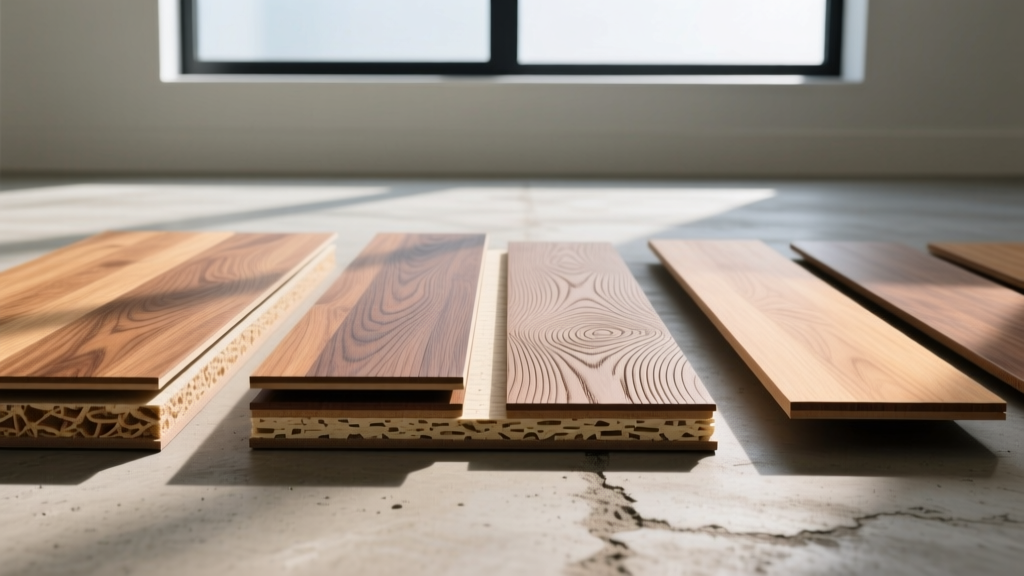
Structural Core Density: The Hidden Quality Metric
The core layer dictates the dimensional stability, acoustic performance, and impact resistance of the flooring. Grading the core requires examining the material composition and density ratings.
| Core Material | Density / Composition | Moisture Tolerance | Best Application |
|---|---|---|---|
| Plywood (Engineered) | Cross-grained Baltic Birch (9-11 ply) | Moderate (requires acclimation) | Above-grade, nail/glue down |
| HDF (Laminate) | 850 - 950 kg/m³ (Moisture Resistant) | Low to Moderate (swells if pooled) | Dry residential, floating |
| WPC (Wood Plastic) | Expanded PVC with wood flour foaming agent | High (100% waterproof) | Basements, high comfort needs |
| SPC (Stone Plastic) | Limestone powder + PVC (High density) | Extreme (impervious to water) | Commercial, uneven subfloors |
When evaluating HDF cores in laminate wood look flooring options, consult the North American Laminate Flooring Association (NALFA) certification standards. Premium laminates utilize moisture-resistant HDF with a thickness swell rate of less than 8% when tested under EN 13329 standards. For rigid core options, the Resilient Floor Covering Institute (RFCI) provides critical guidelines on SPC thickness; specify a minimum 5mm rigid core (excluding the attached underlayment pad) to prevent telegraphing of subfloor imperfections and to ensure the click-lock mechanism does not shear under rolling loads.
Wear Layer Specifications and AC/Class Ratings
The wear layer is the transparent, protective top coat that guards the visual layer against abrasion, stains, and UV fading. The grading of this layer is where manufacturers most frequently cut costs.
Laminate AC Ratings
Laminate flooring is graded using the Abrasion Class (AC) rating system, tested via the Taber abrasion method (ASTM D4060).
- AC3 (Class 23/31): Moderate residential. Suitable for bedrooms and low-traffic living areas.
- AC4 (Class 32): Heavy residential / Light commercial. The minimum recommended grade for main living areas, hallways, and home offices.
- AC5 (Class 33): Heavy commercial. Required for retail spaces, high-traffic entryways, and homes with large, active dogs.
- AC6 (Class 34): Extreme commercial. Rarely needed in residential settings; features an ultra-hard aluminum oxide finish that can feel artificially slick.
Rigid Core Mil Thickness
For SPC and WPC wood look flooring options, the wear layer is measured in mils (1 mil = 0.001 inches). Do not confuse the total plank thickness (e.g., 8mm) with the wear layer thickness.
Many big-box retailers promote 12-mil wear layers as 'premium.' In reality, 12-mil is the absolute baseline for light residential use and will show micro-scratches within 3 to 5 years under normal foot traffic. For a true premium grade that maintains its structural integrity and visual clarity for 15+ years, specify a minimum 20-mil to 22-mil wear layer with a ceramic bead or aluminum oxide UV-cured urethane finish.
2026 Market Pricing and Lifecycle Cost Analysis
Pricing for wood look flooring options has stabilized following the supply chain disruptions of the early 2020s, though premium raw materials and advanced EIR manufacturing command a distinct premium. Below is the current 2026 material cost breakdown (excluding installation, underlayment, and trim):
- Standard Laminate (8mm, AC3, Standard Emboss): $2.50 - $4.00 per sq. ft.
- Premium Laminate (12mm, AC4/AC5, EIR, Moisture-Resistant HDF): $4.50 - $7.50 per sq. ft.
- Entry-Level SPC (4mm core, 12-mil wear): $3.00 - $4.50 per sq. ft.
- Premium SPC/WPC (6mm+ core, 20-mil+ wear, EIR): $5.50 - $9.50 per sq. ft.
- Engineered Hardwood (3mm-4mm sawn veneer, plywood core): $7.00 - $14.00+ per sq. ft.
While engineered hardwood carries the highest initial material cost, its ability to be sanded and refinished (if the veneer is 3mm or thicker) extends its lifecycle to 50+ years, drastically lowering the cost-per-year of ownership compared to resilient options that must be entirely replaced once the wear layer is compromised.
Expert Decision Framework: Matching Options to Subfloor Conditions
Selecting the correct wood look flooring option requires a forensic evaluation of the subfloor and environmental conditions. Use the following decision matrix to prevent catastrophic installation failures.
- Concrete Subfloor (Below Grade / Basement):
- Moisture Test: Perform an ASTM F2170 relative humidity test using in-situ probes. If RH exceeds 75-80% (depending on adhesive manufacturer limits), do not use glue-down engineered wood.
- Selection: Floating SPC with a 6mm core and attached cork or IXPE pad. SPC is impervious to alkaline moisture and will not harbor mold.
- Uneven Subfloor (Variance > 3/16' over 10 feet):
- Selection: Avoid thin SPC (4mm) and standard laminate. The rigid click-lock mechanisms will snap under deflection. Either level the subfloor with a self-leveling underlayment (SLU) or specify a thick WPC (8mm+), which possesses enough flexibility to bridge minor subfloor undulations without breaking the joint.
- Radiant Heat Systems (Hydronic or Electric):
- Selection: Engineered hardwood (glue-down method) or high-density SPC. Avoid WPC, as the foaming agents in the core can act as thermal insulators, reducing heating efficiency and potentially causing the core to expand and contract excessively under repeated thermal cycling. Always verify the manufacturer's maximum surface temperature limit (usually capped at 85°F / 29°C).
Common Failure Modes and Prevention
Even premium wood look flooring options will fail if installation protocols are ignored. The National Wood Flooring Association (NWFA) consistently reports that the vast majority of flooring claims are denied due to installer error or environmental neglect.
Edge Cupping in Rigid Core: Often mistaken for a product defect, edge cupping in SPC/LVP is almost exclusively caused by installing the flooring without the mandated 1/4-inch expansion gap at the perimeter, or by pinning the floor under heavy cabinetry. The floor must float freely to accommodate thermal expansion.
By prioritizing core density, mandating EIR visual technology, and strictly enforcing wear layer minimums (20-mil for resilient, AC4 for laminate), specifiers and homeowners can secure wood look flooring options that deliver both the authentic aesthetic of natural timber and the rigorous performance required for modern building environments.
Written by
David NakamuraDavid Nakamura is a licensed architect (AIA) and construction technology writer focused on sustainable building methods, mass timber engineering, and high-performance building envelopes. He holds a Master of Architecture from the University of Washington and is a certified Passive House Consultant (CPHC). David spent eight years at the Seattle firm Mithun, where he led the design of three LEED Platinum projects, before founding his own practice specializing in net-zero residential design. He serves on the editorial advisory board of GreenBuilder Magazine and has authored peer-reviewed papers on cross-laminated timber (CLT) connections for the Journal of Structural Engineering. In his spare time, David teaches woodworking at Pratt Fine Arts Center and kayaks the Puget Sound.
More from David Nakamura
View all
Construction Cost
Labor Cost to Build a Deck Per Sq Ft: 2026 Installation Guide
Discover the exact labor cost to build a deck per sq ft in 2026. This installation guide breaks down contractor rates, complexity factors, and hidden fees.
Aug 4, 2026

Construction Cost
How Much Does It Cost to Build a 3 Bedroom House? Financing Guide
Learn exactly how much it costs to build a 3 bedroom house and explore 2026 financing options, construction loan types, and budget frameworks for your build.
Aug 4, 2026

Construction Cost
Cost to Build a Tennis Court: 2026 Guide
How much does it cost to build a tennis court in 2026? Breakdowns for asphalt, concrete, and synthetic surfaces plus fencing and lighting.
Jul 30, 2026