Evaluating Types of Hawaiian Wood for Structural Applications
Discover the structural properties, load-bearing limits, and modern building applications for various types of Hawaiian wood like Koa, Mango, and Ohia.

The Engineering Reality of Hawaiian Timber
When architects and builders evaluate types of Hawaiian wood for structural applications, they must navigate a complex intersection of exceptional material density, severe sourcing constraints, and aggressive tropical environmental factors. Unlike mainland softwoods (such as Douglas Fir or SPF) that dominate standard light-frame construction, Hawaiian hardwoods are primarily celebrated for fine woodworking, veneers, and cultural artifacts. However, specific species possess mechanical properties that rival or exceed traditional structural timbers, making them highly viable for heavy timber framing, structural flooring, marine structures, and exposed load-bearing columns in luxury residential and commercial builds.
Utilizing these species structurally requires a departure from standard prescriptive framing codes. Engineers must account for higher specific gravities, unique moisture equilibrium rates, and strict biological degradation risks. This guide breaks down the mechanical realities, building code considerations, and practical engineering frameworks required to specify native and naturalized Hawaiian woods in load-bearing capacities.
Structural Properties Matrix: Native vs. Naturalized Species
The structural viability of any timber is dictated by its Modulus of Rupture (MOR - bending strength), Modulus of Elasticity (MOE - stiffness), and specific gravity. Below is a comparative matrix of the most prominent Hawaiian woods used in heavy timber and structural applications.
| Wood Species | Scientific Name | Janka Hardness (lbf) | MOR (psi) | MOE (million psi) | Primary Structural Use |
|---|---|---|---|---|---|
| Mango | Mangifera indica | 1,070 | 12,940 | 1.59 | Structural flooring, heavy timber posts, joists |
| Koa | Acacia koa | 1,170 | 12,600 | 1.37 | Marine structures, exposed luxury beams, historical framing |
| ʻŌhiʻa Lehua | Metrosideros polymorpha | 2,800 | 16,400+ | 1.90+ | Load-bearing columns, heavy timber trusses, foundation pilings |
| Kamani | Calophyllum inophyllum | 1,430 | 13,500 | 1.50 | Structural joinery, heavy timber connectors, exterior posts |
Mango Wood: The Viable Modern Structural Hardwood
Of all the types of Hawaiian wood available in commercial volumes, Mango (Mangifera indica) is the only species routinely milled for structural and semi-structural building components. Introduced to the islands in the 19th century, mango trees are primarily harvested as an agricultural byproduct when orchard yields decline after 30 to 40 years. According to The Wood Database, mango possesses a specific gravity of 0.68 (basic, 12% MC), placing it in the same structural weight class as Red Oak.
Load-Bearing Capacity and Deflection Limits
Mango's MOR of 12,940 psi makes it exceptionally strong in bending, comparable to or slightly stronger than standard Douglas Fir-Larch (12,400 psi). However, its MOE of 1.59 million psi indicates it is less stiff than Douglas Fir (1.95 million psi). In practical structural engineering, this means mango beams will deflect more under the same load. When designing floor joists or roof rafters from mango timber, engineers must reduce the on-center spacing (e.g., moving from 16" to 12" O.C.) or increase the beam depth by 15-20% to meet the International Residential Code (IRC) deflection limits of L/360 for live loads.
Mango logs are notorious for severe internal tension and interlocked grain. For structural beams, specify quarter-sawn or rift-sawn milling. Flat-sawn mango boards exhibit up to 8% tangential shrinkage, leading to catastrophic cupping and twisting when exposed to Hawaii's fluctuating humidity. Quarter-sawing reduces radial shrinkage to roughly 4%, ensuring dimensional stability in load-bearing applications.
Koa and ʻŌhiʻa: Heavy Timber and Marine Structures
Koa (Acacia koa) and ʻŌhiʻa (Metrosideros polymorpha) represent the pinnacle of Hawaiian timber density, but their structural use is heavily gated by conservation status and cost.
Koa in Marine and Exposed Framing
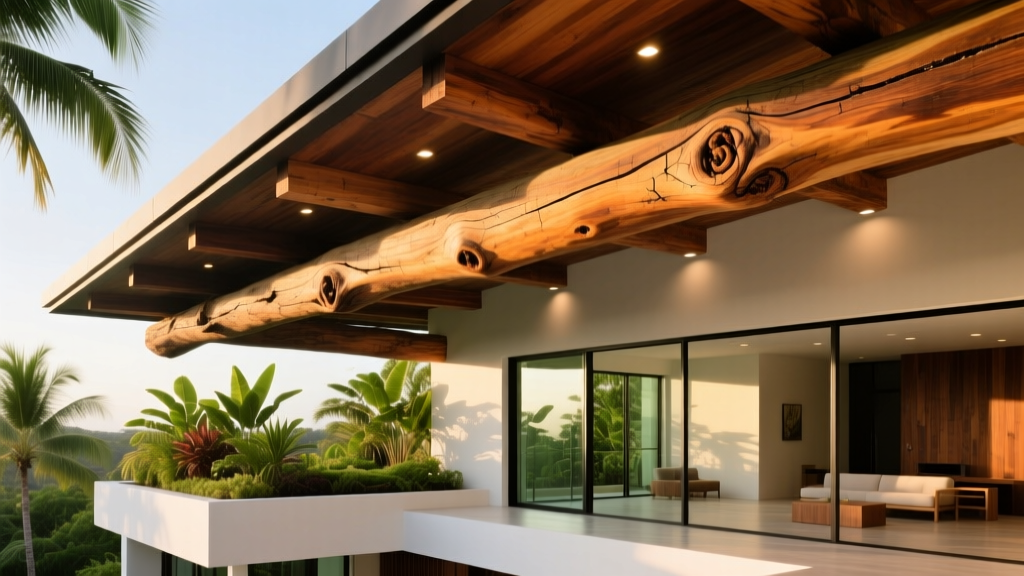
Historically, Koa was the premier structural wood for waʻa (outrigger canoes) due to its incredible rot resistance and workability when green. Today, Koa is prohibitively expensive for standard framing ($40 to $120+ per board foot), but it remains highly relevant in luxury structural applications. It is frequently used for exposed structural ridge beams, cantilevered balcony supports, and marine dock pilings. Koa's natural extractives provide a Class II durability rating against decay, though it requires penetrating epoxy sealants when used in ground-contact or splash-zone marine structures to prevent checking.
ʻŌhiʻa: The Ultimate Load-Bearing Column
ʻŌhiʻa is arguably the strongest wood native to Hawaii, boasting a Janka hardness of 2,800 lbf and an MOR that frequently exceeds 16,000 psi. It is incredibly dense and sinks in water. Structurally, it is unmatched for heavy timber columns and foundation pilings. However, sourcing is strictly regulated. The spread of Rapid ʻŌhiʻa Death (ROD), caused by Ceratocystis fungi, has devastated native populations. According to the Rapid ʻŌhiʻa Death task force, the harvesting of live ʻŌhiʻa for timber is effectively banned. Structural ʻŌhiʻa is now exclusively sourced from salvaged, windthrown, or naturally fallen trees, requiring rigorous chain-of-custody documentation and decontamination protocols for milling equipment to prevent fungal spread.
Moisture Dynamics and Termite Engineering in Tropical Climates
Specifying types of Hawaiian wood for structural use requires addressing two aggressive environmental factors: Equilibrium Moisture Content (EMC) and Formosan subterranean termites.
Managing Tropical EMC
Mainland framing lumber is typically kiln-dried to 19% moisture content (MC). In Hawaii's windward and coastal environments, the ambient EMC hovers between 12.5% and 14.5% year-round, while interior conditioned spaces sit around 10%. Hardwoods like Mango and Koa must be kiln-dried to match the specific end-use EMC. If a mango structural beam is installed at 18% MC in an air-conditioned commercial lobby, it will equilibrate down to 10%, resulting in severe checking and potential joint failure in timber-framing connections. Always specify kiln-drying to 10-12% MC for interior structural elements and 14% MC for exterior covered structures.
Borate Treatment and Termite Barriers
Hawaii is home to the Formosan subterranean termite, which can consume a 2x10 mango joist in a matter of months. While Koa and ʻŌhiʻa possess high natural termite resistance, Mango and Kamani are highly susceptible.
- Pressure Treatment: Mango timbers intended for structural use must be pressure-treated with Disodium Octaborate Tetrahydrate (DOT). Specify a minimum retention level of 0.25 pcf (pounds per cubic foot) for above-ground framing and 0.40 pcf for sill plates or ground-contact columns.
- Physical Barriers: For untreated structural hardwoods (like Koa beams), integrate a physical termite barrier such as Termimesh (stainless steel mesh) or Basaltic rock barriers at the foundation-to-wood transition points, as mandated by Hawaii County Building Code amendments.
Fastener Corrosion and Structural Connections
The dense cellular structure of Hawaiian hardwoods, combined with high ambient humidity and salt spray in coastal zones, creates a highly corrosive environment for structural fasteners. Furthermore, species like Kamani and Mango contain mild acidic extractives that can accelerate the corrosion of standard galvanized steel.
"When connecting dense tropical hardwoods in structural timber framing, hot-dipped galvanized (HDG) fasteners are insufficient for long-term load-bearing integrity in coastal Hawaiian environments. Type 316 stainless steel or specialized structural screws with multi-layer ceramic coatings (e.g., Simpson Strong-Tie Type 316 equivalents) are mandatory to prevent connection shear failure."
— Adapted from USDA Forest Products Laboratory Wood Handbook guidelines on tropical hardwood fastening.
When bolting heavy mango or ʻŌhiʻa beams, pre-drilling is non-negotiable. The wood's density will snap standard structural lag screws during installation. Drill pilot holes at 85% of the fastener's shank diameter to prevent wood splitting and fastener torsion failure.
Sourcing, Grading, and Code Compliance
Unlike mainland softwoods graded by the WWPA or SPIB, Hawaiian hardwoods do not have a dedicated, localized structural grading agency. To use these woods in permitted, load-bearing structural applications, builders must rely on the National Hardwood Lumber Association (NHLA) grading rules combined with custom structural engineering sign-offs.
For structural beams, specify "Structural Select" or "No. 1 Common" NHLA grades, ensuring the timber is free of large knots, slope of grain deviations exceeding 1:12, and pith (the center of the log). Pith included in a structural beam will inevitably cause radial splitting as the wood dries, compromising the beam's shear capacity. Always require the mill to provide a certified moisture content reading and a visual grading stamp before the timber is hoisted into the structural frame.
Written by
Elena RodriguezElena Rodriguez is a civil engineer and technical writer specializing in concrete technology, masonry systems, and ASTM/ACI compliance. She earned her B.S. in Civil Engineering from Texas A&M University and spent a decade at a materials testing laboratory, performing over 2,000 concrete compressive strength tests and masonry prism evaluations. Elena is an ACI-certified Field Testing Technician (Grade I) and a member of ASTM Committee C12 on Natural Building Stone. She currently consults on forensic engineering cases involving concrete failures and moisture intrusion. Based in San Antonio, TX, Elena is a proud member of the Society of Women Engineers (SWE) and coaches her daughter's FIRST Robotics team.
More from Elena Rodriguez
View all
Walls & Panels
Cost Analysis: Light Gauge Steel Framing Advantages and Disadvantages
Evaluate light gauge steel framing advantages and disadvantages through a strict cost analysis lens, comparing material, labor, and lifecycle expenses.
Aug 4, 2026

Walls & Panels
Gypsum Board Types: Exact Specifications, Thickness & Dimensions
Compare standard, Type X, and moisture-resistant gypsum board types. Get exact specifications, thicknesses, dimensions, and ASTM standards for your project.
Aug 4, 2026

Fire Resistance
Best Fire-Resistant Outdoor Decking Materials: 2026 Buyer Guide
Discover the best fire-resistant outdoor decking materials for 2026. Compare Class A PVC, aluminum, and hardwood options for WUI compliance and safety.
Aug 4, 2026