Structural Timber Protection: What Type of Paint for Wood Framing?
Discover what type of paint for wood structural framing, mass timber, and engineered lumber provides fire, moisture, and insect protection.

The Structural Imperative: Why Framing Paint Differs from Finish Paint
When architects and engineers ask what type of paint for wood structural elements is required, the answer diverges sharply from residential finish carpentry. Structural timber—including exposed mass timber (Glulam, CLT), concealed framing (sill plates, rim joists), and engineered lumber (LVL, I-joists)—faces catastrophic failure modes that aesthetic paints cannot prevent. These include deep moisture wicking, capillary-driven end-grain rot, structural delamination, and rapid fire propagation.
Standard 100% acrylic latex paints, while excellent for exterior trim due to their UV resistance and flexibility, often lack the vapor permeability, fire-retardant chemistry, or borate-carrying capacity required for structural integrity. According to the USDA Forest Products Laboratory, applying a non-breathable film to structural lumber with a moisture content (MC) above 19% traps water within the cellular matrix, accelerating internal fungal decay and compromising the wood's load-bearing capacity.
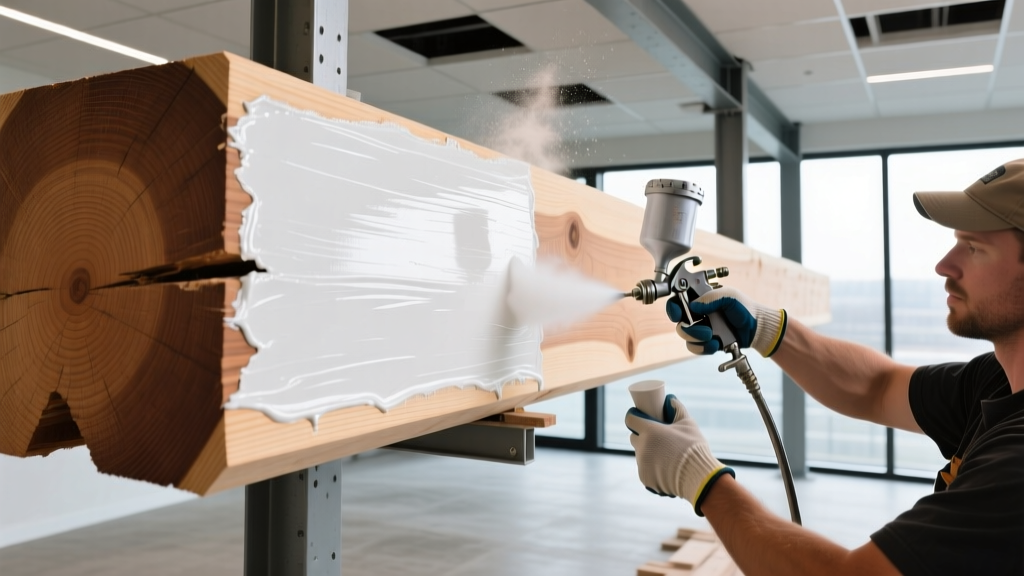
Decision Matrix: Coating Selection by Structural Element
Selecting the correct coating requires matching the chemical properties of the paint to the specific structural threat profile of the wood member.
| Structural Element | Primary Threat | Required Coating Type | Vapor Permeability |
|---|---|---|---|
| Exposed Glulam / CLT (Mass Timber) | Fire propagation, UV degradation | Intumescent fire-retardant, water-based acrylic topcoats | Moderate to High |
| Concealed Sill Plates & Rim Joists | Termites, fungal rot, ground moisture | Borate-based penetrating treatments, Alkyd primers | High (Penetrating) |
| LVL Beams & I-Joist Ends | End-grain moisture wicking, delamination | Epoxy end-sealers, heavy oil-based alkyd primers | Low (Sealing) |
| Fire-Retardant Treated (FRT) Plywood | Alkaline saponification, coating rejection | Alkali-resistant epoxy or specialized acrylic masonry primers | Low to Moderate |
Fire Protection for Exposed Mass Timber and Glulam
The 2024 and 2026 International Building Code (IBC) updates have significantly expanded the allowable height and area for mass timber construction, making fire-rated coatings a critical structural requirement. For exposed Glulam and Cross-Laminated Timber (CLT), the standard answer to what type of paint for wood fire protection is required is intumescent paint.
Intumescent Coatings: Mechanics and Application Specs
Intumescent paints remain inert under normal conditions but undergo a chemical reaction when exposed to temperatures exceeding 200°C (392°F). The coating swells to 10 to 100 times its original thickness, forming an insulating carbonaceous char that delays the heating of the underlying wood.
- Dry Film Thickness (DFT): Achieving a specific fire rating (e.g., 1-hour or 2-hour) is entirely dependent on DFT. A 2-hour rating on a structural Glulam beam typically requires a DFT of 35 to 50 mils (0.9 to 1.2 mm), which often necessitates 3 to 4 separate coats.
- Product Specifications: Products like Sherwin-Williams FX-5050 or Flame Control Coatings' No. 158 are industry standards. They must be applied over a compatible primer and sealed with a compatible topcoat if the timber is exposed to high humidity.
- Application Gotcha: Intumescent paints are highly sensitive to application temperature and humidity. Applying these coatings below 50°F (10°C) or above 85% relative humidity causes improper curing, resulting in a brittle char that flakes off during a fire event, nullifying the American Wood Council's engineered fire-resistance calculations.
Moisture and Insect Defense for Concealed Framing
For concealed structural elements, particularly pressure-treated sill plates resting on concrete foundations and rim joists, the primary enemies are subterranean termites and capillary moisture.
Borate-Based Penetrating Treatments
While pressure-treated lumber is infused with copper-based preservatives (like ACQ or MCA), cut ends and drilled holes expose untreated core wood. Borate-based liquid treatments (such as Bora-Care or Tim-bor) act as both a paint-on preservative and an insecticide. Borates diffuse deeply into the wood's cellular structure when applied to unsealed wood with a moisture content above 10%.
Never apply elastomeric or high-build acrylic masonry paints to freshly milled or 'green' structural framing. If the wood's moisture content exceeds 19%, these impermeable films trap moisture inside the beam. As the wood attempts to dry, the trapped vapor creates hydrostatic pressure that blisters the paint and creates an ideal microclimate for brown rot fungi. Always verify MC with a pin-type moisture meter before applying film-forming structural coatings.
End-Grain Sealing for Engineered Lumber (LVL and I-Joists)
Engineered wood products like Laminated Veneer Lumber (LVL) and wooden I-joists are highly susceptible to moisture intrusion at their cut ends. The end-grain of wood acts like a bundle of straws, wicking moisture up to 15 times faster than the face grain. When LVL beams absorb moisture through unsealed ends, the phenolic resins binding the veneers break down, leading to catastrophic structural delamination.
The Solution: Standard latex paint is insufficient for LVL end-grains. Structural engineers mandate the use of epoxy-based end sealers or heavy oil-based alkyd primers (such as Zinsser Cover Stain or specialized lumber end-seals like Anchorseal). These must be applied within 24 hours of cutting the beam on-site, brushing the coating at least 2 inches past the cut edge to seal the longitudinal capillaries.
The FRT Wood Saponification Problem
Fire-Retardant Treated (FRT) plywood is frequently used in structural roof decking and party walls to meet NFPA 703 standards. However, the chemical salts used to treat FRT wood (often diammonium phosphate or ammonium sulfate) make the wood surface highly alkaline.
If you apply a standard oil-based alkyd paint directly to FRT wood, the alkalinity triggers saponification—a chemical reaction that turns the paint binder into soap. The paint will emulsify, lose adhesion, and peel off in sheets within months. To paint FRT structural sheathing, you must first apply an alkali-resistant primer, such as a 100% epoxy primer or an acrylic masonry primer designed to withstand high pH levels, before applying the final topcoat.
Step-by-Step Application Protocol for Structural Sill Plates
- Moisture Verification: Test the sill plate with a resistance-type moisture meter. Ensure MC is below 15% for interior concealed spaces, or below 19% for exterior structural applications.
- Surface Preparation: Remove all sawdust, dirt, and concrete splatter using a stiff bristle brush. Do not use water to clean the surface.
- Borate Application (If required): Apply a borate solution to the bottom and end-grains of the sill plate using a low-pressure pump sprayer. Allow 48 hours for the borate to diffuse and the surface to dry.
- Primer Application: Apply a vapor-permeable, oil-based structural wood primer to the concrete-facing side and the top edge. This prevents alkaline moisture from the concrete slab from migrating into the wood.
- Fastener Corrosion Check: Ensure the primer used does not contain high levels of chlorides or acidic solvents that could accelerate the corrosion of galvanized anchor bolts embedded in the sill plate.
Cost Breakdown and Coverage Rates for Structural Coatings
Budgeting for structural wood protection requires looking beyond the cost per gallon to the cost per square foot at the required Dry Film Thickness (DFT).
| Coating Type | Avg. Cost per Gallon | Coverage at Required DFT | Cost per Sq. Ft. |
|---|---|---|---|
| Intumescent Paint (2-Hour Rating) | $75.00 - $110.00 | ~80 sq. ft. (requires multiple coats) | $0.95 - $1.35 |
| Borate Treatment (Clear Penetrating) | $20.00 - $35.00 | ~250 sq. ft. per coat | $0.08 - $0.14 |
| Epoxy End-Sealer (LVL/I-Joists) | $60.00 - $85.00 | ~400 sq. ft. (high build) | $0.15 - $0.21 |
| Alkali-Resistant Primer (for FRT) | $45.00 - $65.00 | ~300 sq. ft. | $0.15 - $0.22 |
Ultimately, determining what type of paint for wood structural applications is appropriate requires prioritizing building physics over aesthetics. By matching the coating's vapor permeability, fire-retardant mechanics, and chemical resistance to the specific structural member, builders ensure the longevity, safety, and code-compliance of the timber framework.
Written by
Marcus ChenMarcus Chen is a licensed structural engineer (PE) and building materials analyst with over 12 years of experience across residential, commercial, and industrial construction. He holds a Master of Science in Civil Engineering from UC Berkeley and spent six years at Thornton Tomasetti before transitioning to independent consulting and technical writing. Marcus specializes in material selection for seismic-prone regions, concrete reinforcement strategies, and lifecycle cost analysis. His work has been cited by the American Concrete Institute (ACI) and the Structural Engineers Association of California (SEAOC). When he is not on a job site or at his desk, you will find him hiking the Sierra Nevada or restoring a 1920s craftsman bungalow in Oakland, CA.
More from Marcus Chen
View all
Construction Cost
How Much Did the Eiffel Tower Cost to Build?
How much did the Eiffel Tower cost to build in 1889? We adjust for inflation and compare its budget to modern skyscraper construction.
Aug 4, 2026

Fire Resistance
What Is a Fire Resistant Material? Testing & Certification Guide
Discover what is a fire resistant material through ASTM and UL testing. Learn how fire ratings, certifications, and assemblies work in construction.
Aug 4, 2026

Construction Cost
How Much Did the Burj Khalifa Cost to Build?
How much did the Burj Khalifa cost to build? We break down the $1.5B project and extract 5 money-saving strategies for your next build.
Jul 30, 2026