Types of Engineered Wood Flooring: A Grade and Quality Guide
Compare types of engineered wood flooring by core, veneer thickness, and wood grade. Expert guide to plywood vs HDF, slicing methods, and 2026 costs.

The Core Anatomy: Evaluating Engineered Substrates
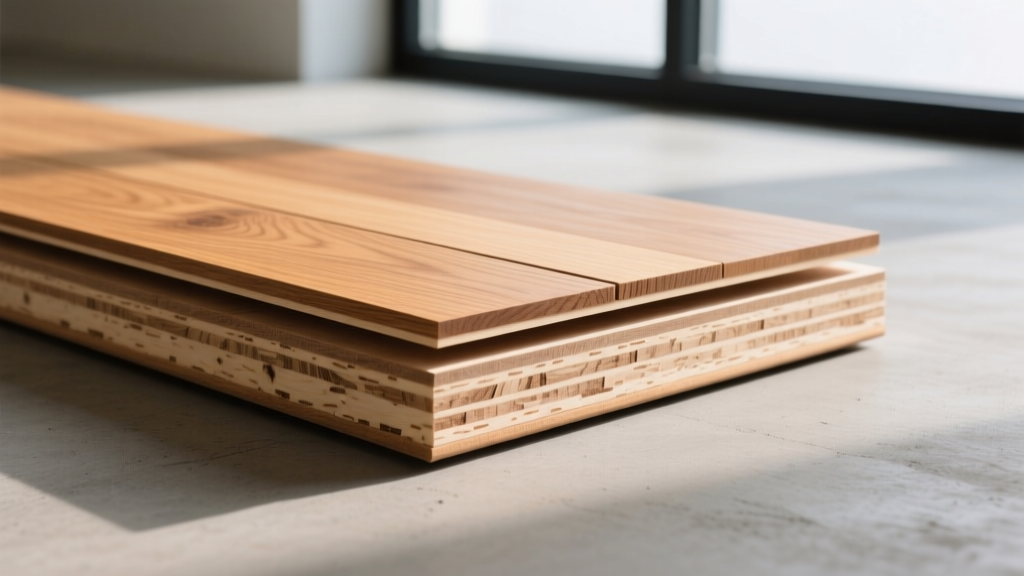
Engineered wood flooring is a composite system where the top veneer provides the aesthetic and the core substrate dictates dimensional stability. When evaluating the types of engineered wood flooring, the core construction is the primary indicator of structural quality and lifespan. A premium veneer bonded to an inferior core will still fail under humidity fluctuations.
| Core Type | Construction Details | Dimensional Stability | Moisture Tolerance | Best Application |
|---|---|---|---|---|
| Baltic Birch Plywood | 9 to 11 cross-banded plies of 100% birch veneer. | Excellent | High | Over concrete, radiant heat, wide planks (>7"). |
| HDF (High-Density Fiberboard) | Compressed wood fibers with resin; typically features click-lock edges. | Fair | Poor (swells if water penetrates joints) | Above-grade dry rooms, budget-conscious floating installs. |
| Softwood / Finger-Jointed Pine | 3 to 5 layers of cross-laminated spruce or pine. | Good | Moderate | Nail-down or glue-down over wood subfloors. |
Decoding Veneer Thickness and Refinishing Math
The wear layer (veneer) thickness determines the floor's lifecycle. However, manufacturers often market total board thickness (e.g., 5/8") rather than the actual sandable veneer. According to the National Wood Flooring Association (NWFA), a floor can only be sanded down to the tongue-and-groove profile, not the full thickness of the veneer.
The Sandable Veneer Matrix
- 0.6mm to 1.2mm (Rotary Peeled): Zero refinishes. Expected lifespan of 10-15 years. The finish wears through to the raw wood, requiring total replacement.
- 2mm to 3mm (Sliced): One professional refinish. The sandable layer above the tongue is roughly 1.5mm. A single drum sander pass removes 0.75mm to 1mm of material.
- 4mm to 6mm (Dry Sawn): Three to five refinishes. The sandable layer is 3mm+. This matches the lifecycle of solid hardwood (50+ years) and is the only specification recommended for high-traffic commercial or generational residential use.
Wood Grading Standards: From Select to Rustic
Wood grading in engineered flooring refers to the visual character and structural clarity of the top veneer, governed by NHLA (National Hardwood Lumber Association) and NWFA standards. Grade does not dictate the hardness of the wood, but it heavily influences the manufacturing yield and final price.
Grade Comparison Breakdown
Select / Clear Grade
- Visuals: Uniform color, minimal sapwood, no knots larger than 1/4 inch.
- Quality Factor: Highest yield of defect-free wood. Best for achieving a seamless, contemporary aesthetic.
- Cost Premium: 20-30% higher than Character grades.
Character / #1 Common Grade
- Visuals: Moderate color variation, pin knots up to 1/2 inch, occasional mineral streaks.
- Quality Factor: The industry standard for residential builds. Offers natural wood character without structural weak points.
Rustic / #2 Common Grade
- Visuals: High color contrast, prominent sapwood, knots up to 2 inches, and surface checks.
- Quality Factor: Requires rigorous factory epoxy filling. If purchased from budget manufacturers, rustic grades often feature poorly sanded knot fills that pop out within the first year.
Slicing Methods: How the Cut Dictates Stability
The method used to slice the veneer from the log fundamentally alters the grain pattern and the wood's reaction to moisture. The USDA Forest Products Laboratory Wood Handbook details how tangential vs. radial shrinkage impacts dimensional stability.
- Rotary Peeling: The log is mounted on a lathe and peeled like a roll of paper. This yields the most material (lowest cost) but creates 'lathe checks'—micro-fractures on the tight side of the veneer. These checks can cause finish adhesion failure and telegraphing over time.
- Plain Slicing: The log is sliced parallel to the center, producing a 'cathedral' grain pattern. It is stable but prone to tangential shrinkage across the width of the plank.
- Quarter Sawn: The log is quartered and sliced perpendicular to the growth rings. This exposes the radial face, which shrinks 50% less than the tangential face. Quarter-sawn veneer is mandatory for engineered planks wider than 7 inches to prevent edge-cupping and face-checking.
2026 Pricing Matrix by Grade and Core Type
Material costs for engineered wood flooring have stabilized following supply chain adjustments, but premium thick-veneer products command a distinct premium. The following ranges reflect Q1 2026 material-only pricing per square foot for White Oak, the current market benchmark.
| Specification Profile | Veneer Cut / Thickness | Core Material | Grade | Material Cost (per sq. ft.) |
|---|---|---|---|---|
| Builder Grade / Multifamily | Rotary Peeled / 1.2mm | HDF Click-Lock | Character | $3.50 - $5.00 |
| Standard Residential | Plain Sliced / 2mm | Softwood 3-Ply | Select | $6.50 - $8.50 |
| Premium / Custom Home | Quarter Sawn / 4mm | Baltic Birch 9-Ply | Select | $9.50 - $13.00 |
| Wide Plank / Architectural | Dry Sawn / 6mm | Baltic Birch 11-Ply | Character | $14.00 - $18.50+ |
Critical Failure Modes and Prevention
Even high-grade engineered flooring will fail if environmental parameters are ignored. Understanding these failure modes is essential for specifying the right product for the right environment.
Delamination from Radiant Heat
Engineered floors rely on adhesives (typically PVA or polyurethane) to bond the veneer to the core. If hydronic or electric radiant heat systems exceed 85°F (29°C) at the floor surface, the adhesive can soften and degrade, leading to veneer delamination. Fix: Specify floors manufactured with high-temperature cross-linked polyurethane adhesives and mandate in-floor temperature sensors capped at 80°F.
Face-Checking in Low Humidity
When winter RH drops below 30%, the top veneer shrinks faster than the plywood core, causing the face of the wood to split (check). Fix: This is almost exclusively seen in plain-sliced or rotary-peeled veneers. Specify quarter-sawn veneers and maintain interior RH between 35% and 55% using whole-home humidification.
Telegraphing over Imperfect Subfloors
HDF and thin softwood cores will 'telegraph' or mirror the imperfections of the subfloor below, causing visible ridges and joint stress. Fix: For HDF engineered floors, the subfloor must be leveled to within 3/16 inch over a 10-foot radius using a Portland cement-based self-leveling underlayment before installation.
Written by
Elena RodriguezElena Rodriguez is a civil engineer and technical writer specializing in concrete technology, masonry systems, and ASTM/ACI compliance. She earned her B.S. in Civil Engineering from Texas A&M University and spent a decade at a materials testing laboratory, performing over 2,000 concrete compressive strength tests and masonry prism evaluations. Elena is an ACI-certified Field Testing Technician (Grade I) and a member of ASTM Committee C12 on Natural Building Stone. She currently consults on forensic engineering cases involving concrete failures and moisture intrusion. Based in San Antonio, TX, Elena is a proud member of the Society of Women Engineers (SWE) and coaches her daughter's FIRST Robotics team.
More from Elena Rodriguez
View all
Walls & Panels
Cost Analysis: Light Gauge Steel Framing Advantages and Disadvantages
Evaluate light gauge steel framing advantages and disadvantages through a strict cost analysis lens, comparing material, labor, and lifecycle expenses.
Aug 4, 2026

Walls & Panels
Gypsum Board Types: Exact Specifications, Thickness & Dimensions
Compare standard, Type X, and moisture-resistant gypsum board types. Get exact specifications, thicknesses, dimensions, and ASTM standards for your project.
Aug 4, 2026

Fire Resistance
Best Fire-Resistant Outdoor Decking Materials: 2026 Buyer Guide
Discover the best fire-resistant outdoor decking materials for 2026. Compare Class A PVC, aluminum, and hardwood options for WUI compliance and safety.
Aug 4, 2026