What Type of Wood is Best for Cutting Boards? Hardness & Grain Guide
Discover what type of wood is best for cutting boards. Compare Janka hardness, grain types, and top species like maple, walnut, and cherry.

The Science of Cutting Board Wood: Janka Hardness & Grain Structure
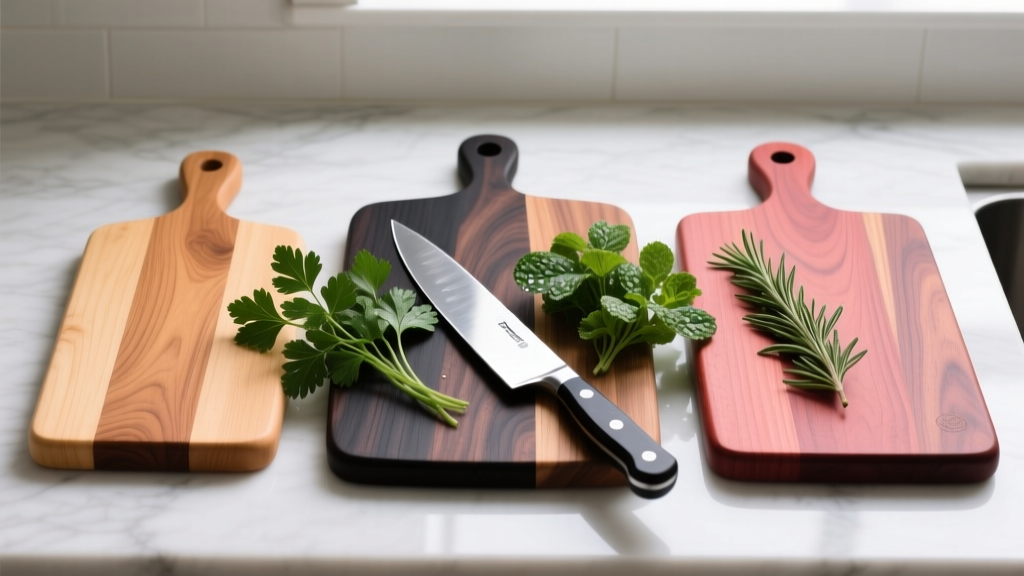
When determining what type of wood is best for cutting boards, the answer relies on two measurable anatomical factors: Janka hardness and pore structure (grain). A cutting board must strike a precise mechanical balance. If the wood is too soft, knife edges will gouge deep trenches that harbor pathogenic bacteria. If the wood is too hard, the surface will act like glass, rapidly rolling and dulling the micro-bevel of your kitchen knives.
Beyond hardness, cellular structure dictates food safety. Woods are broadly categorized into closed-grain (diffuse-porous) and open-grain (ring-porous). Closed-grain woods have microscopic pores that are tightly packed and often plugged with tyloses, preventing moisture and food particles from penetrating the surface. Open-grain woods feature large, visible capillaries that trap meat juices and bacteria, making them fundamentally unsanitary for direct food preparation.
Top Tier Hardwoods: A Head-to-Head Comparison Matrix
Based on the 900–1,500 lbf hardness criteria and closed-grain requirements, four domestic and imported species dominate the premium cutting board market. Below is a structural and economic comparison based on current 2026 specialty lumber pricing.
| Wood Species | Janka Hardness (lbf) | Grain Type | Knife Feel | Avg. Price (per Board Foot) |
|---|---|---|---|---|
| Hard Maple (Sugar Maple) | 1,450 | Closed / Diffuse | Excellent | $7.00 - $10.00 |
| Black Walnut | 1,010 | Closed / Diffuse | Very Good | $11.00 - $15.00 |
| American Cherry | 995 | Closed / Diffuse | Good (Slightly Soft) | $8.50 - $12.00 |
| Teak (Plantation) | 1,070 | Closed | Fair (High Silica) | $28.00 - $38.00 |
Hard Maple remains the undisputed industry standard. Its tight grain and high hardness make it the default choice for commercial butcher blocks. Black Walnut offers a striking dark aesthetic and is slightly softer, making it highly forgiving on expensive Japanese high-carbon knives. Teak is incredibly rot-resistant due to its natural rubber and oil content, but it contains high levels of silica, which will prematurely dull knife edges compared to maple or walnut.
Grain Orientation: End-Grain vs. Edge-Grain vs. Face-Grain
Once you select the species, the way the lumber is milled and glued drastically alters the board's performance, lifespan, and price point.
1. End-Grain (The Professional Choice)
- Structure: The board is constructed by gluing together blocks of wood with the end-grain facing up.
- Performance: Knife blades slip between the vertical wood fibers rather than severing them. This creates a "self-healing" surface where the fibers close back up after cutting, minimizing visible scarring.
- Drawbacks: Requires 40% more mineral oil maintenance, as the exposed capillaries wick moisture rapidly. Typically costs 2x to 3x more than edge-grain due to labor-intensive glue-ups.
2. Edge-Grain (The Pragmatic Workhorse)
- Structure: Long planks are turned on their sides and glued together, presenting the tightest, most stable face of the wood grain.
- Performance: Highly resistant to warping and moisture absorption. Easier to clean and maintain than end-grain.
- Drawbacks: Knife cuts sever the wood fibers permanently, meaning deep scratches will accumulate over years of heavy use.
3. Face-Grain (The Aesthetic/Charcuterie Board)
- Structure: The wide, flat face of the board is used as the cutting surface.
- Performance: Showcases the most dramatic figure and grain patterns (especially in walnut and cherry).
- Drawbacks: The least stable orientation. Highly prone to cupping and warping if exposed to uneven moisture. Shows knife scratches almost immediately. Best reserved for light bread slicing or serving charcuterie.
Woods to Avoid: Toxicity and Open-Grain Hazards
Equally important to knowing what type of wood is best for cutting boards is knowing which woods to strictly avoid. The most common mistake consumers make is purchasing Red Oak or White Ash boards. While these woods are hard enough (Red Oak is 1,290 lbf), they are ring-porous. Under a microscope, Red Oak resembles a bundle of open drinking straws. When used to cut raw poultry or beef, blood and bacteria are drawn deep into these open pores via capillary action, where surface washing and sanitizing cannot reach them.
Softwoods like Pine, Cedar, and Fir must also be avoided. Their Janka ratings fall well below 500 lbf, meaning they will develop deep, bacteria-harboring gouges within weeks of use. Additionally, pines contain high levels of terpene resins, which can impart a bitter, turpentine-like flavor to food.
Maintenance Realities: Oiling, Warping, and Lifespan
Even the finest Hard Maple board will crack and harbor bacteria if improperly maintained. The cellular structure of wood requires lipid saturation to repel ambient moisture and prevent the board from drying out and splitting.
- The Right Oil: Use only USP-grade (food-safe) mineral oil. Never use olive oil, vegetable oil, or flaxseed oil. These organic oils contain triglycerides that will oxidize, polymerize improperly, and turn rancid, causing the board to smell foul and potentially contaminating food.
- The Sealing Wax: After oiling, apply a board cream made from a blend of mineral oil and natural beeswax. The wax fills the microscopic surface pores, creating a physical moisture barrier that pure oil cannot achieve.
- The Water Bead Test: To determine if your board needs maintenance, splash a few drops of water on the surface. If the water beads up, the lipid barrier is intact. If the water immediately darkens the wood and absorbs into the grain, it is time to re-oil.
- Washing Protocol: Wash with warm water, mild dish soap, and a stiff brush. Never submerge a wooden board in water, and never run it through a dishwasher. The rapid thermal expansion and prolonged moisture exposure will instantly delaminate the glue joints and cause severe cupping.
For comprehensive guidelines on sanitizing porous food-contact surfaces in both residential and commercial environments, refer to the FDA Food Code, which outlines specific requirements for cutting surface maintenance to prevent cross-contamination.
Final Verdict: Which Wood Should You Buy?
If you want the ultimate, heirloom-quality board for heavy daily prep and raw meat processing, invest in an End-Grain Hard Maple board. It offers the highest structural integrity and longevity. If you are a culinary enthusiast who uses delicate, high-hardness Japanese knives (like VG-10 or SG2 powdered steel) and prefers a striking visual aesthetic, an Edge-Grain Black Walnut board provides the perfect balance of knife-edge preservation, closed-grain sanitation, and rich color.
Frequently Asked Questions
Is bamboo a good material for cutting boards?
Bamboo is technically a grass, not a wood. While strand-woven bamboo is very hard (approx. 1,380 lbf) and highly moisture-resistant, it contains high levels of natural silica. This silica acts as a mild abrasive, which will dull your knife edges significantly faster than traditional hardwoods like maple or walnut. It is acceptable for light prep, but not ideal for expensive cutlery.
Can I use olive oil to condition my wooden cutting board?
No. Olive oil and other cooking oils (canola, vegetable, peanut) are organic fats that will eventually oxidize and go rancid inside the wood fibers. This results in a foul odor and can transfer spoiled flavors to your food. Always use inert, food-grade mineral oil.
How thick should a high-quality wooden cutting board be?
For edge-grain boards, a minimum thickness of 1.25 inches is required to prevent warping and provide enough mass to stay stationary during heavy chopping. For end-grain boards, the standard thickness is between 1.5 and 2.5 inches to accommodate the cross-sectional glue joints and provide structural stability.
For deeper structural data on wood density, shrinkage rates, and mechanical properties across hundreds of species, consult the USDA Forest Service Wood Handbook.
Written by
Priya KapoorPriya Kapoor is a real estate market analyst and construction economics researcher with expertise in housing affordability, development feasibility, and infrastructure investment. She holds a Master of Regional Planning from Cornell University and previously worked as a senior analyst at CBRE's Investment Properties group, where she modeled returns for $4B in mixed-use development pipelines. Priya now runs an independent research practice advising developers, municipalities, and REITs on construction cost forecasting and market timing. She publishes the quarterly "BuildMat Market Pulse" report tracking material price indices across 12 commodity categories. Based in Austin, TX, Priya serves on the board of Habitat for Humanity Austin and is a marathon runner.
More from Priya Kapoor
View all
Construction Cost
Cost to Build a 1600 Sq Ft Home in 2026: Full Breakdown
Accurate 2026 cost to build a 1600 sq ft home—material, labor, and regional pricing breakdowns included. Plan your budget with real-time estimates.
Aug 11, 2026

Wood & Lumber
Name the Types of Wood for Pressure Treatment and Preservation
Learn how to name the types of wood best suited for pressure treatment. Compare species treatability, chemical retention levels, and 2026 preservation costs.
Aug 4, 2026

Stone & Masonry
Stone Veneer Suppliers Lindenhurst: 2026 Cost Analysis
Analyze 2026 stone veneer costs in Lindenhurst, NY. Compare local supplier pricing, delivery fees, and Suffolk County installation labor rates.
Aug 4, 2026