Best Faux Wood Flooring Options Compared for 2026
Compare the best faux wood flooring options for 2026. We break down LVP, WPC, SPC, and laminate costs, wear layers, and waterproof capabilities.

The 2026 Landscape of Faux Wood Flooring Options
Solid hardwood remains a benchmark for resale value, but faux wood flooring options have captured over 60% of the residential remodeling market. The shift is driven by advancements in Embossed-in-Register (EIR) texturing, which perfectly aligns the physical texture with the visual wood grain, and the advent of 100% waterproof rigid cores. When evaluating faux wood flooring options today, the decision is no longer about settling for an imitation; it is about selecting the right polymer or composite core for your specific moisture, traffic, and subfloor conditions.
Material Showdown: LVP vs. WPC vs. SPC vs. Laminate
The term "faux wood" encompasses several distinct material categories. Understanding the core composition is critical, as it dictates dimensional stability, underfoot comfort, and acoustic performance.
| Material | Core Composition | Waterproof? | Avg Material Cost (2026) | Best Application | Underfoot Feel |
|---|---|---|---|---|---|
| Standard LVP | Flexible PVC | Yes | $1.50 - $3.00 / sq ft | Low-traffic residential | Soft, flexible |
| WPC (Wood Plastic Composite) | PVC + Wood Flour + Foaming Agent | Yes | $3.00 - $6.00 / sq ft | Residential, bedrooms, living areas | Soft, warm, quiet |
| SPC (Stone Plastic Composite) | PVC + Limestone Dust | Yes | $2.50 - $5.00 / sq ft | Commercial, heavy traffic, kitchens | Hard, rigid, dense |
| Laminate | High-Density Fiberboard (HDF) | No (Water-Resistant) | $2.00 - $4.50 / sq ft | Dry residential areas | Hard, acoustic echo |
| Porcelain Tile | Fired Clay & Minerals | Yes | $4.00 - $9.00 / sq ft | Wet areas, patios, radiant heat | Cold, extremely hard |
Rigid Core Deep Dive: WPC vs. SPC
The biggest battleground in modern faux wood flooring options is between WPC and SPC. Both are classified as rigid core luxury vinyl, but their structural differences dictate their performance.
WPC: The Comfort Choice
WPC incorporates a foaming agent and wood flour into the PVC core. This creates microscopic air pockets, making the plank thicker (typically 6mm to 8mm) and significantly softer underfoot. WPC excels at absorbing sound and masking minor subfloor imperfections. However, the foamed core is more susceptible to indentation from heavy, concentrated loads, such as grand pianos or heavy appliance legs.
SPC: The Durability Workhorse
SPC replaces the wood flour with limestone dust, creating an ultra-dense, rock-solid core (typically 4mm to 6mm thick). SPC is virtually immune to indentation and handles extreme temperature fluctuations without expanding or contracting. If you are installing over a radiant heating system or in a sunroom with high thermal variance, SPC is the mandatory choice. The trade-off is a harder underfoot feel and higher acoustic transmission, often requiring an attached acoustic backing pad.
While WPC can forgive minor subfloor flaws, SPC's rigid limestone core will not. If your subfloor has a variance greater than 3/16-inch over a 10-foot radius, the SPC locking mechanisms will eventually snap under foot traffic. Always use a self-leveling compound before installing SPC.
Decoding Wear Layers: The "Mil" Misconception
A common mistake when comparing faux wood flooring options is conflating overall plank thickness with durability. Overall thickness (e.g., 5mm) affects the locking mechanism's strength and underfoot feel. True scratch and scuff resistance is determined solely by the wear layer, measured in mils (1 mil = 1/1000 of an inch).
- 6 to 8 mil (0.15mm - 0.2mm): Suitable only for light residential use (guest rooms, low-traffic bedrooms). Expect visible wear patterns within 3-5 years.
- 12 mil (0.3mm): The baseline standard for active households. Handles pets and daily foot traffic reasonably well.
- 20 mil (0.5mm): The premium residential and light commercial sweet spot. Highly resistant to scratching and required for homes with large dogs.
- 28+ mil (0.7mm+): Commercial grade. Features a urethane or ceramic bead topcoat for maximum scuff resistance. Often overkill for residential but guarantees a 20+ year pristine surface.
For laminate options, ignore mils and look for the AC Rating (Abrasion Criteria). According to the North American Laminate Flooring Association (NALFA), AC3 is standard residential, AC4 is heavy residential/light commercial, and AC5 is heavy commercial. Never install AC2 or lower in a primary living space.
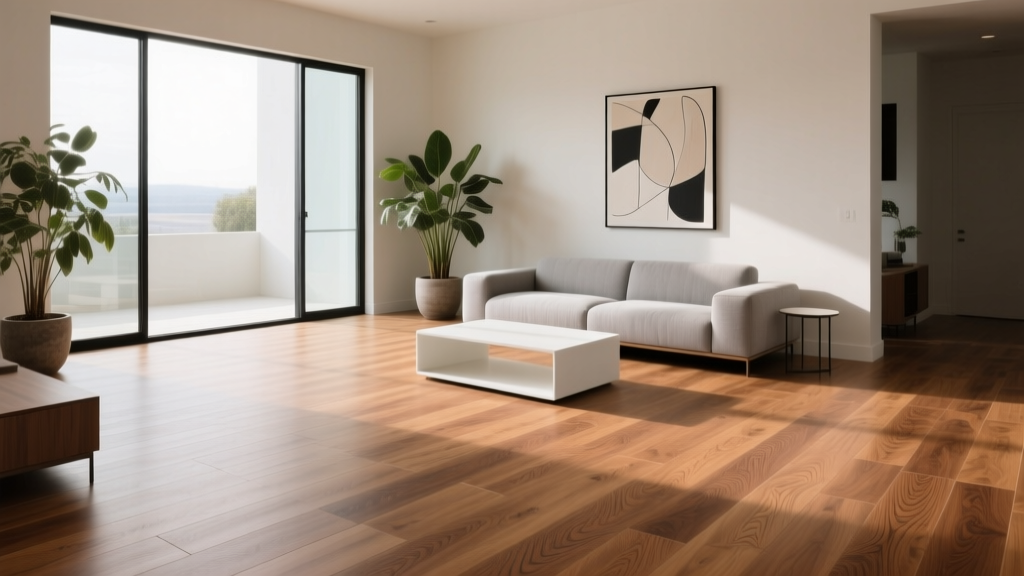
Visual Realism: EIR vs. Stamped Textures
The visual gap between real hardwood and faux options has closed entirely due to Embossed-in-Register (EIR) manufacturing. In older or budget-friendly "stamped" vinyl, the wood grain texture is applied randomly across the plank, meaning the physical ridges do not match the printed knots and grain lines. EIR technology uses precision-mapped steel plates to press the texture exactly where the visual grain dictates. When shopping, physically run your hand across the sample; if the tactile knots do not perfectly align with the visual knots, it is a stamped product and will look artificial under raking light.
Indoor Air Quality and Off-Gassing
Faux wood flooring options, particularly those utilizing PVC and adhesives, can emit Volatile Organic Compounds (VOCs). The EPA guidelines on indoor air quality emphasize that prolonged exposure to elevated VOCs can cause respiratory irritation and headaches. When evaluating products, do not rely on manufacturer marketing claims of "low odor." Instead, verify third-party testing:
- FloorScore: Certifies that the flooring meets strict indoor air quality emissions standards.
- GREENGUARD Gold: A more rigorous UL certification that ensures the product is safe for sensitive environments like schools and healthcare facilities, testing for over 360 VOCs.
Installation Gotchas: Moisture and Expansion
Even 100% waterproof faux wood flooring options will fail if moisture is trapped beneath them. A waterproof plank will not degrade in water, but trapped moisture will breed mold and degrade the subfloor. Before installation:
- Perform a Calcium Chloride Test: For concrete slabs, ensure the moisture vapor emission rate (MVER) is below 3-5 lbs per 1,000 square feet per 24 hours, depending on the manufacturer's spec sheet.
- Check pH Levels: New concrete slabs are highly alkaline. Ensure the pH is below 9 to prevent chemical degradation of the vinyl backing or adhesive.
- Maintain Expansion Gaps: Despite being labeled "waterproof," LVP, WPC, and SPC still experience thermal expansion. Leave a strict 1/4-inch gap around the entire perimeter, covered by baseboards or quarter-round molding.
Decision Framework: Which Option Fits Your Project?
Use this practical framework to finalize your selection based on your specific project parameters:
- Choose SPC if: You are installing over radiant heat, in a high-moisture commercial space, or in a home with heavy furniture and large dogs where indentation resistance is paramount.
- Choose WPC if: You are retrofitting an older home with slightly uneven subfloors, prioritizing acoustic dampening for multi-story buildings, or want a softer, warmer feel in bedrooms and living rooms.
- Choose Laminate if: You are on a strict budget, installing in dry, low-moisture areas (like a home office or formal dining room), and prioritize the ultra-realistic, hard-surface acoustic click of traditional wood.
- Choose Porcelain Wood-Look Tile if: You are building a wet room, a sun-exposed Florida room, or an outdoor covered patio where UV fading and absolute water immunity are non-negotiable, and you have the budget for professional thin-set installation.
Written by
James ThorntonJames Thornton is a construction industry veteran with 25 years of hands-on experience in wood framing, lumber grading, and residential building codes. He started as a framing carpenter in rural Oregon, earned his ICC Residential Building Inspector certification, and eventually became a senior plan reviewer for the City of Portland Bureau of Development Services. James holds a B.S. in Wood Science & Technology from Oregon State University and is a certified lumber grader through the West Coast Lumber Inspection Bureau (WCLIB). He has inspected over 3,000 residential construction sites and authored the city's internal guide on advanced framing techniques (2x6 at 24" O.C.). James lives in Bend, OR, where he builds custom timber-frame cabins and competes in lumberjack sports.
More from James Thornton
View all
Insulation
Best Home Insulation Materials: Complete 2026 Guide
Compare top home insulation materials for 2026. Find R-values, installed costs per square foot, and best uses for fiberglass, spray foam, and mineral wool.
Aug 4, 2026

Sustainable Building
Certify Your Green Building Material for LEED and WELL
Step-by-step guide to certifying a green building material for LEED v5 and WELL v2. Master EPDs, HPDs, and VOC limits for 2026 project specifications.
Aug 4, 2026

Stone & Masonry
Veneer Stacked Stone Panels: Interior Design & Style Showcase
Discover how veneer stacked stone panels transform interiors. Explore modern design profiles, material pairings, and technical installation specs.
Aug 4, 2026