Cabinet Grade Plywood Cost Estimator & Sheet Calculator 2026
Calculate exact cabinet grade plywood costs and sheet quantities for your 2026 project. Includes veneer, core, and grade pricing breakdowns.
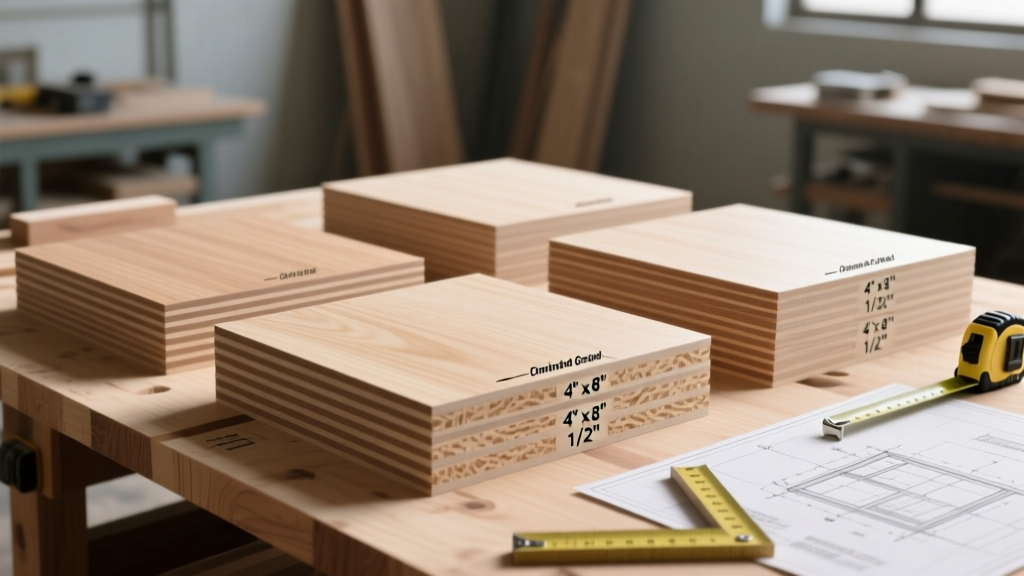
Decoding Cabinet Grade Plywood: Grades, Cores, and Yield
Estimating the cost of cabinet grade plywood requires moving beyond simple square-footage math. Unlike structural sheathing, hardwood plywood is priced and utilized based on a complex matrix of face veneer species, core substrates, and strict grading tolerances defined by the ANSI/HPVA HP-1-2020 standard. In 2026, supply chain stabilization has normalized lead times, but premium species like Black Walnut and Cherry continue to command significant market premiums due to sustainable logging restrictions.
To build an accurate budget, you must first define the core and the grade. 'Cabinet grade' is an industry colloquialism, not a technical specification. For high-end millwork, you are typically sourcing A1 or A2 graded panels. The 'A' face is smooth, defect-free, and sliced for optimal grain presentation, while the '1' or '2' back face permits minor, easily concealed defects.
Core Substrate Selection Framework
- Veneer Core (VC): Cross-banded layers of softwood/hardwood. Best for structural shelving and long spans. Excellent screw-holding capability. Prone to slight telegraphing if not properly sanded.
- MDF Core: Medium-density fiberboard center. Dead-flat surface ideal for paint-grade finishes and high-pressure laminates. Poor edge-screw retention; requires confirmat screws or dado/rabbet joinery.
- Particleboard Core (PBC): Economical and flat, but heavy and highly susceptible to moisture swelling. Rarely used in premium custom cabinetry today.
- Lumber Core: Edge-glued hardwood strips sandwiched between veneers. Superior for long, continuous edge-screwing (e.g., tall pantry doors), but carries a 20-30% price premium.
2026 Market Pricing Matrix: Species and Core Combinations
The following pricing reflects Q1 2026 wholesale-to-retail averages for standard 4x8 foot, 3/4-inch (19mm) thick panels. Prices fluctuate based on regional distribution and whether the veneer is rotary-sliced (cheaper, wider grain) or plain-sliced (premium, cathedral grain).
| Species / Grade | Veneer Core (VC) | MDF Core | Primary Use Case |
|---|---|---|---|
| Maple A1 | $115 - $135 | $125 - $145 | Stain-grade face frames, premium shelving |
| Maple Paint-Grade (A2) | $95 - $110 | $105 - $120 | Painted shaker doors, drawer boxes |
| Red Oak A1 | $90 - $110 | $100 - $115 | Traditional stain-grade cabinetry |
| Cherry A1 (Plain Sliced) | $165 - $195 | $175 - $205 | High-end custom furniture, library walls |
| Black Walnut A1 | $195 - $250 | $210 - $265 | Luxury architectural millwork, accent panels |
| Birch B2 (Utility Back) | $75 - $90 | $85 - $95 | Cabinet interiors, hidden structural dividers |
Step-by-Step Sheet Quantity & Yield Calculator
Dividing your total project square footage by 32 (the square footage of a 4x8 sheet) will result in a massive material shortage. Hardwood plywood requires rigorous yield calculations based on grain matching, defect avoidance, and saw kerf loss. Use the following framework to calculate your true sheet requirements.
- Calculate Raw Square Footage: Measure the exact visible surface area of all cabinet boxes, panels, and shelving. (e.g., 150 sq. ft.).
- Apply the Saw Kerf & Defect Factor: Standard 1/8-inch kerf on a table saw removes material with every cut. Add 8% to your raw square footage to account for kerf loss and minor veneer face defects that must be cut around. (150 * 1.08 = 162 sq. ft.).
- Apply the Grain Matching Yield Multiplier:
- Standard / Unmatched Grain (Paint Grade or utility interiors): Multiply by 1.25 (75% sheet yield).
- Book-Matched / Sequential Grain (High-end stain grade): Multiply by 1.50 to 1.65 (60% sheet yield). Sequential veneer slicing requires cutting panels in exact order from the same flitch.
- Final Sheet Calculation: Divide the adjusted square footage by 32, then round up to the nearest whole sheet. (162 * 1.25 = 202.5 sq. ft. / 32 = 6.32 sheets. Order 7 sheets).
Hidden Cost Variables: Edge Banding and Tooling
The sheet cost is only the baseline. Unfinished plywood edges must be covered, and machining MDF-core panels introduces secondary expenses that frequently break project budgets.
MDF core contains high levels of urea-formaldehyde resin and dense fiber that rapidly dulls standard carbide saw blades and router bits. If your project utilizes more than 10 sheets of MDF-core plywood, budget an additional $80-$120 for a premium high-ATB (Alternate Top Bevel) scoring blade or a compression router bit to prevent bottom-face veneer tear-out.
Edge Banding Cost Estimator
Pre-glued veneer edge banding is applied using a hot iron or edge-banding machine. Calculate linear footage for all exposed edges, adding 15% for trimming and overlap waste.
- Standard Pre-Glued Wood Tape (15/16" wide): $0.45 - $0.85 per linear foot (Maple, Oak, Birch).
- Premium / Exotic Pre-Glued Tape: $1.20 - $2.50 per linear foot (Walnut, Cherry, Quarter-Sawn Oak).
- PVC / Melamine Banding (for interiors): $0.25 - $0.40 per linear foot.
Compliance with Architectural Woodwork Institute (AWI) Standards
For commercial projects or high-end residential builds governed by an architect, your plywood selection must align with Architectural Woodwork Institute (AWI) standards. AWI categorizes cabinetry into three grades: Premium, Custom, and Economy.
AWI Premium Grade Requirement: Mandates the use of A1 or A2 face veneers. For transparent finishes, the face veneer must be plain-sliced or quarter-sliced; rotary-sliced veneers are strictly prohibited due to their unnatural, stretched grain appearance. Core telegraphing must be completely eliminated, often requiring a secondary cross-band layer or MDF core.
If your project specifications cite 'AWI Premium,' you must exclude B-grade panels and rotary-sliced options from your estimator, which will increase your baseline material costs by approximately 22% to 35% compared to standard residential builder-grade allowances.
Procurement Strategy for 2026
To optimize costs without sacrificing grade integrity, utilize a 'mixed-core' procurement strategy. Specify expensive A1 MDF-core panels exclusively for tall, highly visible doors and drawer fronts where dead-flat stability is critical. Use A1 or B1 Veneer-core panels for structural cabinet boxes, shelving, and internal dividers where screw-holding strength is required and surface flatness is secondary. This hybrid approach typically reduces total hardwood plywood expenditure by 12% to 18% on full-kitchen millwork packages.