Different Types of Wood Colors: A Selection Framework for Builders
Master the selection of different types of wood colors with our builder's framework covering UV aging, heartwood ratios, and finish chemistry.

The Chromatic Spectrum of Structural and Finish Lumber
When architects, interior designers, and builders evaluate different types of wood colors, the decision extends far beyond simple aesthetic preference. Wood color is a complex chemical property dictated by extractives, lignin concentration, and cellular structure. Selecting the right timber requires a rigorous framework that accounts for photo-oxidation, finishing chemistry, and natural intra-species variations. A material that looks perfect on a sample board in a showroom will behave entirely differently once milled, finished, and exposed to ambient ultraviolet (UV) light on a job site.
This selection framework moves beyond basic color swatches, providing construction professionals with the technical data needed to predict long-term color stability, manage heartwood-to-sapwood ratios, and specify the correct chemical finishes to lock in the desired hue.
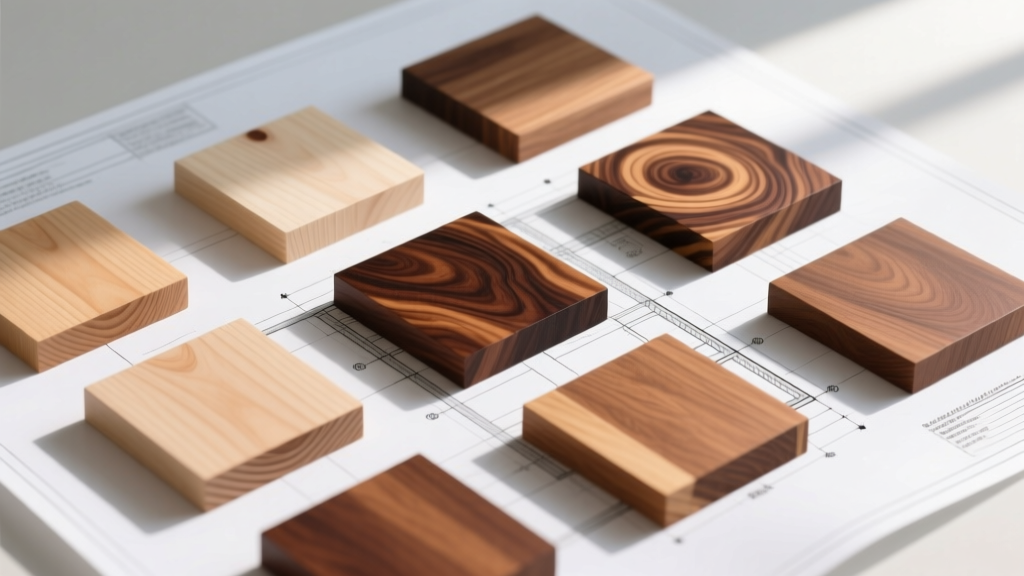
Natural Wood Color Classification Matrix
The baseline color of any lumber species is determined by its extractives—the non-structural chemical compounds deposited in the heartwood during the tree's growth. Below is a technical matrix of common architectural woods, detailing their natural hues and structural hardness.
| Species | Heartwood Baseline Color | Sapwood Color | Janka Hardness (lbf) | Primary Extractive Influence |
|---|---|---|---|---|
| Black Walnut | Deep chocolate to purplish-brown | Pale yellow-gray | 1,010 | Juglone and tannins |
| American Cherry | Light pinkish-brown | Pale creamy white | 950 | Flavonoids and phenolic compounds |
| Hard Maple | Light reddish-brown (rare) | Off-white to pale cream | 1,450 | Low extractive content |
| White Oak | Light to medium brown, olive undertones | White to light brown | 1,360 | Tyloses and high tannin content |
| Purpleheart | Vibrant violet to deep purple | Whitish to pale brown | 2,520 | Unique oxidizing resins |
The Lightfastness Factor: Predicting Color Shift Over Time
The most critical failure point in wood color selection is ignoring lightfastness. When UV light strikes wood, it triggers photo-oxidation, a chemical reaction that breaks down lignin and alters the wood's extractives. According to data from The Wood Database, this reaction is highly species-specific and entirely unavoidable in naturally lit environments.
Freshly milled American Cherry (Prunus serotina) starts as a pale, almost blonde pinkish-brown. Within six months of direct sunlight exposure, it oxidizes into a deep, rich reddish-brown. Conversely, Purpleheart (Peltogyne spp.) is prized for its vivid violet hue when freshly cut, but UV exposure rapidly degrades its unique resins, shifting the color to a permanent, muddy brown. If a client specifies Purpleheart for a sun-drenched atrium floor, you must manage expectations or specify a heavy UV-inhibitor coating.
To mitigate unwanted photo-oxidation, specifiers must integrate UV-blocking finishes into the material budget. Standard clear coats offer minimal UV protection. For high-value millwork, specify finishes containing hindered amine light stabilizers (HALS) or UV absorbers, such as Epifanes Wood Finish or specialized architectural lacquers.
Finish Selection Framework: Refractive Index and Chemistry
The finish applied to wood fundamentally alters its optical properties. When a liquid finish penetrates the wood's cellular structure, it changes the surface's refractive index, effectively 'wetting' the wood and making the natural color appear deeper and more saturated. This phenomenon, known as chatoyance, varies wildly based on the chemical composition of the topcoat.
Decision Tree for Finish Specification
- Goal: Preserve raw, light wood color (e.g., Hard Maple, White Ash).
Specification: Use a water-based 2K polyurethane (e.g., Bona Traffic HD) or a raw-effect penetrating oil (e.g., Rubio Monocoat Pure). Water-based resins do not amber over time and maintain the high-LRV (Light Reflectance Value) of pale woods. - Goal: Enhance warmth, depth, and grain contrast (e.g., Walnut, Cherry).
Specification: Use natural penetrating oils (e.g., Osmo Polyx-Oil) or traditional oil-based polyurethane. The linseed and tung oil bases naturally amber, enriching the red and brown extractives in the heartwood. - Goal: High-traffic commercial durability without color shift.
Specification: Moisture-cure urethane or factory-applied aluminum oxide finishes. These provide maximum abrasion resistance (ASTM D4060) while remaining optically clear.
Builders must also be aware of tannin bleed. Woods with high tannin content, like White Oak, will react with the ammonia and water in water-based finishes, sometimes causing a greenish or grayish discoloration if the wood is not properly sealed with a tannin-blocking primer or a specialized water-based sealer designed for high-tannin species.
Heartwood vs. Sapwood: Managing Intra-Species Variation
A common mistake in procurement is assuming a species name guarantees a uniform color. The National Hardwood Lumber Association (NHLA) grading rules dictate the allowable percentage of sapwood in a given grade, but sapwood lacks the pigmented extractives found in heartwood. In Black Walnut, the heartwood is a rich chocolate brown, while the sapwood is a stark, pale yellow.
To minimize the stark contrast between heartwood and sapwood, many mills steam Black Walnut before kiln-drying. This process forces the dark extractives from the heartwood into the pale sapwood, creating a more uniform, albeit slightly grayish-brown, overall board color. If your design requires the deep, pure chocolate tones of natural heartwood, you must explicitly specify 'Unsteamed, Heartwood-Face' Walnut in your purchase orders, which commands a 20% to 35% price premium over standard FAS grade steamed lumber.
For projects requiring absolute color consistency, such as large-format conference tables or continuous wall paneling, rely on 'Select' or 'Color-Matched' grades rather than standard FAS (Firsts and Seconds). FAS guarantees board size and clear cutting area, but it does not guarantee color uniformity.
Exterior Color Stability and Weathering Protocols
Exterior wood color selection introduces moisture and biological decay into the equation. When exposed to the elements, all wood species will eventually weather to a silvery-gray patina. This is caused by the leaching of water-soluble extractives and the photodegradation of surface lignin, as documented by the USDA Forest Products Laboratory.
If the design intent is to maintain the original color of exterior cladding or decking, penetrating film-forming finishes will inevitably fail due to moisture vapor transmission causing peeling. Instead, specify pigmented, penetrating oil finishes like Messmer's UV Plus or Ipe Oil. These products do not form a surface film; they soak into the cellular structure, repel liquid water, and utilize trans-iron oxide pigments to block UV radiation without hiding the wood's natural grain. Reapplication is required every 12 to 24 months depending on the local UV index and precipitation levels.
Sourcing Specifications for Consistent Millwork
To ensure the different types of wood colors you select translate perfectly from the design phase to the final build, implement the following specification language in your architectural documents:
- Define the Acceptable Sapwood Margin: Explicitly state the maximum allowable sapwood percentage per board face (e.g., 'Maximum 10% sapwood by surface area on exposed faces').
- Mandate Pre-Finish Samples: Require the millwork contractor to provide three 12x12 inch physical samples, finished with the exact specified topcoat, and aged under UV light for 14 days prior to final approval.
- Specify Milling Origin: Wood grown in different soil compositions and climates yields varying extractive densities. Specifying 'Appalachian-grown' Cherry or 'Midwest-grown' Walnut reduces the risk of batch-to-batch color variation on large-scale commercial projects.
By treating wood color as a dynamic, chemical property rather than a static visual trait, builders and designers can eliminate costly change orders, prevent client dissatisfaction, and deliver architectural woodwork that ages exactly as intended.
Written by
Marcus ChenMarcus Chen is a licensed structural engineer (PE) and building materials analyst with over 12 years of experience across residential, commercial, and industrial construction. He holds a Master of Science in Civil Engineering from UC Berkeley and spent six years at Thornton Tomasetti before transitioning to independent consulting and technical writing. Marcus specializes in material selection for seismic-prone regions, concrete reinforcement strategies, and lifecycle cost analysis. His work has been cited by the American Concrete Institute (ACI) and the Structural Engineers Association of California (SEAOC). When he is not on a job site or at his desk, you will find him hiking the Sierra Nevada or restoring a 1920s craftsman bungalow in Oakland, CA.
More from Marcus Chen
View all
Construction Cost
How Much Did the Eiffel Tower Cost to Build?
How much did the Eiffel Tower cost to build in 1889? We adjust for inflation and compare its budget to modern skyscraper construction.
Aug 4, 2026

Fire Resistance
What Is a Fire Resistant Material? Testing & Certification Guide
Discover what is a fire resistant material through ASTM and UL testing. Learn how fire ratings, certifications, and assemblies work in construction.
Aug 4, 2026

Construction Cost
How Much Did the Burj Khalifa Cost to Build?
How much did the Burj Khalifa cost to build? We break down the $1.5B project and extract 5 money-saving strategies for your next build.
Jul 30, 2026