Cedar Shakes Selection Guide: Species Taxonomy, Grades, and Costs
Master cedar shakes selection with our taxonomy guide. Compare Western Red vs. Yellow cedar species, grading standards, treatment types, and real costs.
The Fundamental Divide: Shakes vs. Shingles
Before specifying materials, architectural taxonomies require a strict distinction between cedar shakes and cedar shingles. While often used interchangeably in casual conversation, they are manufactured differently and perform differently on the roof deck.
Cedar Shakes are split from logs using a froe and mallet or hydraulic splitters. This mechanical splitting forces the wood to separate along its natural longitudinal grain. The resulting product is thicker, highly textured, and inherently resistant to moisture wicking because the cellular capillaries remain unbroken and aligned.
Cedar Shingles, conversely, are sawn on both sides. The sawing process cuts across the natural grain, creating a smooth, uniform taper but exposing cellular end-grains that can wick moisture if not properly treated or graded. Shakes require a minimum roof pitch of 3:12 (and often 4:12 depending on local codes), while sawn shingles can sometimes be applied on pitches as low as 2:12 with specialized underlayment.
Species Taxonomy: Western Red, Alaskan Yellow, and Eastern White
The performance of a cedar shake roof is inextricably linked to the botanical species harvested. The USDA Forest Products Laboratory categorizes these species by density, natural extractive content (tannins and oils that resist decay), and dimensional stability.
| Species | Botanical Name | Density (pcf) | Natural Decay Resistance | Best Application |
|---|---|---|---|---|
| Western Red Cedar | Thuja plicata | 22 | High (Heartwood) | Standard residential roofing, temperate climates |
| Alaskan Yellow Cedar | Callitropsis nootkatensis | 29 | Very High | Coastal zones, high-wind regions, harsh freeze-thaw |
| Eastern White Cedar | Thuja occidentalis | 20 | Moderate to High | Sidewall applications, historical restorations |
Selection Insight: Western Red Cedar (WRC) dominates the market due to its large log diameter, yielding long shakes (up to 24 inches). However, for coastal projects within 1,500 feet of saltwater, Alaskan Yellow Cedar is the superior specification. Its higher density and tighter growth rings resist wind-driven salt abrasion and mechanical erosion far better than the softer WRC.
Decoding Cedar Shake Grades and Grain Orientation
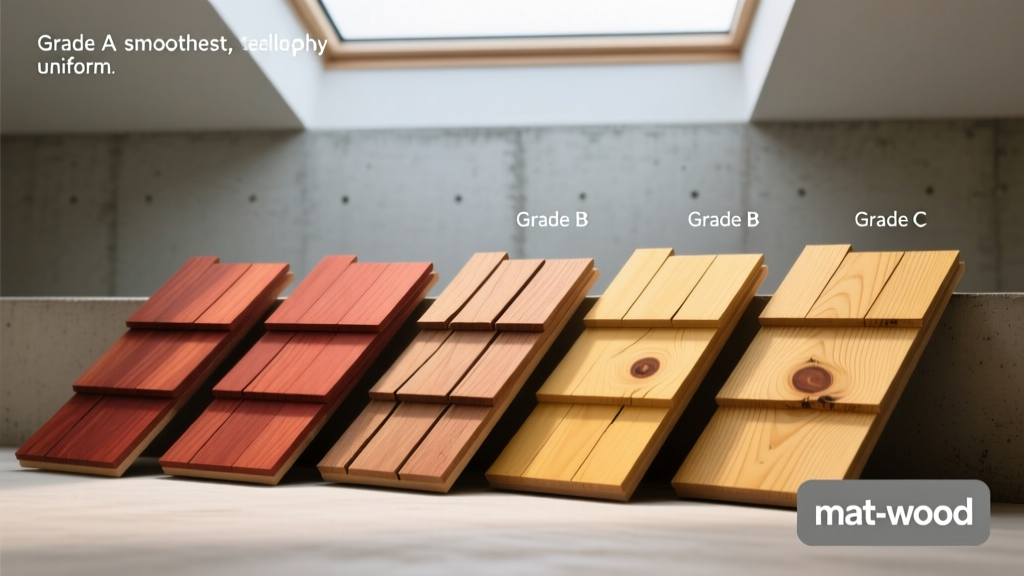
The Cedar Shake & Shingle Bureau (CSSB) enforces strict grading rules. The primary differentiator in shake grading is grain orientation and the presence of sapwood.
Edge Grain vs. Flat Grain
Edge Grain (Vertical Grain): The growth rings intersect the face of the shake at an angle greater than 45 degrees. This orientation is critical for roofing because edge-grain wood expands and contracts uniformly, preventing the 'cupping' and 'curling' that plague flat-grain wood when exposed to cyclic wetting and drying.
Flat Grain: The growth rings run parallel to the face. Flat-grain shakes are prone to severe cupping, which breaks the horizontal water-shedding plane and invites wind-driven rain infiltration.
The CSSB Grade Matrix
- Premium Grade: 100% edge grain, 100% clear heartwood. Zero sapwood. Mandatory for high-end architectural specifications and areas with severe freeze-thaw cycles.
- No. 1 Grade: 100% clear heartwood, but allows up to 15% flat grain. Excellent performance, but slightly higher risk of edge curling over a 30-year lifespan.
- No. 2 Grade: Permits some sapwood and flat grain. Suitable for sidewall applications or secondary structures, but not recommended for primary roof planes.
- No. 3 Grade: Utility grade with significant knots and sapwood. Strictly for temporary structures or under-courses.
Sapwood lacks the natural fungicidal extractives found in heartwood. If a No. 2 grade shake with exposed sapwood is installed on a north-facing roof plane with heavy canopy shade, localized rot will initiate in the sapwood bands within 7 to 10 years, compromising the fastener holding the shake.
Fire Codes, WUI Zones, and Preservative Treatments
Untreated cedar shakes are classified as Class C or unrated, making them illegal in many Wildland-Urban Interface (WUI) zones. The National Fire Protection Association (NFPA) and local building codes dictate strict assembly requirements for wood roofs in fire-prone regions.
Pressure-Impregnated Fire Retardant (PIFR) Shakes
To achieve a Class A fire rating (the highest, equivalent to asphalt or tile), manufacturers use pressure-impregnated fire retardants like ACQ (Alkaline Copper Quaternary) or specialized polymeric resins. PIFR shakes are not merely surface-coated; the chemicals are forced into the cellular structure.
Crucial Assembly Requirement: A Class A rating is rarely achieved by the shake alone. It requires a specific assembly: PIFR shakes installed over a minimum 72 lb. mineral-surfaced roll roofing underlayment, interwoven at every course. Using standard synthetic underlayment beneath Class A shakes will void the fire rating and fail municipal inspection.
Cost Breakdown: Material and Installation Metrics
Pricing for cedar shakes is calculated by the 'square' (100 square feet of covered roof area). The following metrics reflect current market rates for a standard 5,000 sq. ft. roof footprint (approx. 55 squares accounting for pitch and waste).
| Cost Component | Premium WRC (Untreated) | Class A PIFR WRC | Alaskan Yellow (Untreated) |
|---|---|---|---|
| Material (per square) | $450 - $600 | $550 - $750 | $650 - $850 |
| Specialized Underlayment | $45 - $65 | $85 - $120 | $45 - $65 |
| Labor & Installation | $650 - $850 | $750 - $950 | $700 - $900 |
| Total Installed (per sq. ft.) | $11.45 - $15.15 | $13.85 - $18.20 | $14.45 - $18.15 |
Note: Complex roof geometries (dormers, valleys, steep pitches over 8:12) will increase labor costs by 20% to 35% due to the meticulous hand-cutting required for woven valleys and ridge caps.
The Selection Decision Matrix
Use this framework to finalize your material specification based on site-specific variables:
Scenario 1: Coastal / High-Wind / Salt Spray Environment
- Species: Alaskan Yellow Cedar.
- Grade: Premium (100% Edge Grain).
- Fasteners: Type 316 Stainless Steel (Type 304 will corrode in salt air; hot-dipped galvanized will fail in under 5 years).
- Exposure: Reduce standard exposure by 1 inch to increase headlap and wind resistance.
Scenario 2: Wildland-Urban Interface (WUI) / Strict Fire Codes
- Species: Western Red Cedar (PIFR treated).
- Grade: No. 1 or Premium.
- Underlayment: 72 lb. mineral-surfaced roll roofing (required for Class A assembly).
- Maintenance: Schedule professional inspection every 5 years to ensure fire-retardant salts have not leached from excessive moss buildup.
Scenario 3: Humid, Heavy Canopy / Low Sunlight
- Species: Western Red Cedar.
- Grade: Premium (Edge grain only to resist cupping from constant moisture).
- Treatment: Specify factory-applied fungicide/mildewcide dip.
- Hardware: Install zinc or copper ridge strips to create a natural biocide wash over the roof plane during rain events.
Fastener and Exposure Specifications
Never use electro-galvanized nails. Specify hot-dipped galvanized (minimum) or stainless steel ring-shank nails. The nail length must penetrate a minimum of 3/4 inch into solid decking (typically 1-1/2 inch or 1-3/4 inch nails for 1/2 inch CDX plywood or spaced sheathing). For standard 18-inch shakes, the maximum weather exposure is 5.5 inches, yielding a 3-ply thickness at any point on the roof deck.