What Type of Wood to Use for Deck Projects: A Lumber Grade Guide
Discover exactly what type of wood to use for deck framing and boards. Learn lumber grades, moisture stamps, and species quality for lasting results.

Beyond the Species: Why Lumber Grades Dictate Deck Longevity
When deciding what type of wood to use for deck construction, most builders and homeowners focus exclusively on the species—debating the merits of pressure-treated pine versus Western Red Cedar or tropical hardwoods. However, species selection is only half the equation. The structural integrity, resistance to warping, and ultimate lifespan of your deck are fundamentally dictated by the lumber's grade and moisture content at the time of installation.
A premium species stamped with a low-grade rating will underperform a standard species with a high-grade stamp. This guide decodes the grading matrices, moisture acronyms, and quality control checkpoints you need to specify the exact right material for both your deck's structural framing and its visible walking surface.
Decoding the Grade Stamp: A Structural Matrix
Every piece of dimensional lumber carries an ink stamp from an accredited grading agency (such as the Southern Pine Inspection Bureau or the Western Wood Products Association). This stamp is your guarantee of load-bearing capacity and visual quality. Below is the matrix for the most common deck lumber grades.
| Grade Stamp | Species Commonality | Best Application | Defect Tolerance & Wane Limits |
|---|---|---|---|
| Select Structural | Southern Yellow Pine (SYP), Douglas Fir | Heavy-load framing, long-span joists | Very strict. Small, tight knots only. Minimal wane. |
| No. 1 | SYP, Spruce-Pine-Fir (SPF) | Standard joists, beams, and posts | Moderate. Allows larger knots but restricts slope of grain. |
| No. 2 | SYP, SPF, Hem-Fir | Standard deck framing (workhorse grade) | Higher knot tolerance. Wane allowed on edges but not bearing surfaces. |
| Select / C & Better | Western Red Cedar, Redwood | Premium surface decking, fascia, railings | Strict visual grade. Clear on one face, minor defects on the back. |
| FAS (First & Second) | Ipe, Cumaru, Tigerwood (Tropicals) | High-end surface decking | Minimum 83.3% clear-face cuttings. Exceptional stability. |
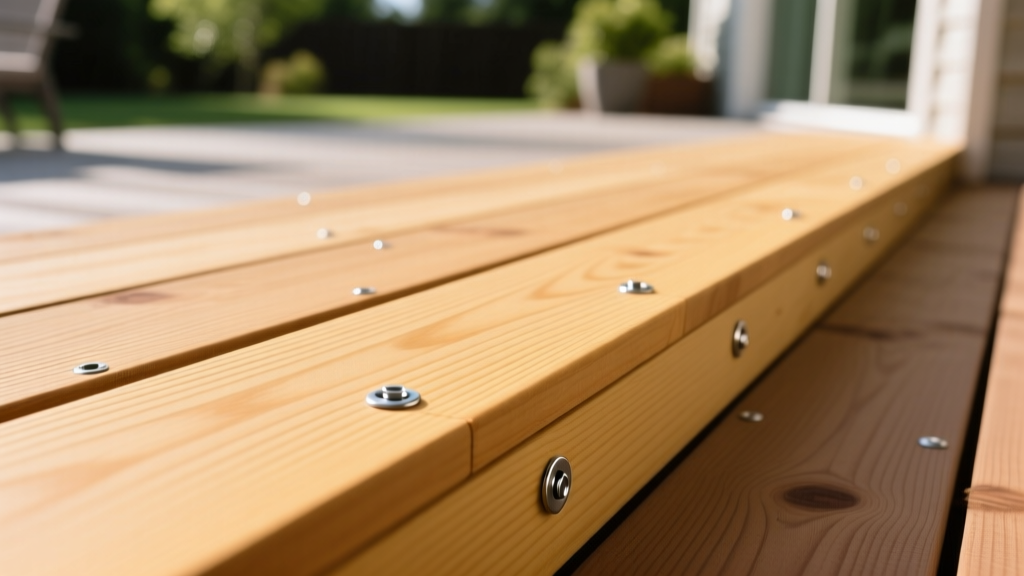
Structural Framing vs. Surface Decking: Divergent Quality Needs
The question of what type of wood to use for deck framing requires a completely different grading approach than surface decking. Framing lumber is evaluated for structural load capacity, while decking is evaluated for dimensional stability and visual appeal.
Never use lumber with excessive "wane" (missing wood or bark on the corner of the board) for joists or ledger boards. Wane reduces the actual bearing surface where the joist rests on the beam or ledger. According to the American Wood Council's DCA 6 Deck Construction Guide, joists must have a minimum 1.5-inch bearing surface. If wane compromises this, the joist can slip under dynamic loads.
Framing Requirements: The No. 2 Standard
For 90% of residential deck framing, No. 2 grade pressure-treated Southern Yellow Pine or Douglas Fir is the specified standard. No. 2 allows for knots that do not exceed specific size limits relative to the board's width, ensuring the board can handle the bending stress (Fb) and shear stress (Fv) required by local building codes. Always reject framing lumber that exhibits "pith" (the soft, spongy center core of the tree), as pith-containing boards are highly prone to severe twisting and splitting as they dry.
Decking Requirements: Visual and Stability Grades
For the walking surface, structural grades like No. 2 are unacceptable due to high knot counts, which lead to splintering, localized decay, and uneven weathering. For softwoods, specify Select or C & Better grades. These grades guarantee that the exposed face is virtually free of knots and pitch pockets, providing a smooth, splinter-free surface that takes sealants evenly.
Moisture Content and Kiln-Drying Standards
The moisture content (MC) of lumber at the time of installation is the primary driver of post-construction cupping, checking, and fastener pop-outs. Understanding the moisture acronyms on your grade stamp is non-negotiable.
Lumber shrinks significantly as it drops below the 30% fiber saturation point. A 2x6 SYP board installed at 35% MC (green) and drying to 12% MC (equilibrium) will shrink approximately 1/8 inch in thickness and 3/8 inch in width. This differential shrinkage is what causes deck boards to cup and pull out of standard screws.
- S-GRN (Surfaced Green): MC is above 19%. This lumber will experience maximum shrinkage. Avoid for decking; acceptable only for heavy timber framing that will be bolted, not screwed.
- S-DRY (Surfaced Dry): MC is 19% or less at the time of surfacing. The standard for most structural framing lumber.
- KDAT (Kiln-Dried After Treatment): The gold standard for pressure-treated decking. The wood is pressure-treated with preservatives, then kiln-dried back to an MC of 15-19%. KDAT lumber is significantly more dimensionally stable, lighter to carry, and ready to accept oil-based sealants immediately upon installation.
Tropical Hardwoods: Grading the Exotics
When the budget allows for tropical hardwoods like Ipe, Cumaru, or Garapa, the grading system shifts from the structural softwood rules to the National Hardwood Lumber Association (NHLA) standards. For exterior decking, you must specify FAS (First and Second) grade.
FAS requires that the board yields a minimum of 83.3% clear, defect-free cuttings. Because tropical hardwoods are incredibly dense (Ipe has a Janka hardness of 3,680 lbf, compared to SYP at 870 lbf), internal defects like hidden checks or mineral streaks can cause catastrophic splitting when driven with standard fasteners. FAS grading minimizes these internal faults. Always ensure tropical decking is kiln-dried to an MC of 12-14% and allowed to acclimate on-site for 7 to 10 days before installation to prevent end-checking.
2026 Cost vs. Quality Trade-Offs
Material costs fluctuate based on regional supply chains and mill quotas. The table below reflects average national pricing for Q1 2026, illustrating the premium paid for higher grades and specialized drying processes.
| Material & Grade | Moisture Standard | Avg. Cost (per linear foot, 2x6) | Expected Lifespan |
|---|---|---|---|
| PT SYP No. 2 (Standard) | S-DRY / S-GRN | $2.20 - $2.80 | 15 - 20 Years |
| PT SYP Premium (KDAT) | KDAT (15-19%) | $3.50 - $4.25 | 20 - 25 Years |
| Western Red Cedar Select | S-DRY / KD | $5.50 - $7.00 | 20 - 25 Years |
| Redwood Construction Common | S-DRY | $6.00 - $8.50 | 20 - 25 Years |
| Ipe (FAS Grade) | KD (12-14%) | $13.00 - $16.50 | 40 - 75+ Years |
The Lumber Yard Inspection Checklist
Even with the correct grade and species specified, individual boards can fail quality control. The USDA Forest Products Laboratory notes that localized grain deviations can compromise even top-tier graded lumber. Execute this physical inspection checklist at the yard before loading:
- Sight the Crown: Look down the length of the board from the end. Every board has a slight natural curve (crown). For joists, install them "crown up" so gravity and live loads flatten them over time. For decking boards, reject any with a crown exceeding 1/2 inch over a 12-foot span.
- Check for Spiral Grain: Look at the face of the board. If the grain lines wrap diagonally around the board rather than running parallel to the edges, reject it. Spiral grain guarantees the board will twist into a propeller shape as it dries.
Verify the End Stamp: Ensure the ink stamp clearly shows the grading agency logo, the species, the grade (e.g., "No. 2"), and the moisture condition (e.g., "S-DRY 19" or "KDAT"). Faded or missing stamps mean the board cannot be verified for code compliance. - Reject the Pith: Look at the end grain. If you see the concentric rings curving sharply upward or a distinct, spongy dot in the center of the board's width, it contains the pith. Pith is juvenile wood that lacks structural maturity and will split radially.
- Measure Wane on Joists: If buying No. 2 framing lumber, ensure wane does not extend more than 1/4 of the board's width, and never on the top or bottom edges where bearing and fastener withdrawal occur.
Final Specification Advice
Knowing what type of wood to use for deck projects requires matching the lumber's physical properties to its specific structural role. Specify KDAT pressure-treated No. 2 SYP for framing to balance cost and structural reliability, and invest in Select grade Cedar or FAS tropical hardwoods for the walking surface to ensure dimensional stability and aesthetic longevity. Always verify the grade stamp and moisture content in person—your deck's performance is only as good as the ink stamped on its worst board.
Written by
Elena RodriguezElena Rodriguez is a civil engineer and technical writer specializing in concrete technology, masonry systems, and ASTM/ACI compliance. She earned her B.S. in Civil Engineering from Texas A&M University and spent a decade at a materials testing laboratory, performing over 2,000 concrete compressive strength tests and masonry prism evaluations. Elena is an ACI-certified Field Testing Technician (Grade I) and a member of ASTM Committee C12 on Natural Building Stone. She currently consults on forensic engineering cases involving concrete failures and moisture intrusion. Based in San Antonio, TX, Elena is a proud member of the Society of Women Engineers (SWE) and coaches her daughter's FIRST Robotics team.
More from Elena Rodriguez
View all
Walls & Panels
Cost Analysis: Light Gauge Steel Framing Advantages and Disadvantages
Evaluate light gauge steel framing advantages and disadvantages through a strict cost analysis lens, comparing material, labor, and lifecycle expenses.
Aug 4, 2026

Walls & Panels
Gypsum Board Types: Exact Specifications, Thickness & Dimensions
Compare standard, Type X, and moisture-resistant gypsum board types. Get exact specifications, thicknesses, dimensions, and ASTM standards for your project.
Aug 4, 2026

Fire Resistance
Best Fire-Resistant Outdoor Decking Materials: 2026 Buyer Guide
Discover the best fire-resistant outdoor decking materials for 2026. Compare Class A PVC, aluminum, and hardwood options for WUI compliance and safety.
Aug 4, 2026