Difference Between Hardwood and Softwood: Brand Product Lines Compared
Explore the difference between hardwood and softwood through top brand product lines, comparing structural grades, Janka ratings, and 2026 pricing.
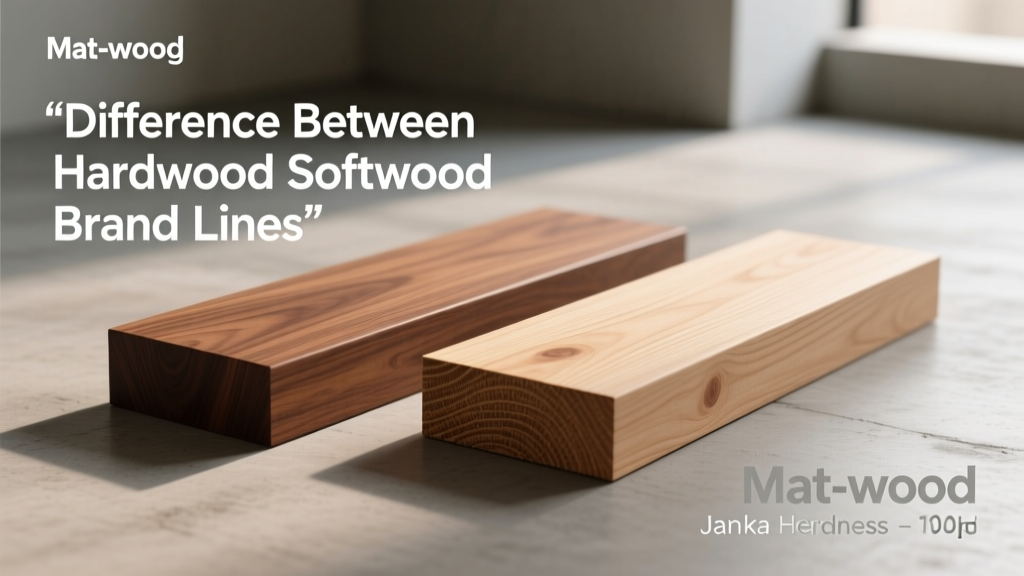
The Botanical Baseline vs. Commercial Reality
The commercial distinction between hardwood and softwood extends far beyond basic botanical classifications. For architects, builders, and procurement managers, the difference between hardwood and softwood is defined by product line engineering, structural grading, and brand-specific manufacturing processes. Botanically, hardwoods are angiosperms (broad-leafed, deciduous trees with enclosed seeds), while softwoods are gymnosperms (coniferous, needle-bearing trees with naked seeds). However, this biological divide does not strictly dictate physical hardness.
According to the USDA Forest Products Laboratory Wood Handbook, balsa is technically a hardwood despite its extreme softness, while yew is a softwood that is harder than many commercial hardwoods. In the modern building materials market, brands categorize these woods not by seed type, but by end-use application: softwoods dominate structural framing, engineered beams, and exterior applications, while hardwoods command the finish, flooring, and high-wear architectural markets.
Softwood Product Lines: Structural & Exterior Dominance
Softwood lumber accounts for roughly 80% of all timber used in global construction. Major manufacturers like Weyerhaeuser and Boise Cascade engineer softwood product lines to maximize load-bearing capacity, dimensional stability, and cost-efficiency.
Solid Framing and Machine Stress Rated (MSR) Lumber
Weyerhaeuser’s Southern Yellow Pine (SYP) product lines are the backbone of North American residential framing. Unlike standard visually graded lumber (e.g., #2 SYP), high-performance softwood lines utilize Machine Stress Rating (MSR). An MSR 2400f stamp indicates the wood has been mechanically tested to withstand a bending stress of 2,400 psi. This allows structural engineers to specify smaller softwood members for longer spans, reducing overall material volume. In 2026, premium MSR SYP framing costs approximately $5.50 to $7.20 per linear foot for 2x10 dimensions, reflecting a 12% premium over standard visually graded equivalents.
Engineered Softwood: LVL and PSL
When solid softwood dimensions are insufficient, brands deploy engineered composite lines. Boise Cascade’s Versa-Lam LVL (Laminated Veneer Lumber) peels softwood logs (typically Douglas Fir or Southern Pine) into thin veneers, dries them, and bonds them under heat and pressure with waterproof phenolic resins. The APA – The Engineered Wood Association notes that LVL eliminates natural softwood defects like knots and slope-of-grain, yielding a product with a predictable modulus of elasticity (E) exceeding 2.0 million psi. These softwood-based beams routinely replace solid hardwood or steel headers in commercial builds.
Hardwood Product Lines: Finish, Flooring, and High-Wear
Hardwood product lines prioritize aesthetics, surface durability, and wear resistance. Brands like AHF Products (parent of Bruce hardwood) and Shaw Industries engineer their hardwood lines around the Janka hardness scale, which measures the force required to embed a 0.444-inch steel ball halfway into the wood.
Solid Hardwood Flooring Lines
The National Wood Flooring Association (NWFA) tracks Janka ratings across commercial species. AHF Products’ Bruce line features solid Hickory (Janka rating: 1820 lbf) and solid White Oak (Janka rating: 1360 lbf) as their premium high-traffic offerings. These lines utilize precision-milled tongue-and-groove profiles and are typically finished with 7 to 9 coats of UV-cured aluminum oxide. Solid hardwood lines remain restricted to above-grade, nail-down installations due to their susceptibility to hygroscopic expansion. Material costs for premium 3/4-inch solid White Oak planks range from $7.50 to $11.00 per square foot in 2026.
Engineered Hardwood: The Cross-Ply Solution
To mitigate the dimensional instability of solid hardwood, brands engineer cross-ply product lines. Shaw’s Epic Plus engineered hardwood features a 3mm solid hardwood veneer (such as Maple or Walnut) bonded to a multi-ply softwood or HDF (High-Density Fiberboard) core. The perpendicular layering of the core neutralizes the hardwood’s natural tendency to cup or warp when exposed to moisture, allowing installation over concrete slabs and below-grade environments where solid hardwood would fail.
Head-to-Head Matrix: Brand Specifications & Cost Breakdown
The following matrix contrasts specific brand product lines across the hardwood and softwood divide, highlighting the technical specifications and 2026 market pricing that drive procurement decisions.
| Brand / Product Line | Wood Class | Primary Species | Janka Rating (lbf) | Primary Application | 2026 Avg. Material Cost |
|---|---|---|---|---|---|
| Weyerhaeuser SYP Framing | Softwood | Southern Yellow Pine | 870 | Structural Wall Framing | $4.15 / linear ft (2x6) |
| Boise Cascade Versa-Lam LVL | Softwood | Douglas Fir / SYP | N/A (Engineered) | Load-Bearing Headers / Beams | $14.50 / linear ft (1.75x11.875) |
| Bruce Oak Plains Solid | Hardwood | White Oak | 1360 | Above-Grade Nail-Down Flooring | $8.75 / sq ft |
| Shaw Epic Plus Engineered | Hardwood/Softwood Core | Hickory Veneer | 1820 (Wear Layer) | Float/Glue-Down Flooring | $10.20 / sq ft |
| Kebony Decking | Modified Softwood | Radiata Pine | 1500+ (Modified) | Exterior Decking / Cladding | $9.80 / linear ft (5/4x6) |
Modification Technologies: How Brands Bridge the Gap
The most significant innovation in modern lumber manufacturing is the use of chemical and thermal modification to force softwoods to perform like premium hardwoods. This blurs the traditional difference between hardwood and softwood in exterior applications.
Insight: The Furfuryl Alcohol Process
Brands like Kebony take fast-growing, low-density softwoods (Radiata Pine, Janka ~400 lbf) and impregnate them with furfuryl alcohol, an organic compound derived from agricultural waste. When heated, the alcohol polymerizes within the softwood’s cell walls. This permanent modification boosts the wood's Janka hardness to over 1500 lbf (rivaling White Oak) and achieves a Class 1 durability rating against rot, eliminating the need for toxic copper-based pressure treatments like ACQ or MCA.
Similarly, thermal modification brands like Thermory subject softwoods (like Scots Pine) and hardwoods (like Ash) to temperatures exceeding 400°F in an oxygen-depleted environment. This process permanently alters the hemicellulose in the wood, removing the sugars that attract moisture and insects. The resulting product is highly dimensionally stable, making thermally modified softwood a premier choice for exterior cladding and sauna interiors where traditional unmodified hardwoods would warp or degrade.
Procurement Framework: Selecting the Right Line for Your Build
Choosing between hardwood and softwood product lines requires matching the material's engineered properties to the specific environmental and structural demands of the project. Use the following decision framework during the specification phase:
- For Load-Bearing Framing & Long Spans: Specify softwood product lines. Standard SYP or Douglas Fir for conventional framing; upgrade to MSR-rated softwoods or LVL/PSL engineered softwoods for high-load headers, rim boards, and commercial roof trusses.
- For Interior High-Traffic Flooring: Specify solid or engineered hardwood lines. Demand a minimum Janka rating of 1200 lbf (e.g., White Oak, Hard Maple, Hickory) for commercial or heavy residential use. Avoid softwood flooring (like Pine or Fir) in high-traffic zones due to severe denting susceptibility.
- For Exterior Decking & Cladding: Evaluate modified softwoods against tropical hardwoods. While tropical hardwoods like Ipe (Janka 3680 lbf) offer extreme durability, they carry high costs and FSC-certification challenges. Modified softwood lines (Kebony, Thermory) provide equivalent lifespan and weather resistance at a 20-30% lower installed cost and with a vastly smaller carbon footprint.
- For Millwork and Cabinetry: Specify hardwood lines (Maple, Cherry, Walnut) for painted or stained cabinet faces where a smooth, dent-resistant finish is required. Softwoods like Alder or Pine can be used for rustic or distressed cabinetry lines where character marks and softness are aesthetic features rather than defects.
Understanding the difference between hardwood and softwood is no longer just about identifying tree leaves versus pine needles. It requires a deep analysis of brand-specific engineering, modification technologies, and structural grading to ensure the selected product line performs exactly as required over the lifecycle of the building.