Types of Dark Wood: Flooring Installation Best Practices
Master the installation of various types of dark wood flooring. Learn UV protection, acclimation, and scratch-prevention best practices.

Material Matrix: Matching Dark Wood Species to Installation Zones
When evaluating different types of dark wood for interior applications, installers must recognize that color alone does not dictate performance. Dark woods range from relatively soft domestic species to ultra-dense tropical exotics, each presenting unique mechanical and chemical challenges during installation. Selecting the correct species for the specific traffic and moisture profile of a zone is the first critical step in preventing premature failure.
| Wood Species | Janka Hardness (lbf) | Dimensional Stability | Best Installation Zone | Primary Installation Challenge |
|---|---|---|---|---|
| Black Walnut (Domestic) | 1,010 | High | Low-traffic residential, bedrooms | Denting and scratch visibility; requires pristine subfloor prep. |
| Wenge (Exotic) | 1,930 | Moderate | Commercial lobbies, high-traffic halls | Extreme splintering; dulls carbide blades rapidly; toxic dust. |
| Jatoba (Brazilian Cherry) | 2,820 | Low | Living areas, commercial spaces | Severe photo-oxidation (color shift); high tension causes cupping. |
| Macassar Ebony | 3,000+ | Very Low | Accent borders, low-moisture zones | Extreme movement with humidity swings; difficult to glue. |
According to the USDA Forest Products Laboratory Wood Handbook, the tangential shrinkage values of exotic dark woods like Jatoba can exceed 8%, meaning installation without adequate expansion gaps will inevitably result in lateral buckling during seasonal humidity drops.
Pre-Installation: Acclimation and Moisture Mapping
Dark woods are notoriously unforgiving when it comes to moisture imbalances. Because many dark finishes and natural dark species feature low-porosity grain structures, moisture transfer occurs slower than in open-grained species like red oak. This means standard 48-hour acclimation periods are often insufficient.
The target Equilibrium Moisture Content (EMC) for interior installations in 2026 remains between 6% and 9%, depending on the regional climate. The subfloor moisture must be within 2% of the flooring material for solid 3/4-inch planks, and within 1% for engineered dark wood products. Always map the subfloor using a grid pattern (one test per 100 square feet) and document the readings with timestamped photographs to protect against future liability claims.
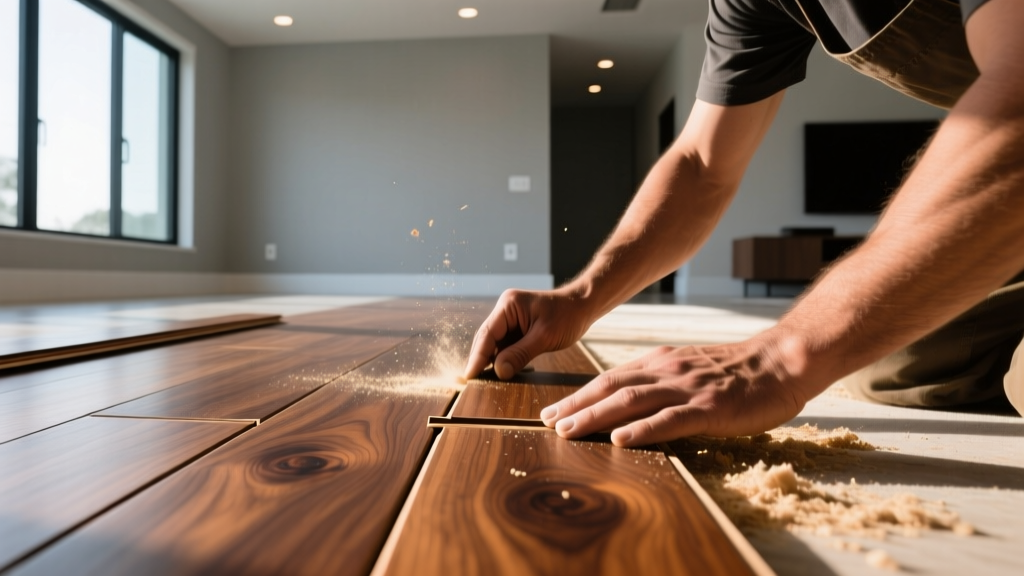
The Scratch and Dust Dilemma: Subfloor Prep and Handling
The most common complaint regarding types of dark wood flooring post-installation is the visibility of micro-scratches and dust accumulation in the bevels. Dark surfaces absorb light, making any disruption to the surface sheen highly visible. To mitigate this, subfloor flatness must exceed the standard NWFA tolerance of 3/16-inch over 10 feet; aim for 1/8-inch over 10 feet.
- Underlayment Selection: Avoid standard asphalt-saturated felt paper, which can off-gas and leave black residue on the edges of light-beveled dark woods. Use a high-density synthetic underlayment or rosin paper to keep the plank edges pristine during the blind-nailing process.
- Handling Protocols: Installers should wear clean, soft-soled shoes or dedicated canvas booties. A single piece of gravel trapped in a work boot tread will permanently crush the fibers of Black Walnut, leaving a bright, uncompressed scar that stands out starkly against the dark background.
- Micro-Bevel Management: If installing pre-finished dark wood with micro-bevels, use a pull bar with a smooth, radiused edge. Standard square-edged pull bars will chip the dark finish at the bevel line, exposing the raw, lighter wood beneath.
UV Fading and Photo-Oxidation: Managing Color Shifts
Unlike light woods that tend to yellow or amber over time, many types of dark wood undergo dramatic photo-oxidation. This chemical reaction is triggered by ultraviolet light and oxygen, fundamentally altering the wood's chromophores.
Conversely, true Black Walnut (Juglans nigra) tends to lighten and take on a honey-colored patina when exposed to direct, sustained UV radiation. To preserve the deep, dark chocolate tones of Walnut, specify a finish system with advanced UV-inhibitor packages. In 2026, two-component waterborne finishes with integrated HALS (Hindered Amine Light Stabilizers) are the industry standard for locking in the original dark hue of domestic Walnut without resorting to ambering oil-based polyurethanes.
Fastening and Adhesive Selection for Oily and Dense Woods
Mechanical fastening and chemical bonding present distinct hurdles when working with dense, oily, or highly acidic dark woods. Standard flooring adhesives often fail to cure properly when applied to species with high natural oil or resin content.
Adhesive Protocols for Exotics
For glue-down installations of oily dark woods, standard urethane adhesives can remain tacky indefinitely or suffer from adhesive bond degradation. The National Wood Flooring Association (NWFA) recommends preparing the back of oily planks by wiping them with acetone or denatured alcohol immediately before troweling. However, solvent-wiping is labor-intensive and poses ventilation hazards. The superior modern approach is to use Silane-Modified Polymer (SMP) adhesives, such as those detailed in Bona's professional adhesive line. SMP adhesives are moisture-curing, highly elastic, and chemically immune to the natural oils and acids present in woods like Wenge and Ipe, ensuring a permanent bond without solvent prep.
Blind-Nailing Dense Species
When pneumatic nailing woods with a Janka hardness over 2,000 lbf, standard 16-gauge cleats will frequently deflect, bend, or cause the tongue to split. Switch to 18-gauge, 1.5-inch L-cleats or specialized high-density flooring staples. Pre-drilling is rarely feasible for full-room installations, so ensure the compressor is dialed to exactly 70-80 PSI; too high, and the fastener will blow through the dark face; too low, and the staple will sit proud, preventing the next dark plank from seating tightly and leaving a visible gap.
Finishing on Site: Sanding Grits and Dark Stain Blotch Prevention
If installing unfinished dark wood or site-applying a dark stain to a lighter species like White Oak to mimic dark woods, the sanding and staining sequence dictates the final aesthetic. Dark pigments pool in the soft summer wood and sit on top of the hard winter wood, leading to severe blotching if the surface tension is not properly managed.
- Grit Progression: Never sand dark woods past 120 grit if applying an oil-based finish, or 150 grit for waterborne finishes. Over-sanding polishes the dense grain, preventing stain penetration and resulting in a washed-out, uneven appearance.
- Water-Popping: To achieve a uniform, deep dark stain on closed-grain woods, use the water-popping technique. Mist the floor evenly with distilled water and allow it to dry for 1 to 2 hours. This raises the grain and opens the cellular structure, allowing dark pigments to penetrate deeply and evenly.
- Stain Selection: Avoid traditional penetrating oil stains for ultra-dark colors (like Jacobean or Ebony) on site. They require excessive dwell times to achieve opacity, which can prevent the topcoat from curing. Use gel stains or specialized high-pigment reactive dyes that sit perfectly on the surface without oversaturating the wood fibers.
Troubleshooting Common Dark Wood Installation Failures
Even with meticulous preparation, specific failures disproportionately affect dark wood installations. Recognizing the root causes allows installers to implement immediate corrective actions.
- Picture Framing (Halo Effect): Caused by using an edge sander that cuts more aggressively than the drum sander, leaving circular scratch marks that trap dark stain. Fix: Always blend the perimeter with a multi-disk buffer using 100-grit abrasive screens before applying the dark stain.
- End-Match Popping: Dense dark woods expand and contract with significant force. If end-joints are forced too tightly together during installation, the compressive stress will cause the end-matches to pop upward. Fix: Leave a 1/32-inch micro-gap at end joints and fill with a color-matched, flexible elastomeric wood filler post-finishing.
- Adhesive Starvation: Occurs on engineered dark wood with a thick wear layer when the trowel notch size is too small to bridge subfloor imperfections, leaving hollow spots that sound like drums when walked on. Fix: Use a 3/16-inch x 5/32-inch V-notch trowel for engineered planks wider than 5 inches, and back-butter the ends of every board.
Mastering the installation of types of dark wood requires moving beyond generic flooring practices. By respecting the unique photochemical, mechanical, and moisture-related properties of these premium materials, installers can deliver flawless, high-end surfaces that maintain their structural integrity and deep aesthetic appeal for decades.
Written by
David NakamuraDavid Nakamura is a licensed architect (AIA) and construction technology writer focused on sustainable building methods, mass timber engineering, and high-performance building envelopes. He holds a Master of Architecture from the University of Washington and is a certified Passive House Consultant (CPHC). David spent eight years at the Seattle firm Mithun, where he led the design of three LEED Platinum projects, before founding his own practice specializing in net-zero residential design. He serves on the editorial advisory board of GreenBuilder Magazine and has authored peer-reviewed papers on cross-laminated timber (CLT) connections for the Journal of Structural Engineering. In his spare time, David teaches woodworking at Pratt Fine Arts Center and kayaks the Puget Sound.
More from David Nakamura
View all
Construction Cost
Labor Cost to Build a Deck Per Sq Ft: 2026 Installation Guide
Discover the exact labor cost to build a deck per sq ft in 2026. This installation guide breaks down contractor rates, complexity factors, and hidden fees.
Aug 4, 2026

Construction Cost
How Much Does It Cost to Build a 3 Bedroom House? Financing Guide
Learn exactly how much it costs to build a 3 bedroom house and explore 2026 financing options, construction loan types, and budget frameworks for your build.
Aug 4, 2026

Construction Cost
Cost to Build a Tennis Court: 2026 Guide
How much does it cost to build a tennis court in 2026? Breakdowns for asphalt, concrete, and synthetic surfaces plus fencing and lighting.
Jul 30, 2026