The Complete Species Guide to Different Types of Wood Fencing
Compare different types of wood fencing with our complete species guide. Analyze rot resistance, Janka hardness, grades, and fastener compatibility.
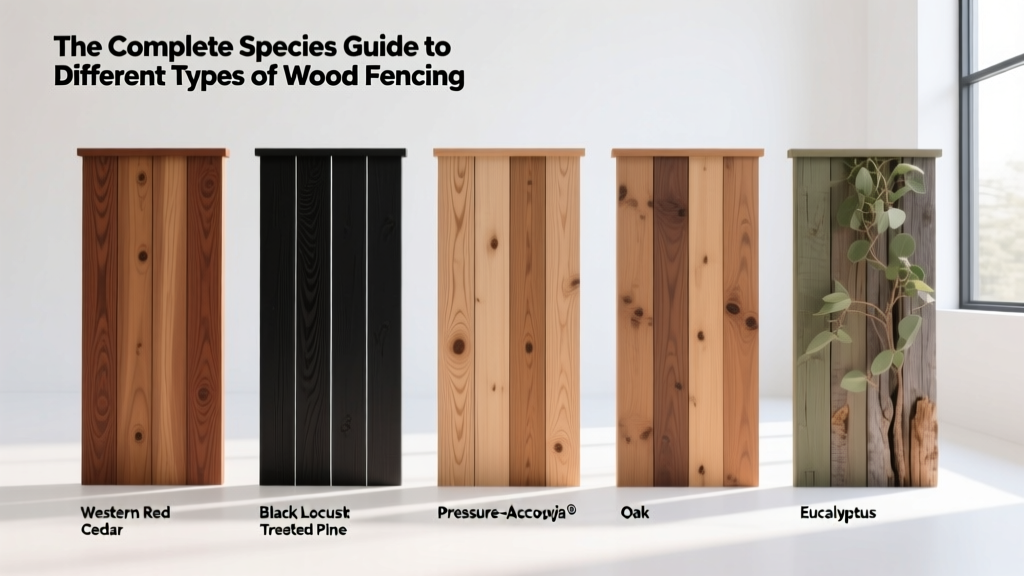
Selecting the Right Species for Your Microclimate
Choosing among the different types of wood fencing requires moving beyond basic aesthetics to evaluate cellular structure, natural extractive content, and dimensional stability. A fence in a high-humidity coastal zone faces entirely different biological threats than one in an arid, high-UV desert environment. This guide dissects the exact mechanical and biological properties of the primary fencing species, providing the technical specifications needed to specify the correct lumber grade, fastener type, and finishing protocol for long-term structural integrity.
Premium Hardwoods: High-Density & Coastal Solutions
Tropical and domestic hardwoods offer unparalleled decay resistance and structural density, making them ideal for high-traffic commercial applications, coastal salt-spray zones, and horizontal slat privacy screens where sagging is a concern.
Ipe (Handroanthus spp.)
Often marketed as Brazilian Walnut, Ipe is the benchmark for exterior hardwoods. With a Janka hardness rating of 3,680 lbf, it is virtually impervious to surface scratching and denting. Its high density (roughly 69 lbs/ft³) and natural oils provide a Class A fire rating and extreme resistance to rot and insect attack. According to data compiled by The Wood Database, Ipe's interlocked grain requires carbide-tipped saw blades and mandatory pre-drilling for all fasteners. For fencing, specify 5/4x6 square-edge profiles for horizontal runs to minimize cupping.
Black Locust (Robinia pseudoacacia)
The premier domestic alternative to tropical hardwoods. Black Locust boasts a Janka hardness of 1,700 lbf and contains high levels of flavonoids that render the heartwood virtually immune to decay, even in direct ground contact. It is significantly more dimensionally stable than oak and weathers to a striking silvery-gray if left unfinished. When sourcing Black Locust for fencing, ensure you are purchasing heartwood; the sapwood lacks rot resistance and will fail rapidly in exterior applications.
The Softwood Standards: Cedar, Redwood, and Pine
Softwoods dominate the residential fencing market due to their workability, lower cost, and widespread availability. However, their performance varies drastically based on the specific lumber grade and preservative treatment.
Western Red Cedar (Thuja plicata)
Western Red Cedar (WRC) relies on thujaplicins—natural fungicides—to resist decay. It is highly dimensionally stable with a low shrinkage factor, making it excellent for board-on-board and shadowbox fence styles. WRC has a Janka hardness of just 350 lbf, meaning it is susceptible to impact damage. A critical installation detail for WRC is managing tannin bleed; you must prime all faces and edges with a stain-blocking oil-based primer (such as Zinsser Cover Stain) before applying acrylic topcoats, otherwise, dark tannin streaks will ruin the finish within weeks.
Redwood (Sequoia sempervirens)
Redwood offers superior decay resistance compared to cedar due to its high concentration of tannins and extractives, but it is increasingly expensive and subject to strict harvesting regulations. For fencing, avoid 'Garden Grade' or 'Construction Common' (which includes sapwood). Instead, specify 'Construction Heart' or 'Architectural Clear Heart' to ensure you are receiving the decay-resistant inner wood.
Pressure-Treated Southern Yellow Pine
When budget constraints dictate the use of pine, modern pressure treatment is mandatory. The American Wood Protection Association (AWPA) categorizes treated lumber by end-use. For fence posts embedded in concrete or soil, you must specify UC4B (Ground Contact, Heavy Duty) with a minimum retention level of 0.60 pcf for CA-C or ACQ preservatives. Above-ground rails and pickets only require UC4A (0.25 pcf). Using UC4A lumber for posts will result in subterranean rot failure within 5 to 7 years.
Lumber Grade Matrix: Specifying the Right Material
Buying the wrong grade is the most common cause of premature fence failure. Use this matrix to specify the correct grade at the lumber yard based on your project requirements.
| Species | Grade Designation | Characteristics | Best Fencing Application |
|---|---|---|---|
| Western Red Cedar | Select Tight Knot (STK) | Sound, tight knots; no sapwood. | Standard privacy pickets, horizontal slats. |
| Western Red Cedar | Clear All Heart (CVG) | No knots, 100% heartwood, vertical grain. | High-end modern screens, staining applications. |
| Redwood | Construction Heart | Contains knots, but strictly heartwood. | Posts, structural rails, budget-friendly privacy. |
| Redwood | Architectural Clear | Flawless, no knots, uniform color. | Luxury estate fencing, horizontal modern designs. |
| Treated Pine | #1 Premium | Tight growth rings, minimal wane, small knots. | Visible pickets where aesthetics matter. |
| Treated Pine | #2 Standard | Larger knots, some wane, higher warp potential. | Structural posts, backer rails, agricultural fencing. |
Fastener Compatibility & Hardware Specifications
The interaction between wood extractives, preservative chemicals, and metal fasteners dictates the lifespan of the fence hardware. The USDA Forest Products Laboratory provides extensive data on galvanic corrosion in exterior wood assemblies.
- Ipe & Cumaru: The high tannin and oil content will react with galvanized steel, causing unsightly black streaks down the face of the boards. You must use Type 316 Stainless Steel screws. Type 304 is acceptable for dry climates, but 316 is required for coastal or high-humidity zones.
- Cedar & Redwood: Tannins will corrode standard steel and electro-galvanized nails. Use hot-dipped galvanized (HDG) or aluminum fasteners. Stainless steel is preferred for clear-grade cedar to prevent any potential staining.
- Pressure-Treated Pine: As noted, copper-based preservatives eat aluminum and standard zinc. Use HDG (ASTM A153) or stainless steel. Never use aluminum flashing or brackets in direct contact with ACQ or CA-C treated pine.
Species Performance & Decay Resistance Data
Use the following technical data to align your species choice with your expected maintenance cycle and local environmental pressures.
| Wood Species | Janka Hardness (lbf) | Natural Decay Resistance | Expected Lifespan (Unfinished) | Movement in Service (Tangential) |
|---|---|---|---|---|
| Ipe | 3,680 | Class 1 (Very Resistant) | 40-75+ Years | 6.6% |
| Black Locust | 1,700 | Class 1 (Very Resistant) | 30-50+ Years | 7.2% |
| Redwood (Heart) | 420 | Class 2 (Resistant) | 20-30 Years | 4.7% |
| W. Red Cedar | 350 | Class 2 (Resistant) | 15-25 Years | 5.1% |
| Treated SYP (UC4B) | 870 | Class 1 (Via Chemical Treatment) | 20-40 Years | 7.2% |
Technical FAQ: Installation Edge Cases
Do I need to seal the end-grain on hardwood fence boards?
Yes. Hardwoods like Ipe and Cumaru lose moisture through the end-grain up to 50 times faster than through the face grain. If left unsealed, the ends will check (split) rapidly. Apply a wax-based end-grain sealer (such as Anchorseal) to every cut end immediately during installation, including the bottom edges of pickets that will sit near grade.
Can I install cedar pickets directly against a concrete retaining wall?
No. Concrete wicks moisture and maintains a high alkaline pH, which will accelerate the decay of the bottom cedar boards and cause severe tannin bleed. Maintain a minimum 2-inch clearance between the bottom of cedar or redwood pickets and any concrete or masonry surface. Use a stainless steel or HDG bottom rail to elevate the wood.
How do I prevent horizontal cedar slats from bowing?
Western Red Cedar has low bending strength. For horizontal privacy fences, limit unsupported spans to 32 inches. If your post spacing is 8 feet, you must install a mid-rail or use a thicker profile (e.g., 2x2 or 2x3 material) to prevent the slats from sagging under their own weight and wind loads over time.
Written by
David NakamuraDavid Nakamura is a licensed architect (AIA) and construction technology writer focused on sustainable building methods, mass timber engineering, and high-performance building envelopes. He holds a Master of Architecture from the University of Washington and is a certified Passive House Consultant (CPHC). David spent eight years at the Seattle firm Mithun, where he led the design of three LEED Platinum projects, before founding his own practice specializing in net-zero residential design. He serves on the editorial advisory board of GreenBuilder Magazine and has authored peer-reviewed papers on cross-laminated timber (CLT) connections for the Journal of Structural Engineering. In his spare time, David teaches woodworking at Pratt Fine Arts Center and kayaks the Puget Sound.
More from David Nakamura
View all
Construction Cost
Labor Cost to Build a Deck Per Sq Ft: 2026 Installation Guide
Discover the exact labor cost to build a deck per sq ft in 2026. This installation guide breaks down contractor rates, complexity factors, and hidden fees.
Aug 4, 2026

Construction Cost
How Much Does It Cost to Build a 3 Bedroom House? Financing Guide
Learn exactly how much it costs to build a 3 bedroom house and explore 2026 financing options, construction loan types, and budget frameworks for your build.
Aug 4, 2026

Construction Cost
Cost to Build a Tennis Court: 2026 Guide
How much does it cost to build a tennis court in 2026? Breakdowns for asphalt, concrete, and synthetic surfaces plus fencing and lighting.
Jul 30, 2026