Ground Contact Pressure Treated Lumber Lifespan and Decay Analysis
Analyze ground contact pressure treated lumber lifespan, AWPA retention levels, and installation protocols to prevent premature structural decay.
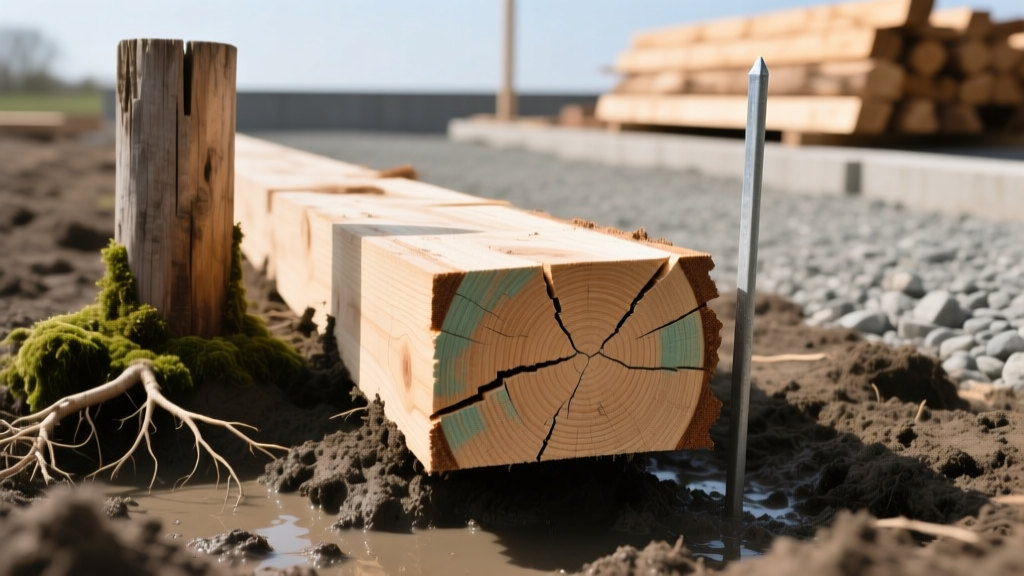
The Hostile Ground-Line Environment
The transition zone where wood meets soil—often referred to as the ground line—is the most biologically and chemically hostile environment in residential and commercial construction. In this critical 12-inch band, oxygen, moisture, and soil-borne fungi converge to create optimal conditions for wood decay. When specifying ground contact pressure treated lumber, builders and engineers must look beyond generic 'treated' labels and understand the precise chemical retention levels, use categories, and installation physics required to achieve a 40- to 60-year structural lifespan.
Marketing materials often promise 'lifetime' durability, but field inspections routinely reveal premature rot in structural posts, retaining walls, and deck framing. This failure is rarely due to the pressure treatment process itself; rather, it stems from specifying the wrong American Wood Protection Association (AWPA) Use Category for the specific microclimate, or employing installation methods that inadvertently trap moisture against the wood fibers.
Decoding AWPA Use Categories and Retention Levels
The AWPA Use Category System dictates the minimum chemical retention levels required for different exposure conditions. Retention is measured in pounds of preservative per cubic foot of wood (pcf). For modern copper-based preservatives like Micronized Copper Azole (MCA-C) and Copper Azole (CA-C), the retention thresholds are strictly defined. According to the American Wood Protection Association (AWPA) Use Category System, ground contact lumber is divided into three distinct tiers.
| AWPA Category | Designation | MCA-C Retention (pcf) | Application Scope |
|---|---|---|---|
| UC4A | Ground Contact, General | 0.15 | Standard deck posts, fence posts in well-drained soils, landscaping timbers. |
| UC4B | Ground Contact, Heavy Duty | 0.31 | Structural building posts, retaining walls, posts in poorly drained or high-moisture soils. |
| UC4C | Ground Contact, Extreme Duty | 0.60 | Permanent wood foundations, utility poles, agricultural posts, saltwater or continuous moisture exposure. |
A common and costly error in residential construction is specifying UC4A lumber for structural deck posts or retaining walls in heavy clay soils. While UC4A meets the bare minimum building code requirement for 'ground contact' in many jurisdictions, it lacks the chemical reservoir necessary to resist aggressive fungal strains over a 40-year horizon. Upgrading to UC4B (0.31 pcf) effectively doubles the preservative concentration, providing a critical buffer against localized treatment deficiencies within the wood matrix.
Primary Failure Modes in Ground Contact Applications
Even properly treated UC4B lumber can fail prematurely if subjected to mechanical or hydrological abuse. The USDA Forest Products Laboratory (FPL) identifies several non-chemical failure modes that compromise the preservative envelope:
1. The 'Bathtub Effect' in Concrete Collars
Setting a treated post directly into a poured concrete collar is a legacy practice that accelerates decay. Concrete is highly porous and wicks groundwater upward via capillary action. When water pools at the base of the post and cannot drain, it creates a permanent, saturated micro-environment. The wood swells, compressing against the rigid concrete, which eventually checks (cracks) the wood surface, exposing untreated inner fibers to soil fungi.
Never encase the base of a pressure-treated post in solid concrete below grade. Instead, use a sonotube filled with gravel, or pour a concrete footing below the frost line and mount the post using an elevated, hot-dipped galvanized post base anchored to the concrete. This maintains a 1-inch air gap between the concrete and the wood end-grain.
2. End-Grain Wicking and Capillary Action
Wood acts as a bundle of microscopic straws. When a treated post is cut to length in the field, the end-grain is exposed. Water can wick up to 12 inches into the post from an untreated cut end, bypassing the chemical shell and initiating interior rot. This is the leading cause of failure in fence posts and retaining wall deadmen.
3. Mechanical Abrasion of the Preservative Shell
Dragging treated lumber across gravel, dropping it on concrete, or using heavy-duty steel clamps during installation can scrape off the outer 1/16-inch of the wood. Because preservative penetration is not uniform throughout the cross-section (especially in species like Douglas Fir or Spruce-Pine-Fir), removing the outer shell exposes the vulnerable, untreated heartwood to immediate biological attack.
Hardware Compatibility and Galvanic Corrosion
Modern ground contact pressure treated lumber relies heavily on copper-based preservatives (MCA, CA-C, ACQ). Copper is highly cathodic and will aggressively corrode standard steel, electro-galvanized hardware, and even aluminum. When selecting fasteners and structural connectors for ground contact applications, the galvanization coating thickness must match the corrosivity of the preservative.
| Hardware Material | Coating/Grade | Compatibility with UC4A/UC4B | Recommended Use Case |
|---|---|---|---|
| Hot-Dipped Galvanized | G185 (1.85 oz/sq ft) | Excellent | Standard post bases, joist hangers, structural screws in ground contact zones. |
| Stainless Steel | Type 304 | Superior | High-moisture environments, coastal regions, critical structural connections. |
| Stainless Steel | Type 316 | Ultimate | Saltwater exposure, UC4C extreme duty applications, chemical storage facilities. |
| Electro-Galvanized | Zinc plating | FAIL - Do Not Use | Will corrode within 2-3 years when in contact with copper-treated lumber. |
Per the International Code Council (ICC) and manufacturer warranties, using hardware that does not meet G185 or stainless steel standards voids both the hardware warranty and, in many cases, the lumber treatment warranty. Always verify the coating weight on structural connectors; many big-box store brackets are only G90, which is insufficient for ground contact treated wood.
Field Treatment and Installation Protocols
To maximize the lifespan of ground contact pressure treated lumber, contractors must adhere to strict field-handling protocols. The following step-by-step framework ensures the preservative envelope remains intact from the lumber yard to final backfill:
- Minimize Field Cuts: Order lumber in exact lengths whenever possible. If cutting is unavoidable, restrict cuts to the top of the post, never the end that will be nearest to the ground line.
- AWPA M4 End-Cut Treatment: Any field cut, drilled hole, or notch must be immediately coated with a copper naphthenate-based preservative (e.g., Copper Green). Apply two heavy coats, allowing the first to penetrate for 10 minutes before applying the second. This restores the chemical barrier on exposed end-grain.
- Drainage Preparation: Excavate post holes 6 inches deeper than the required frost line depth. Fill the bottom 6 inches with 3/4-inch crushed angular gravel and compact it. This creates a French drain effect, pulling hydrostatic pressure away from the wood base.
- Physical Sleeves (Optional but Recommended): For high-value structural applications, apply a polyethylene or bituminous post sleeve (e.g., PostSaver) over the ground-line transition zone before backfilling. This physical barrier blocks oxygen and moisture, effectively halting fungal metabolism at the most critical decay point.
- Backfill with Drainage Media: Do not backfill post holes with native clay or topsoil. Use crushed gravel or a highly permeable sand-gravel mix, tamping it in 4-inch lifts to prevent settling while ensuring rapid water percolation away from the timber.
Cost vs. Longevity ROI Analysis
When evaluating material budgets, the premium for upgrading from UC4A to UC4B ground contact lumber is marginal compared to the labor costs associated with structural replacement. In 2026, a standard 4x4x8 UC4A MCA-treated post retails for approximately $14.00 to $16.00. The equivalent UC4B Heavy Duty post costs between $21.00 and $24.00.
'The $7.00 material premium for UC4B lumber is entirely absorbed by the first 15 minutes of labor required to dig a replacement post hole. Specifying UC4A for permanent structural framing is a false economy that transfers risk to the homeowner.'
For retaining walls, the calculus is even more aggressive. Replacing a failed UC4A deadman anchor requires excavating tons of backfill, dismantling the wall face, and disposing of contaminated soil. By specifying UC4B or UC4C lumber and utilizing gravel backfill protocols, builders secure a 50-year structural lifespan, eliminating callback liabilities and ensuring long-term asset integrity.