Strongest Types of Wood for Structural Framing: Complete Guide
Discover the strongest types of wood for construction. Compare MOR, MOE, and Janka ratings for Douglas Fir, SYP, and Hickory in our complete species guide.
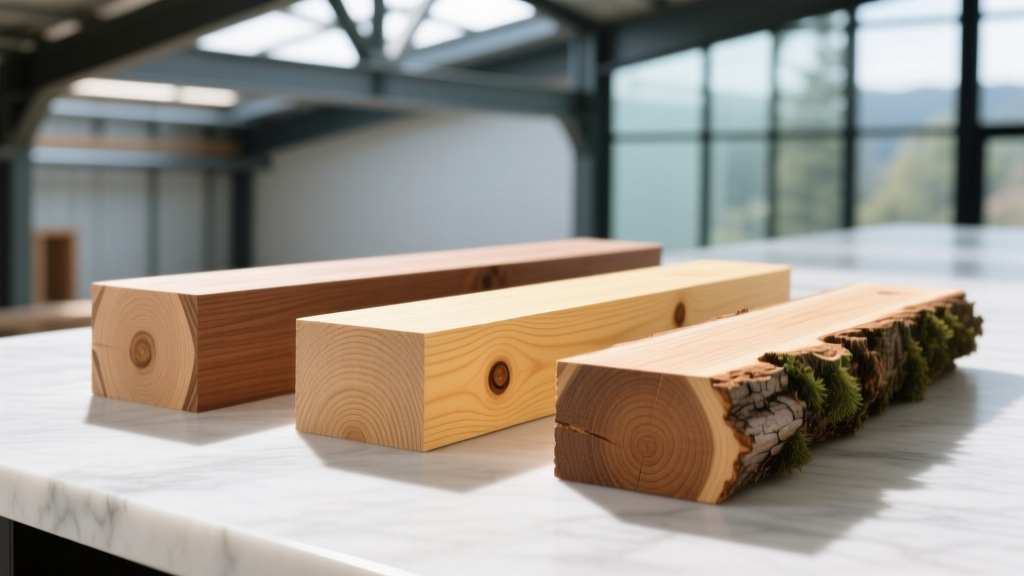
Defining Wood Strength: MOR, MOE, and Compression
When architects and structural engineers specify the strongest types of wood for a project, they are not looking at a single metric. 'Strength' in timber is categorized by how the material responds to specific physical stresses. Understanding the difference between bending strength, stiffness, and hardness is critical for preventing structural deflection, fastener pull-out, and surface wear.
A common mistake in residential construction is assuming that a high Janka hardness rating equates to high structural load-bearing capacity. Ipe (3,510 lbf Janka) is incredibly hard and resistant to denting, but its Modulus of Elasticity (stiffness) is not proportionally higher than structural softwoods like Douglas Fir. Always match the specific mechanical property to the structural demand: use MOR for joists, MOE for long-span beams, and Compression for load-bearing columns.
- Modulus of Rupture (MOR): Measured in pounds per square inch (psi), this indicates bending strength—the maximum load a beam or joist can carry before snapping.
- Modulus of Elasticity (MOE): Measured in millions of psi, this dictates stiffness. A high MOE means the wood will resist sagging and deflection under heavy loads, which is often the governing factor in floor joist design.
- Compression Parallel to Grain: Measured in psi, this is the crushing strength of wood when weight is applied vertically to the end grain, critical for posts and columns.
- Janka Hardness: Measured in pounds-force (lbf), this is the force required to embed a 0.444-inch steel ball halfway into the wood. It is the primary metric for flooring and high-wear surfaces.
For comprehensive baseline data on these mechanical properties across hundreds of species, the USDA Forest Products Laboratory Wood Handbook remains the definitive industry standard.
Top 3 Strongest Types of Wood for Structural Framing
In North American light-frame and heavy-timber construction, softwoods dominate due to their superior strength-to-weight ratios, rapid growth cycles, and straight grain. However, not all framing lumber is created equal.
1. Douglas Fir (Pseudotsuga menziesii)
Douglas Fir (specifically the Coast variety) is the benchmark for structural framing in the western United States and Canada. It boasts an exceptional strength-to-weight ratio and excellent dimensional stability, meaning it resists warping and twisting as it dries.
- MOR: 12,400 psi
- MOE: 1.95 million psi
- Best Application: Long-span floor joists, roof rafters, and Glulam (glued-laminated) beams.
- Cost Context: A #2 grade 2x10 DF-L stud typically ranges from $2.80 to $3.60 per linear foot in 2026, reflecting its premium status over standard spruce-pine-fir (SPF).
2. Southern Yellow Pine (Pinus palustris / taeda)
Southern Yellow Pine (SYP) is the undisputed powerhouse of the eastern and southern U.S. markets. It is the densest of the structural softwoods, allowing it to hold heavy loads and grip nails and screws with superior withdrawal resistance.
- MOR: 14,500 psi (Longleaf variety)
- MOE: 2.14 million psi
- Best Application: Floor trusses, heavy-duty decking, and treated sill plates.
- Expert Note: When specifying SYP for structural framing, look for 'Dense Select Structural' or 'No. 1' grades. The high resin content in SYP can sometimes interfere with certain water-based finishes, so solvent-based or specialized masonry-compatible sealants are required for exterior applications.
3. White Oak (Quercus alba)
While rarely used in standard 2x4 light framing due to cost and weight, White Oak is a heavyweight champion in heavy timber construction and marine applications. Its closed-cell structure makes it highly resistant to rot and moisture penetration.
- Compression Parallel to Grain: 8,000 psi (Exceptional for vertical load-bearing posts).
- Best Application: Heavy timber post-and-beam frames, marine docks, and exterior structural sills.
The Strongest Wood Species for Flooring and High-Wear Surfaces
When the requirement shifts from structural load-bearing to surface durability, hardwoods take the lead. The strongest types of wood for flooring must resist impact, abrasion, and moisture-induced cupping.
Hickory (Carya ovata)
Hickory is the strongest commercially available domestic hardwood. Its extreme density makes it highly resistant to denting from dropped tools, high heels, and pet claws. However, its high MOE also makes it notoriously difficult to mill and nail; installers must pre-drill fastener holes or use specialized pneumatic flooring nailers to prevent the tongues from splitting.
- Janka Hardness: 1,820 lbf
- Cost Context: $6.50 to $9.00 per square foot for unfinished solid 3/4-inch planks.
Ipe (Handroanthus spp.)
Often called 'ironwood,' Ipe is a tropical hardwood imported from South America. It is the gold standard for exterior decking and commercial boardwalks. Its density is so high that it sinks in water, and it possesses a Class A fire rating—the same as steel and concrete.
- Janka Hardness: 3,510 lbf
- Expert Note: Ipe requires carbide-tipped saw blades and hidden fastener systems. Face-screwing Ipe requires pre-drilling with specialized bits and plugging, adding roughly 30% to total installation labor costs.
Comprehensive Wood Strength Matrix
| Wood Species | MOR (psi) | MOE (10^6 psi) | Janka (lbf) | Primary Construction Use |
|---|---|---|---|---|
| Ipe | 25,400 | 3.11 | 3,510 | Exterior decking, marine structures |
| Hickory | 18,200 | 2.16 | 1,820 | High-traffic interior flooring, tool handles |
| Longleaf SYP | 14,500 | 2.14 | 870 | Structural joists, trusses, heavy framing |
| White Oak | 15,200 | 1.78 | 1,360 | Heavy timber posts, exterior sills |
| Douglas Fir | 12,400 | 1.95 | 620 | Glulam beams, roof rafters, general framing |
| SPF (Spruce-Pine-Fir) | 9,900 | 1.60 | 480 | Standard interior wall studs, basic joists |
Data sourced from the USDA Forest Products Laboratory and The Wood Database. Values represent average clear-wood specimens at 12% moisture content.
Engineered vs. Solid Sawn: Maximizing Structural Capacity
When solid sawn lumber reaches its dimensional limits, engineered wood products (EWP) take over. According to the APA - The Engineered Wood Association, engineered products disperse natural defects like knots and slope-of-grain across multiple laminations, resulting in predictable, highly concentrated strength.
LVL (Laminated Veneer Lumber)
Created by bonding thin wood veneers (usually Douglas Fir or SYP) with parallel grain orientation. LVL beams offer MOE ratings up to 2.0 million psi and are manufactured in continuous lengths up to 60 feet, eliminating the need for splicing over long spans like ridge beams and header applications.
Glulam (Glued-Laminated Timber)
Composed of thick dimension lumber laminations (typically 1.5 inches thick) bonded with structural adhesives. Glulam can be manufactured with camber (an upward curve) to counteract dead-load deflection. It is the premier choice for exposed architectural beams in commercial timber-frame construction.
Decoding the Lumber Grade Stamp
Specifying the strongest types of wood is useless if the grade stamp on the lumber does not match the engineering plans. Every piece of structural framing lumber must bear a grade stamp verifying its species, mill, and structural capacity.
- Species Identification: 'DF-L' indicates Douglas Fir-Larch. 'SYP' indicates Southern Yellow Pine. 'SPF' indicates Spruce-Pine-Fir.
- Grade Designation: 'Select Structural' is the highest visual grade, offering maximum MOR and MOE. 'No. 1' and 'No. 2' are standard for residential framing, with No. 2 allowing slightly larger knots.
- Span Rating: Often seen on sheathing (e.g., 24/16), indicating maximum joist spacing (24 inches) and rafter spacing (16 inches).
- Moisture Content: 'S-DRY' means surfaced dry (19% or less moisture content), which is critical for interior framing to prevent shrinkage and drywall cracking.
Frequently Asked Questions
What is the absolute strongest wood in the world?
Australian Buloke (Allocasuarina luehmannii) holds the record for the highest Janka hardness at 5,060 lbf. However, it is not used in structural construction due to its small size and limited availability. For structural building purposes, tropical hardwoods like Ipe and Cumaru offer the highest accessible strength metrics.
Is Southern Yellow Pine stronger than Douglas Fir?
It depends on the specific metric and grading. Dense Select Structural Southern Yellow Pine has a higher Modulus of Rupture (bending strength) and crushing strength than Douglas Fir. However, Douglas Fir generally offers better dimensional stability and is less prone to checking and twisting as it acclimates, making it the preferred choice for exposed timber and long-span beams.
Can I use Hickory for structural floor joists?
While Hickory possesses immense MOR and MOE values, it is almost never graded or stamped for structural framing by North American lumber agencies. Using ungraded Hickory for joists will fail building code inspections. Stick to graded DF-L, SYP, or engineered I-joists for structural framing, and reserve Hickory for finish flooring and millwork.
Written by
Elena RodriguezElena Rodriguez is a civil engineer and technical writer specializing in concrete technology, masonry systems, and ASTM/ACI compliance. She earned her B.S. in Civil Engineering from Texas A&M University and spent a decade at a materials testing laboratory, performing over 2,000 concrete compressive strength tests and masonry prism evaluations. Elena is an ACI-certified Field Testing Technician (Grade I) and a member of ASTM Committee C12 on Natural Building Stone. She currently consults on forensic engineering cases involving concrete failures and moisture intrusion. Based in San Antonio, TX, Elena is a proud member of the Society of Women Engineers (SWE) and coaches her daughter's FIRST Robotics team.
More from Elena Rodriguez
View all
Walls & Panels
Cost Analysis: Light Gauge Steel Framing Advantages and Disadvantages
Evaluate light gauge steel framing advantages and disadvantages through a strict cost analysis lens, comparing material, labor, and lifecycle expenses.
Aug 4, 2026

Walls & Panels
Gypsum Board Types: Exact Specifications, Thickness & Dimensions
Compare standard, Type X, and moisture-resistant gypsum board types. Get exact specifications, thicknesses, dimensions, and ASTM standards for your project.
Aug 4, 2026

Fire Resistance
Best Fire-Resistant Outdoor Decking Materials: 2026 Buyer Guide
Discover the best fire-resistant outdoor decking materials for 2026. Compare Class A PVC, aluminum, and hardwood options for WUI compliance and safety.
Aug 4, 2026