Selecting Pre Finished Hardwood Flooring: A Material Taxonomy
Explore the material taxonomy of pre finished hardwood flooring. Compare solid vs. engineered cores, finish types, and species for optimal selection.
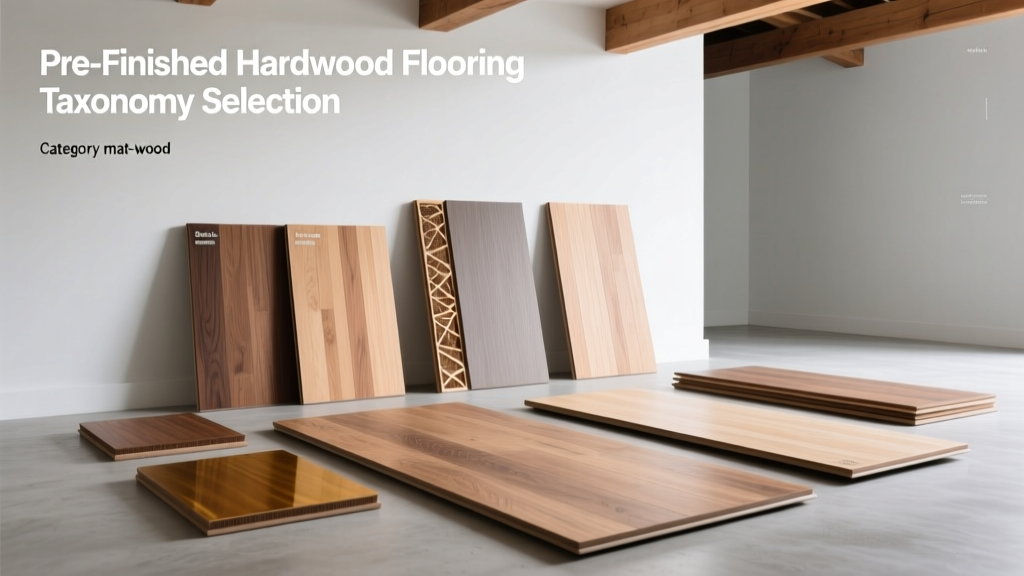
The Anatomy of Pre-Finished Hardwood: Solid vs. Engineered
When specifying pre finished hardwood flooring, the primary taxonomic division lies in the plank's structural composition. Factory-finished planks arrive on-site with their protective topcoats already applied and cured, eliminating the dust, VOC off-gassing, and multi-day curing times associated with site-finished floors. However, the internal architecture of the plank dictates its application limits.
Pre-finished flooring undergoes industrial UV-curing processes, embedding abrasion-resistant compounds (like aluminum oxide) into the polyurethane matrix. Site-finished flooring is sanded raw and coated on-site, offering a seamless surface but lacking the industrial hardness of factory UV-cured finishes.
Solid Hardwood Architecture
Solid pre finished hardwood flooring is milled from a single piece of timber, typically 3/4-inch thick. Its homogeneous structure allows for multiple sanding cycles over its lifespan. However, solid wood is highly hygroscopic. It expands and contracts significantly across the grain with fluctuations in ambient relative humidity (RH). Consequently, solid planks are restricted to nail-down or staple-down installations over wooden subfloors and are strictly prohibited below grade or over concrete slabs due to moisture vapor transmission risks.
Engineered Hardwood Architecture
Engineered pre finished hardwood flooring utilizes a cross-ply construction methodology. The top layer (wear layer) is a veneer of real hardwood, bonded to a core of high-density fiberboard (HDF) or multi-ply Baltic birch plywood. This perpendicular lamination neutralizes the wood's natural tendency to expand and contract, providing exceptional dimensional stability. Engineered planks can be glued directly to concrete, floated over acoustic underlayments, or installed over radiant heating systems, making them the dominant choice for modern commercial and multi-family residential construction.
Wood Species Taxonomy: Hardness and Dimensional Stability
Selecting a wood species requires balancing aesthetic preferences with mechanical performance. The Janka hardness test measures the force required to embed a 0.444-inch steel ball into the wood, indicating dent resistance. Equally critical, yet often overlooked, is dimensional stability—how much the wood shrinks or swells with moisture changes.
| Species | Janka Hardness (lbf) | Dimensional Stability | Best Application |
|---|---|---|---|
| White Oak | 1,360 | High | High-traffic residential, commercial, wide-plank engineered |
| Hard Maple | 1,450 | Medium | Sports courts, contemporary interiors, solid nail-down |
| Hickory | 1,820 | Low | Rustic aesthetics, areas requiring max dent resistance |
| American Walnut | 1,010 | High | Low-traffic luxury residential, formal dining, studies |
According to the USDA Forest Products Laboratory Wood Handbook, White Oak exhibits superior dimensional stability compared to Hickory due to its lower tangential-to-radial shrinkage ratio. For wide-plank installations (planks exceeding 7 inches in width), White Oak is the definitive choice to minimize edge-cupping and gapping.
Finish Chemistry: UV-Cured Aluminum Oxide vs. Hardwax Oil
The factory-applied finish determines the floor's maintenance cycle, sheen retention, and repairability. Pre finished hardwood flooring primarily utilizes two distinct chemical taxonomies:
1. UV-Cured Polyurethane with Aluminum Oxide
This is the industry standard for high-durability applications. Manufacturers suspend microscopic aluminum oxide (Al2O3) particles in multiple layers of polyurethane, which are then instantly cured using ultraviolet light. This process creates a cross-linked polymer matrix that routinely achieves 10,000+ cycles on the Taber Abrasion Test (CS-17 wheel, 1000g load). While exceptionally resistant to wear, deep scratches cannot be spot-repaired; the entire plank must be replaced or the entire floor must be professionally screened and recoated.
2. UV-Cured Hardwax Oil
Hardwax oil finishes (utilizing brands like Rubio Monocoat or Osmo) penetrate the wood fibers rather than sitting on top as a plasticized film. The finish cures via oxidation and UV acceleration. While hardwax oil offers lower initial abrasion resistance than aluminum oxide, it provides a significant functional advantage: localized spot repairability. A deep scratch can be sanded and re-oiled seamlessly without leaving a visible lap mark, making it highly favored in commercial hospitality and luxury residential sectors.
Wear Layer Thickness: The True Metric of Longevity
When selecting engineered pre finished hardwood flooring, the wear layer thickness is the most critical specification governing the product's lifecycle and refinishing potential.
- 0.6mm to 1.2mm (Sliced/Rotary Peel Veneer): Cannot be sanded. Maintenance is limited to screening and recoating the existing factory finish. Typical lifespan: 15-25 years.
- 2.0mm to 3.0mm (Sawn Veneer): Can withstand one to two light sanding cycles. Ideal for residential applications with a 40-year expected lifespan.
- 4.0mm to 6.0mm (Solid Sawn Top Layer): Functions identically to solid hardwood. Can be fully drum-sanded 3 to 5 times. Required for commercial applications or multi-generational residential specifications.
Selection Framework: Matching Material to Subfloor & Climate
Proper material selection must align with the structural subfloor and the building's HVAC capabilities. The National Wood Flooring Association (NWFA) mandates strict environmental controls for all wood flooring installations.
Before installing any pre finished hardwood flooring over a concrete slab, in-situ relative humidity testing must be conducted per ASTM F2170 standards. Concrete slabs must read below 75% RH. If moisture vapor emission rates (MVER) exceed 3 lbs per 1,000 sq ft per 24 hours (ASTM F1869), a two-part epoxy moisture mitigation system must be applied prior to glue-down installation.
Decision Matrix for Subfloor Compatibility
Plywood/OSB Subfloor (Above Grade): Both solid (nail-down) and engineered (nail, glue, or float) are acceptable. Solid 3/4-inch is the most cost-effective choice here.
Concrete Slab (On-Grade or Below-Grade): Engineered hardwood only. Must be glued down using a moisture-cured urethane adhesive or floated over a vapor-barrier underlayment.
Radiant Heated Subfloors: Engineered hardwood only. Quarter-sawn White Oak or Rift-sawn Oak is required to prevent checking. Plank width should not exceed 5 inches to minimize thermal stress.
Installation & Cost Variables
Material costs for pre finished hardwood flooring vary significantly based on core construction, species, and plank dimensions. As of current market conditions, expect the following material-only pricing parameters:
Solid 3/4" x 3-1/4" Red Oak: $4.50 - $6.50 per sq. ft.
Engineered 1/2" x 5" HDF Core White Oak: $6.00 - $8.50 per sq. ft.
Engineered 5/8" x 7" Baltic Birch Core White Oak (4mm wear layer): $9.50 - $14.50 per sq. ft.
Installation labor adds $3.50 to $6.00 per square foot for nail-down or glue-down methods, while floating installations typically range from $2.50 to $4.00 per square foot. Always factor in a 7% to 10% waste allowance for diagonal layouts or rooms with complex geometries.
Frequently Asked Questions
Can pre finished hardwood flooring be installed in full bathrooms?
No. Even highly stable engineered hardwood with UV-cured finishes is vulnerable to standing water and extreme humidity spikes. Wood-look porcelain tile or luxury vinyl plank (LVP) are the appropriate material selections for full wet environments.
Does the gloss level affect the durability of the finish?