How Preservation Treatments Affect Different Types of Wood Colors
Discover how chemical preservation treatments and UV exposure alter different types of wood colors, plus expert techniques to maintain or restore natural hues.

The Chemistry of Wood Coloration and UV Degradation
The natural aesthetic of timber is dictated by its extractives—complex organic compounds like tannins, resins, and lignins. When evaluating the different types of wood colors available for exterior cladding, decking, or structural applications, builders must account for how these extractives react to environmental exposure and chemical preservatives. Untreated wood exposed to ultraviolet radiation (specifically in the 290–400 nm wavelength) undergoes photo-oxidation. This process breaks down lignin, the polymer binding the wood cells, leading to the characteristic silvery-gray patina seen on weathered Western Red Cedar and Redwood.
According to research from the USDA Forest Products Laboratory, this surface degradation penetrates only about 0.002 to 0.08 inches into the wood. While structurally superficial, it drastically alters the visual profile of the material. Preservation treatments are designed to halt biological decay, but the active ingredients in these preservatives inherently interact with the wood's natural pigments, often shifting the baseline color before the wood is even installed.
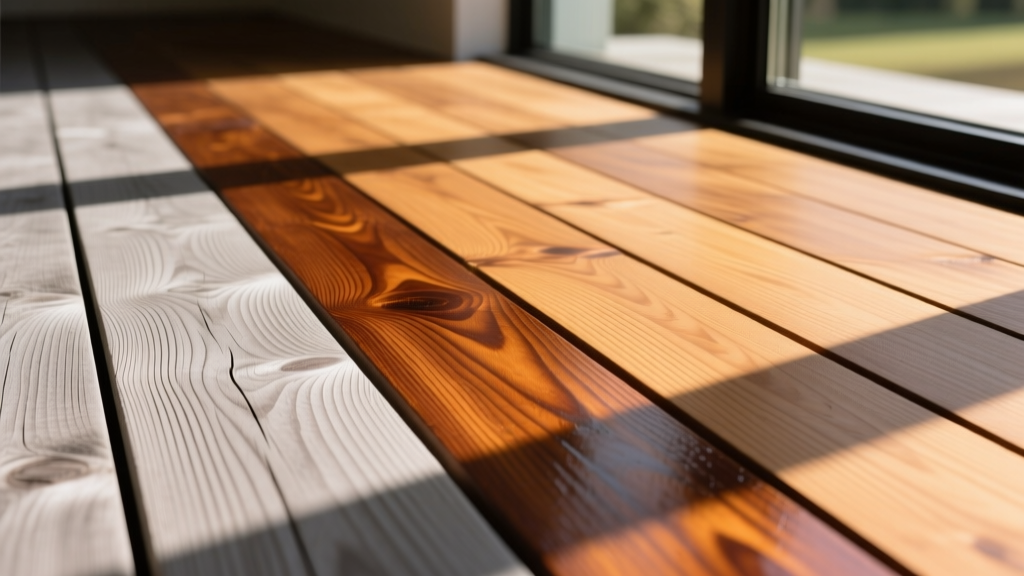
How Common Preservation Treatments Shift Wood Hues
Pressure-treated lumber dominates the structural and exterior market, but the chemical carriers used to force preservatives deep into the cellular structure leave distinct visual markers. Understanding these shifts is critical for architects and contractors specifying finishes.
Alkaline Copper Quaternary (ACQ)
ACQ relies on dissolved copper oxide as its primary fungicide and quaternary ammonium compounds as a co-biocide. Because the copper is fully dissolved in an alkaline solution, it imparts a distinct, dark greenish-brown hue to Southern Yellow Pine and other treatable species. Over the first 6 to 12 months of UV exposure, this green tint fades to a muted, earthy brown before eventually graying if left unsealed.
Micronized Copper Azole (MCA)
MCA represents a technological shift in preservation. Instead of dissolving the copper, MCA suspends micronized (micro-fine) copper particles in the treatment solution. This results in a much lighter, more natural golden-brown initial color that closely mimics the appearance of untreated wood. MCA is the preferred choice when the design intent requires a natural timber aesthetic without immediate heavy staining.
Borate Treatments
Borates (such as disodium octaborate tetrahydrate) are highly effective against termites and wood-decaying fungi but are water-soluble. Therefore, they are typically used for interior framing or exterior wood that will be protected by a continuous water-repellent barrier. Borates are completely colorless and do not alter the natural types of wood colors. However, the required topcoat sealants often contain alkyd resins that can amber over time, artificially warming the wood's tone.
Treatment vs. Weathering Color Matrix
The following matrix outlines how specific preservative systems alter the visual profile of Southern Yellow Pine (SYP) and Western Red Cedar over time when left uncoated.
| Preservation System | Initial Color Shift | 1-Year Uncoated Weathering | Best Application |
|---|---|---|---|
| ACQ (Alkaline Copper Quaternary) | Dark greenish-brown | Muted earthy brown | Ground contact, hidden structural framing |
| MCA (Micronized Copper Azole) | Light golden-brown | Warm gray-brown | Visible decking, exposed architectural beams |
| Borate (Water-Soluble) | No change (Colorless) | Natural silver-gray (if unsealed) | Interior framing, covered exterior trim |
| Untreated (Heartwood only) | Species natural (e.g., Cedar amber) | Uniform silvery-gray | Siding, fencing, non-ground contact |
Strategies for Maintaining Original Species Colors
Preserving the natural color of wood requires blocking both biological decay and UV degradation. The American Wood Protection Association (AWPA) sets the standards for preservative retention levels, but maintaining aesthetics requires a secondary finish system applied over the preserved wood.
Step 1: Select UV-Inhibitive Penetrating Oils
Film-forming finishes (like polyurethane or solid acrylics) will peel and blister on exterior pressure-treated lumber due to moisture vapor transmission. Instead, use penetrating alkyd-oil finishes fortified with transoxide pigments and benzotriazole UV absorbers. Transparent sealers contain only 1-2% pigment and offer minimal UV protection (lasting 6-12 months). Semi-transparent finishes contain 5-10% pigment load, providing enough color density to block UV rays while allowing the wood grain to remain visible. Expect to pay $75 to $95 per gallon for premium hardwood formulas in 2026, covering roughly 150 to 250 square feet per coat.
Step 2: Allow Proper Curing Before Sealing
Applying a water-repellent sealer over freshly treated, wet lumber traps moisture, accelerating internal rot and causing the finish to fail prematurely. Kiln-Dried After Treatment (KDAT) lumber is ready for immediate sealing. Standard wet pressure-treated lumber requires 30 to 90 days of weathering to reach a moisture content below 15% before a penetrating oil can effectively absorb into the cellular structure.
Reversing Discoloration: Oxalic Acid and Wood Bleaching
When preservation fails or tannin bleed occurs, mechanical sanding is often insufficient and removes too much of the wood's protective profile. Chemical restoration is the industry standard for resetting the wood's color.
- Oxalic Acid Brighteners: Oxalic acid specifically targets and dissolves iron tannate stains and gray oxidized lignin. Mix powdered oxalic acid at a ratio of 1 pound per gallon of warm water. Apply via pump sprayer, agitate with a stiff synthetic bristle brush, and rinse thoroughly. A 5-pound bucket costs approximately $35 to $45 and covers up to 1,000 square feet.
- Two-Part Wood Bleaches: For severe black staining or extracting deep natural pigments (such as lightening Walnut or Mahogany), a two-part hydrogen peroxide and sodium hydroxide bleach system is required. This breaks down the chromophores (color-producing molecules) within the wood extractives.
- Sodium Hypochlorite Wash: A 1% to 2% sodium hypochlorite solution is highly effective for killing surface mold and mildew that causes black or green mottling on preserved wood, but it does not reverse UV graying or tannin stains.
Frequently Asked Questions
Can I paint directly over ACQ or MCA pressure-treated wood?
Yes, but only after the wood has fully dried to a moisture content below 15%. You must first apply an alkyd-based or stain-blocking acrylic primer specifically formulated to resist copper tannin bleed-through. Painting directly over treated wood without a primer will result in brown or green stains migrating through the topcoat within months.
Does the EPA regulate the colorants used in wood preservatives?
The Environmental Protection Agency (EPA) regulates the active biocides (like copper and quaternary ammonium) for environmental and human safety, but the inert colorants and carrier solvents are generally classified as trade secrets by manufacturers. However, all registered preservatives must meet AWPA U1 standards for efficacy, regardless of their visual impact.
Why does my cedar siding turn black instead of gray?
Silvery-gray weathering only occurs in dry, well-ventilated environments with consistent UV exposure. If cedar siding turns black, it is experiencing biological colonization (mildew or mold) due to trapped moisture, or it is suffering from iron tannate staining caused by incompatible flashing, nails, or runoff from untreated metal roofs above.
Written by
James ThorntonJames Thornton is a construction industry veteran with 25 years of hands-on experience in wood framing, lumber grading, and residential building codes. He started as a framing carpenter in rural Oregon, earned his ICC Residential Building Inspector certification, and eventually became a senior plan reviewer for the City of Portland Bureau of Development Services. James holds a B.S. in Wood Science & Technology from Oregon State University and is a certified lumber grader through the West Coast Lumber Inspection Bureau (WCLIB). He has inspected over 3,000 residential construction sites and authored the city's internal guide on advanced framing techniques (2x6 at 24" O.C.). James lives in Bend, OR, where he builds custom timber-frame cabins and competes in lumberjack sports.
More from James Thornton
View all
Insulation
Best Home Insulation Materials: Complete 2026 Guide
Compare top home insulation materials for 2026. Find R-values, installed costs per square foot, and best uses for fiberglass, spray foam, and mineral wool.
Aug 4, 2026

Sustainable Building
Certify Your Green Building Material for LEED and WELL
Step-by-step guide to certifying a green building material for LEED v5 and WELL v2. Master EPDs, HPDs, and VOC limits for 2026 project specifications.
Aug 4, 2026

Stone & Masonry
Veneer Stacked Stone Panels: Interior Design & Style Showcase
Discover how veneer stacked stone panels transform interiors. Explore modern design profiles, material pairings, and technical installation specs.
Aug 4, 2026