Treating Every Oak Type of Wood: A Complete Preservation Guide
Discover the best treatment and preservation methods for every oak type of wood. Learn specific finishes, moisture controls, and rot prevention techniques.

Cellular Anatomy: The Foundation of Oak Preservation
Oak remains a premier structural and finish material, but its high tannin content and distinct cellular structures demand species-specific preservation strategies. When selecting a treatment for your specific oak type of wood, the primary variable is cellular porosity. The commercial oak market is broadly divided into two categories: the white oak group (Quercus alba and related species) and the red oak group (Quercus rubra and related species). Understanding the microscopic differences between these groups dictates how chemical preservatives and surface finishes will perform.
Moisture Content Targets and Acclimation Metrics
Applying any finish or preservative to an oak type of wood with improper moisture content (MC) guarantees premature failure. Oak is highly hygroscopic and dimensionally reactive. Before treatment, the wood must be acclimated to its end-use environment. According to the USDA Forest Products Laboratory, applying film-forming finishes over wood with high MC traps moisture, leading to sub-surface fungal growth and finish delamination.
| Application Environment | Target Moisture Content (MC) | Acclimation Timeframe | Recommended Meter Type |
|---|---|---|---|
| Interior Flooring (Climate Controlled) | 6% - 8% | 7-14 days indoors | Pin-type (insulated pins to read core MC) |
| Interior Furniture & Millwork | 6% - 9% | 5-10 days indoors | Pinless (surface scanning) or Pin-type |
| Exterior Cladding & Decking | 12% - 15% | 14-21 days in shaded exterior area | Pin-type (required for deep moisture gradients) |
| Structural Timber Framing | 15% - 19% (or kiln-dried to 12%) | Variable based on cross-section | Deep-penetration pin-type meter |
Managing Tannin Bleed and Iron Reactions
All oak species are rich in tannic acid. When tannins interact with moisture and iron, they produce a severe black or blue-black stain. This chemical reaction is the most common preservation failure in exterior and high-humidity interior oak applications.
Fastener and Hardware Protocols
Never use standard galvanized or plain steel fasteners with any oak type of wood. The tannic acid will rapidly corrode the zinc coating and react with the underlying iron. Always specify 304 or 316 stainless steel fasteners, or hot-dipped galvanized (HDG) hardware coated with a polymer barrier. For exterior decking, hidden fastener systems made from glass-filled nylon or marine-grade aluminum are optimal.
Priming for Painted Oak
If your design requires painting the oak, water-based acrylic primers will raise the grain and fail to block tannin bleed, resulting in yellow or brown stains bleeding through the topcoat within weeks. You must use a shellac-based primer, such as Zinsser B-I-N, or a dedicated tannin-blocking alkyd primer. Apply two coats of the blocking primer, sanding lightly with 220-grit paper between coats, before applying your chosen polyurethane or acrylic topcoat.
Chemical Preservation: Borate Treatments
For structural oak or timber framing vulnerable to termites, carpenter ants, and wood-decaying fungi, borate treatments are the industry standard. Borates (disodium octaborate tetrahydrate) are highly toxic to insects and fungi but possess low mammalian toxicity. The EPA recognizes borate dust and liquid products as effective, low-risk wood preservatives.
Because white oak is impermeable, surface-applied borate liquids (like Bora-Care or Tim-bor) will not diffuse deeply into the heartwood. For white oak structural timbers, borate treatments are primarily effective on the sapwood edges and end-grain. Red oak, however, will wick borate solutions deeply into the wood via capillary action. For maximum efficacy, borate solutions must be applied to wood with a moisture content above 30%, allowing the water to carry the borate salts deep into the cellular structure before the wood dries to its equilibrium moisture content.
Finish Selection Matrix: Penetrating vs. Film-Forming
The choice of surface finish depends on the oak's porosity, the environmental exposure, and the desired maintenance cycle. The University of Minnesota Extension emphasizes that matching the finish chemistry to the wood's physical properties prevents premature degradation.
| Finish Category | Best Oak Type | UV & Moisture Resistance | Maintenance Cycle |
|---|---|---|---|
| Hard Wax Oils (e.g., Rubio Monocoat, Osmo Polyx-Oil) | White & Red Oak (Interior floors/tables) | Moderate moisture; Low UV | Re-coat every 2-4 years (no sanding required) |
| Pure Tung / Boiled Linseed Oil | Red Oak (Open pores absorb deeply) | Low moisture; Low UV | Annual re-oiling required |
| Marine Spar Varnish (e.g., Epifanes High Gloss) | White Oak (Exterior doors, marine trim) | High moisture; High UV (contains UV absorbers) | Scuff and re-coat every 1-2 years |
| Two-Part Epoxy + Polyurethane | White Oak (Boat decks, exterior sills) | Extreme moisture; High UV (if top-coated) | 5-10 years (requires full stripping to repair) |
Sanding Protocols for Optimal Adhesion
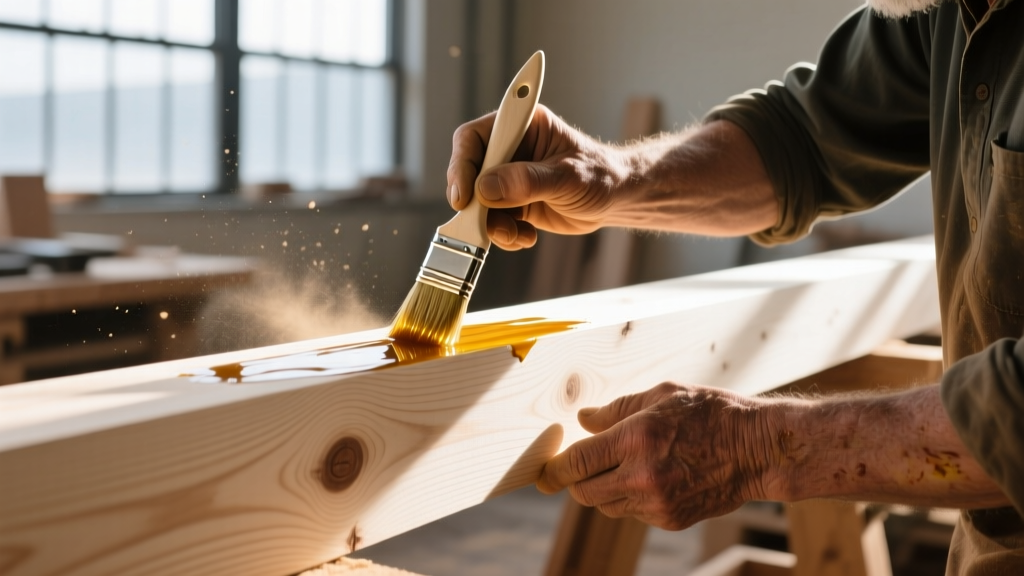
Do not over-sand oak before applying penetrating finishes. Sanding white or red oak past 120-grit or 150-grit burnishes the dense latewood, closing the pores and preventing hard wax oils and penetrating oils from anchoring into the cellular structure. For film-forming finishes like polyurethane or lacquer, sanding to 180-grit or 220-grit is acceptable to achieve a glass-smooth surface, as these finishes rely on surface tension and mechanical micro-scratches rather than deep pore penetration.
Troubleshooting Common Oak Preservation Failures
1. Symptom: Milky White Blush Under Film Finish
Cause: Moisture trapped beneath a polyurethane or lacquer film, often due to applying the finish in high ambient humidity (>70%) or over wood that had not reached target MC. The solvents evaporate rapidly, cooling the surface and causing ambient moisture to condense and become trapped in the curing film.
Fix: Strip the affected area using a chemical methylene chloride stripper or sand down to bare wood. Re-acclimate the room to 40-50% relative humidity. Apply a moisture-cured urethane or a specialized blush-eliminating thinner (retarder) if spraying lacquer.
2. Symptom: Black Staining Around Fastener Holes
Cause: Tannin-iron reaction. Even if stainless steel screws were used, the drill bit or countersink bit used to pre-drill the hole may have left microscopic iron particles embedded in the oak pores.
Fix: Apply a 5% solution of oxalic acid (wood bleach) directly to the black stains. The oxalic acid chemically reduces the iron-tannin complex, neutralizing the black color. Rinse thoroughly with distilled water and neutralize with a baking soda/water solution before re-finishing.
3. Symptom: Exterior Oak Turning Gray and Checking
Cause: UV radiation degrading the lignin (the natural glue holding wood cells together) at the surface. As lignin breaks down, moisture cycles cause the surface to shrink and crack (check), exposing raw wood to decay fungi.
Fix: If the gray patina is acceptable, apply a clear water-repellent preservative (WRP) containing a mildewcide to prevent fungal rot in the checks. If the original color must be restored, power-wash at a low PSI (under 1500) with an oxygenated bleach cleaner, sand the surface, and apply a heavily pigmented exterior oil stain containing benzotriazole UV absorbers.
Summary of Best Practices
Preserving any oak type of wood requires respecting its unique chemistry and anatomy. Always verify moisture content with a pin-type meter before sealing, mandate stainless steel hardware to prevent tannin reactions, and select finishes that align with the specific porosity of the white or red oak group. By matching the preservation chemistry to the wood's cellular reality, you ensure structural integrity and aesthetic longevity for decades.
Written by
Priya KapoorPriya Kapoor is a real estate market analyst and construction economics researcher with expertise in housing affordability, development feasibility, and infrastructure investment. She holds a Master of Regional Planning from Cornell University and previously worked as a senior analyst at CBRE's Investment Properties group, where she modeled returns for $4B in mixed-use development pipelines. Priya now runs an independent research practice advising developers, municipalities, and REITs on construction cost forecasting and market timing. She publishes the quarterly "BuildMat Market Pulse" report tracking material price indices across 12 commodity categories. Based in Austin, TX, Priya serves on the board of Habitat for Humanity Austin and is a marathon runner.
More from Priya Kapoor
View all
Construction Cost
Cost to Build a 1600 Sq Ft Home in 2026: Full Breakdown
Accurate 2026 cost to build a 1600 sq ft home—material, labor, and regional pricing breakdowns included. Plan your budget with real-time estimates.
Aug 11, 2026

Wood & Lumber
Name the Types of Wood for Pressure Treatment and Preservation
Learn how to name the types of wood best suited for pressure treatment. Compare species treatability, chemical retention levels, and 2026 preservation costs.
Aug 4, 2026

Stone & Masonry
Stone Veneer Suppliers Lindenhurst: 2026 Cost Analysis
Analyze 2026 stone veneer costs in Lindenhurst, NY. Compare local supplier pricing, delivery fees, and Suffolk County installation labor rates.
Aug 4, 2026