Installing Types of Wood from Brazil: Deck & Floor Best Practices
Master the installation of Brazilian hardwoods like Ipe, Cumaru, and Jatoba. Learn acclimation, fastening, and moisture best practices for lasting results.

Understanding Brazilian Hardwood Characteristics
Brazilian hardwoods are globally recognized for their exceptional density, natural rot resistance, and striking grain patterns. Species such as Ipe, Cumaru, Jatoba, and Tigerwood routinely exceed 2,500 lbf on the Janka hardness scale, making them up to five times harder than domestic oak. While this density guarantees a lifespan of 40 to 75 years in exterior applications, it also demands specialized installation protocols. Standard framing nails and generic wood screws will snap or deflect upon contact with these timbers.
⚠️ Silica Dust & Safety Warning
Many types of wood from Brazil, particularly Ipe (Handroanthus spp.), contain high levels of natural silica. Cutting or sanding these boards without proper protection exposes installers to crystalline silica dust, a known respiratory hazard. Always use a NIOSH-approved P100 respirator, pair your saw with a HEPA dust extraction system, and cut outdoors whenever possible.
Species Comparison Matrix
Selecting the right species depends on your structural requirements, budget, and aesthetic preferences. Below is a technical comparison of the most common Brazilian imports.
| Species | Janka Hardness | Dimensional Stability | Best Application |
|---|---|---|---|
| Ipe | 3,684 lbf | Excellent | Exterior decking, boardwalks, heavy traffic |
| Cumaru | 3,540 lbf | Good (prone to checking) | Decking, exterior siding, structural beams |
| Jatoba | 2,690 lbf | Moderate | Interior flooring, cabinetry, furniture |
| Tigerwood | 2,160 lbf | Good | Interior flooring, accent walls, light decking |
For deeper botanical and mechanical profiles, consult the comprehensive species guides at The Wood Database for Ipe and The Wood Database for Cumaru.
Pre-Installation: Acclimation and Moisture Mapping
Skipping acclimation is the primary cause of cupping and gapping in Brazilian hardwoods. Because these woods are so dense, moisture moves in and out of the cellular structure much slower than in softwoods.
Interior Flooring Targets
For interior installations like Jatoba or Tigerwood, the wood must reach an Equilibrium Moisture Content (EMC) of 6% to 9%. Use a pinless moisture meter (such as the Wagner Meters Orion 920) to scan every fifth board. Stack the lumber in the installation room with 3/4-inch sticker spacers between layers for a minimum of 14 days. Ensure the HVAC system is running and maintaining normal living conditions (65°F–75°F, 35%–50% relative humidity) during this period.
Exterior Decking Targets
Exterior boards like Ipe and Cumaru should be acclimated to the local outdoor EMC, typically between 12% and 15% in most North American climates. Cross-stack the bundles on a flat, well-drained surface, cover the top with a tarp to block direct UV and rain, but leave the sides open for airflow. Allow 7 to 10 days of acclimation before fastening.
Fastening Systems: Hidden Clips vs. Face Screwing
The extreme density of Brazilian timber dictates your fastening strategy. Never use galvanized or coated carbon-steel fasteners; the natural tannins and oils in the wood will cause rapid corrosion, leading to black stains and structural failure.
- Stainless Steel Requirement: Always use Type 304 stainless steel for standard exterior applications, and Type 316 marine-grade stainless steel for coastal environments or ground-contact installations.
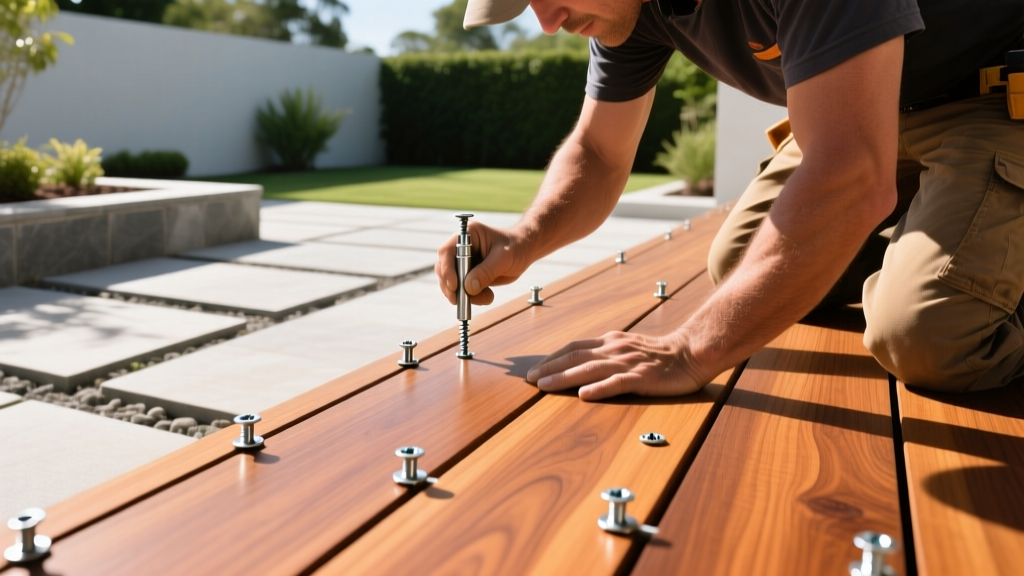
- Hidden Edge Fasteners (e.g., EB-TY, CAMO Marksman): These systems route into the edge of the board or drive at an angle through the gap. They are highly recommended for Ipe and Cumaru as they eliminate top-hole water traps and preserve the clean visual plane of the deck.
- Face Screwing: If face screwing, you must pre-drill. Use a carbide-tipped countersink bit. Drill the shank hole 1/64-inch larger than the screw shank to allow for seasonal expansion and contraction, preventing the screw from acting as a pivot point and snapping under sheer stress.
Step-by-Step Decking Installation Flow
- Substructure Prep: Flash all joists with butyl rubber tape (e.g., Trex Protect) to prevent moisture accumulation and joist rot beneath the dense hardwood.
- Layout & Spacing: Maintain a strict 3/32-inch to 1/8-inch gap between boards. Use a 16d common nail as a spacer gauge. This accounts for the minimal tangential shrinkage of Brazilian woods.
- Cutting: Use a 60-tooth or 80-tooth Alternate Top Bevel (ATB) carbide saw blade. Standard 40-tooth framing blades will tear out the dense end-grain fibers.
- End-Grain Sealing: Within 24 hours of any cut, apply a wax-based emulsion end sealer (such as Anchorseal 2) to all exposed end grains. This slows moisture egress from the highly porous end tubes, preventing severe end-checking and splitting.
- Fastening: Drive screws or engage clips, ensuring the head sits flush. Do not over-torque, as stripping the threads in stainless steel fasteners embedded in Ipe requires drilling them out with a titanium cobalt bit.
Troubleshooting Common Installation Failures
| Symptom | Root Cause | Corrective Action |
|---|---|---|
| Severe end-splitting | Rapid moisture loss from unsealed end grain | Cut off split sections past the fastener line; apply heavy coat of wax end sealer immediately. |
| Board cupping (edges raised) | Moisture differential; top drying faster than bottom | Improve under-deck ventilation; remove soil/debris trapping moisture against the joists. |
| Black halo stains around screws | Galvanized or coated fasteners reacting with wood tannins | Extract corroded screws; replace with 316 stainless steel; clean wood with oxalic acid brightener. |
Sourcing and Sustainability Verification
Because many types of wood from Brazil originate in the Amazon basin, verifying sustainable harvest practices is a critical professional responsibility. Illegal logging remains a concern, and specifying uncertified timber can violate green building codes like LEED or the Lacey Act. Always require your lumber supplier to provide a valid Chain of Custody certificate from the Forest Stewardship Council (FSC). FSC-certified Brazilian hardwoods ensure that the timber was harvested from managed concessions that maintain biodiversity, protect indigenous water rights, and enforce strict reforestation quotas.
Written by
James ThorntonJames Thornton is a construction industry veteran with 25 years of hands-on experience in wood framing, lumber grading, and residential building codes. He started as a framing carpenter in rural Oregon, earned his ICC Residential Building Inspector certification, and eventually became a senior plan reviewer for the City of Portland Bureau of Development Services. James holds a B.S. in Wood Science & Technology from Oregon State University and is a certified lumber grader through the West Coast Lumber Inspection Bureau (WCLIB). He has inspected over 3,000 residential construction sites and authored the city's internal guide on advanced framing techniques (2x6 at 24" O.C.). James lives in Bend, OR, where he builds custom timber-frame cabins and competes in lumberjack sports.
More from James Thornton
View all
Insulation
Best Home Insulation Materials: Complete 2026 Guide
Compare top home insulation materials for 2026. Find R-values, installed costs per square foot, and best uses for fiberglass, spray foam, and mineral wool.
Aug 4, 2026

Sustainable Building
Certify Your Green Building Material for LEED and WELL
Step-by-step guide to certifying a green building material for LEED v5 and WELL v2. Master EPDs, HPDs, and VOC limits for 2026 project specifications.
Aug 4, 2026

Stone & Masonry
Veneer Stacked Stone Panels: Interior Design & Style Showcase
Discover how veneer stacked stone panels transform interiors. Explore modern design profiles, material pairings, and technical installation specs.
Aug 4, 2026