What Type of Wood Are Railroad Ties Made Of? Cost & Value Guide
Discover what type of wood railroad ties are made of, comparing oak and pine species, treatment costs, and lifecycle value for construction and landscaping.

The Core Question: What Type of Wood Are Railroad Ties Made Of?
When evaluating heavy timber for structural retaining walls, industrial landscaping, or track maintenance, understanding the exact species composition is critical for accurate lifecycle costing. North American railroads consume approximately 20 million crossties annually. To answer the question of what type of wood are railroad ties made of, one must look at a bifurcated market: dense hardwoods, which dominate the mainline tracks, and highly treatable softwoods, which serve branch lines and specialized applications.
Railway engineers do not select timber based on aesthetics; they select it based on specific gravity (density), modulus of rupture (bending strength), and side-hardness (spike-holding ability). The Railway Tie Association (RTA) categorizes these materials into distinct classes, each with vastly different procurement costs, treatment requirements, and ultimate service lifespans.
Hardwood vs. Softwood Ties: A Cost and Lifespan Matrix
Hardwoods account for roughly 75% to 80% of all new railroad ties produced in the United States. Softwoods make up the remainder. The cost disparity between the two is driven by the raw timber market, but the value is determined by the cost-per-year of service life in ground contact.
| Wood Species | Avg. Density (pcf) | Wholesale Cost (New) | Expected Service Life | Primary Application |
|---|---|---|---|---|
| White Oak | 47 lbs/ft³ | $55 - $68 | 35 - 45 Years | High-speed mainlines, heavy axle loads, curves |
| Red Oak / Mixed Oak | 44 lbs/ft³ | $45 - $58 | 25 - 35 Years | Standard freight routes, regional transit |
| Hickory | 51 lbs/ft³ | $60 - $75 | 30 - 40 Years | Extreme wear areas, switch ties |
| Southern Yellow Pine (SYP) | 36 lbs/ft³ | $35 - $48 | 15 - 25 Years | Branch lines, lighter freight, yard tracks |
| Douglas Fir | 34 lbs/ft³ | $40 - $55 | 15 - 20 Years | Pacific Northwest regional routes |
The White Oak Advantage: Cellular Anatomy and Value
White Oak (Quercus alba) is the gold standard for railroad ties. Its premium cost is justified by its unique cellular structure. White oak contains tyloses—balloon-like cellular growths that plug the xylem vessels. This makes the wood highly resistant to natural decay and moisture ingress. However, during the pressure-treatment process, the end-grain of white oak absorbs creosote deeply, creating a robust chemical envelope that protects the most vulnerable areas of the tie, while the side-grain remains dimensionally stable and incredibly hard.
Southern Yellow Pine: The Softwood Alternative
Southern Yellow Pine (SYP) lacks the natural density of oak, but it possesses a high ratio of sapwood to heartwood. Sapwood is highly permeable, allowing SYP ties to be deeply and uniformly penetrated by preservatives. To compensate for its lower side-hardness, SYP ties are often incised (punctured with small needles) prior to treatment to ensure chemical penetration to the core. While the upfront cost is 20% to 30% lower than oak, the shorter lifespan makes SYP a higher long-term cost for heavy-haul mainlines, though it remains highly valuable for lighter-duty landscaping and secondary tracks.
The Hidden Costs of Treatment: Creosote vs. Modern Alternatives
A raw, untreated oak tie will rot in ground contact within 5 to 7 years. The true value of a railroad tie lies in its preservative treatment, which adds $12 to $20 to the manufacturing cost per unit. Understanding these chemical treatments is essential for both structural engineers and landscape architects.
- Coal-Tar Creosote: The industry standard for over a century. It costs approximately $12-$15 per tie to apply. Creosote is a heavy, oily preservative that does not leach easily into groundwater, making it highly effective for long-term ground contact. However, it poses handling and environmental risks.
- Copper Naphthenate (CuN): A more expensive alternative ($18-$22 per tie) used in environmentally sensitive areas, such as bridges over waterways or wetlands. It is less toxic than creosote and allows the wood to be painted or stained later, adding value for architectural and residential applications.
- Borate Treatment: Often used in dual-treatment processes (borate followed by a water-repellent topcoat) to protect against termite and fungal attack in southern climates. Borates are highly mobile in water, so they must be sealed.
Reclaimed vs. New Ties: Landscaping and Construction Value Analysis
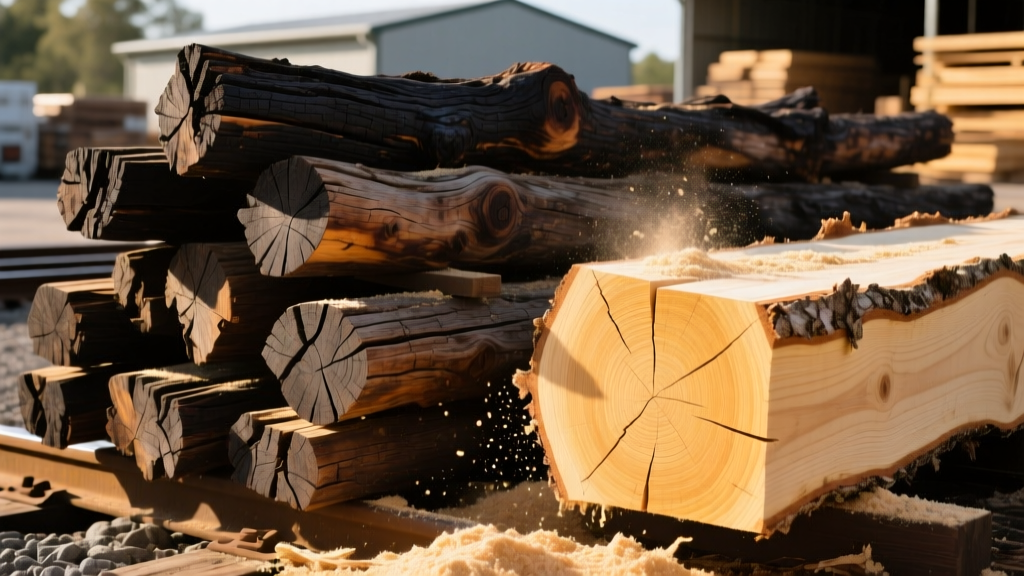
The secondary market for reclaimed (used) railroad ties is massive, driven by the landscaping and heavy-timber construction sectors. When a tie is retired from mainline service—typically after 20 to 30 years—it still retains significant structural mass. However, evaluating the cost-value ratio requires careful grading.
Grading and Pricing the Secondary Market
Reclaimed ties are generally sorted into three grades by salvage yards, each with a distinct value proposition:
- Grade 1 (Relay / Premium Landscaping): $28 - $40 per tie. These are straight, have minimal spike-hole damage, and retain 70% or more of their original creosote charge. They are suitable for structural retaining walls up to 4 feet high and secondary track relays.
- Grade 2 (Standard Landscaping): $18 - $27 per tie. These exhibit surface checking (cracking), weathering, and multiple spike holes. They are structurally sound for basic garden borders, steps, and low retaining walls (under 2 feet) but lack the sheer strength for heavy load-bearing applications.
- Grade 3 (Mulch / Biomass): $5 - $12 per tie. Severely decayed, split, or structurally compromised. These hold zero construction value and are typically chipped for industrial boiler fuel or specialized mulch.
Procurement and Freight: The Real Cost Drivers
When calculating the landed cost of railroad ties for a construction project, the material cost is only half the equation. The sheer mass of the timber dictates severe freight penalties. A standard mainline tie measures 7 inches by 9 inches by 102 inches (8.5 feet) and weighs between 160 and 240 pounds, depending on the species and moisture content.
Freight Calculation Example:
A standard flatbed trailer can legally haul approximately 44,000 pounds. If using dense White Oak ties averaging 200 lbs each, a single truckload maxes out at roughly 220 ties. If the treating plant is 500 miles from the job site, line-haul freight might cost $1,800. This adds $8.18 per tie in pure transportation costs before any local delivery, offloading equipment (a standard tie requires a skid steer or excavator to move), or markup is applied.
Value Optimization Tip: For non-critical landscaping projects where the 7x9 profile is not strictly required, consider sourcing 'switch ties' or 'bridge timbers' that have been cut down to 8x8 or 6x6 profiles from salvage yards. This reduces weight, increases the number of units per truckload, and lowers the per-linear-foot freight cost.
Decision Framework: When to Specify Railroad Ties
Should you use railroad ties or standard dimensional lumber (like pressure-treated 6x6s) for your next project? Use this framework to determine the highest-value material:
- Specify Railroad Ties (New or Grade 1 Reclaimed) When: You are building retaining walls exceeding 3 feet in height, dealing with high lateral earth pressure, requiring massive spike/lag-screw pull-out resistance, or building in highly abrasive industrial environments where the 9-inch face provides necessary wear resistance.
- Specify Pressure-Treated 6x6 Dimensional Lumber When: The project is in a residential backyard near edible plants (avoiding creosote), requires precise cutting and joinery (railroad ties are notoriously warped and difficult to cut cleanly), or when manual labor is the only option for installation (a 6x6 weighs ~70 lbs; a tie weighs 200+ lbs).
Ultimately, the wood species inside a railroad tie—whether it is the dense, tylose-rich White Oak or the deeply treatable Southern Yellow Pine—dictates its structural ceiling. By aligning the species, treatment chemistry, and grade with the specific load and environmental requirements of your project, you can accurately capture the true lifecycle value of these massive timber elements.
Written by
James ThorntonJames Thornton is a construction industry veteran with 25 years of hands-on experience in wood framing, lumber grading, and residential building codes. He started as a framing carpenter in rural Oregon, earned his ICC Residential Building Inspector certification, and eventually became a senior plan reviewer for the City of Portland Bureau of Development Services. James holds a B.S. in Wood Science & Technology from Oregon State University and is a certified lumber grader through the West Coast Lumber Inspection Bureau (WCLIB). He has inspected over 3,000 residential construction sites and authored the city's internal guide on advanced framing techniques (2x6 at 24" O.C.). James lives in Bend, OR, where he builds custom timber-frame cabins and competes in lumberjack sports.
More from James Thornton
View all
Insulation
Best Home Insulation Materials: Complete 2026 Guide
Compare top home insulation materials for 2026. Find R-values, installed costs per square foot, and best uses for fiberglass, spray foam, and mineral wool.
Aug 4, 2026

Sustainable Building
Certify Your Green Building Material for LEED and WELL
Step-by-step guide to certifying a green building material for LEED v5 and WELL v2. Master EPDs, HPDs, and VOC limits for 2026 project specifications.
Aug 4, 2026

Stone & Masonry
Veneer Stacked Stone Panels: Interior Design & Style Showcase
Discover how veneer stacked stone panels transform interiors. Explore modern design profiles, material pairings, and technical installation specs.
Aug 4, 2026