Matching Wood Grain Direction to Structural and Finish Applications
Learn how to match wood grain direction, figure, and type to specific structural framing, flooring, and fine woodworking applications for optimal performance.
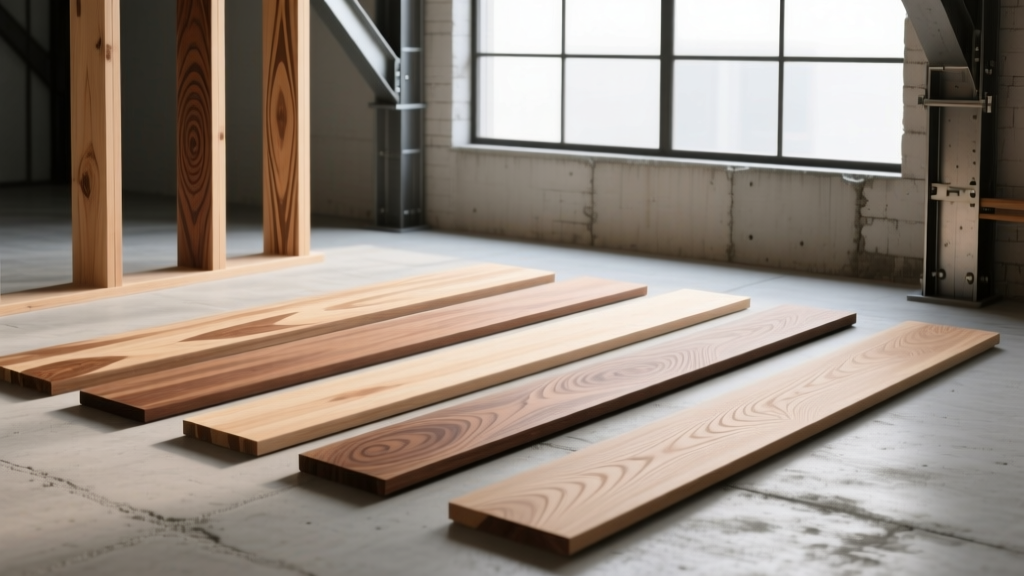
The Physics of Wood Grain: Why Direction Dictates Performance
Wood is an anisotropic material, meaning its physical properties change depending on the direction of the applied force or environmental shift relative to its grain. In construction and fine woodworking, treating wood as a uniform material leads to catastrophic structural failures, warped flooring, and shattered millwork joints. Understanding wood grain is not merely an aesthetic exercise; it is a fundamental requirement for predicting dimensional stability, load-bearing capacity, and fastener retention.
The cellular structure of wood consists of longitudinal tracheids and vessels that act like a bundle of straws. When moisture content fluctuates, these cells swell and shrink. According to the Wood Database, shrinkage occurs at vastly different rates across three distinct axes:
- Longitudinal (Parallel to grain): Negligible shrinkage, typically between 0.1% and 0.2% from green to oven-dry.
- Radial (Perpendicular to grain, along the rays): Moderate shrinkage, usually 4% to 6%.
- Tangential (Perpendicular to grain, tangent to the growth rings): Maximum shrinkage, often 8% to 12%, roughly double the radial rate.
Scenario Matching: Structural Framing and Load-Bearing Timber
In structural applications, the primary concern is the continuous alignment of the longitudinal grain with the axis of the applied load. A floor joist or roof rafter derives its bending strength (Modulus of Rupture) almost entirely from the uninterrupted longitudinal fibers.
The most common structural failure related to grain is 'slope of grain'—where the wood fibers run diagonally across the face of the board rather than parallel to its length. Grading agencies like the Southern Pine Inspection Bureau (SPIB) strictly penalize slope of grain. A slope of 1:10 (the grain deviates 1 inch over a 10-inch length) can reduce the bending strength of a timber by up to 40% compared to a 1:16 slope. When inspecting structural lumber, always trace the grain direction using the bark edge or surface checking; never assume the milled edge represents the true fiber direction.
'In heavy timber connections, dowel-type fasteners (bolts and lag screws) must be placed with strict adherence to end-grain and edge-grain distances. A bolt placed too close to the end grain will split the timber along the longitudinal rays under load, bypassing the calculated shear capacity of the steel fastener entirely.' — Adapted from the USDA Forest Products Laboratory Wood Handbook guidelines on timber joinery.
Scenario Matching: Hardwood Flooring and High-Traffic Surfaces
For hardwood flooring, the visual figure of the wood grain must be balanced against dimensional stability and surface wear. The method used to saw the log determines the grain orientation on the face of the board, which directly impacts how the floor will react to seasonal humidity swings.
| Sawing Method | Grain Appearance | Dimensional Stability | Best Application Scenario |
|---|---|---|---|
| Plainsawn (Flat Sawn) | Cathedral arches, wide tangential grain lines. | Lowest stability. Prone to width shrinkage and cupping. | Standard residential flooring, rustic aesthetics, budget-conscious projects. |
| Quartersawn | Straight, tight grain lines; prominent medullary ray flecks in white oak. | High stability. Shrinks mostly in thickness, not width. | Radiant heat flooring, historic restorations, high-humidity environments. |
| Rift Sawn | Perfectly straight, linear grain with zero ray fleck. | Maximum stability. Uniform movement in all transverse directions. | High-end modern architectural floors, custom stair treads, geometric inlays. |
When specifying flooring over radiant heating systems, plainsawn boards wider than 4 inches are highly prone to gapping and checking. Quartersawn or rift-sawn white oak (Janka hardness 1360 lbf) is the mandatory choice for these scenarios, as its radial orientation minimizes lateral shrinkage across the heating elements.
Architectural Millwork and Veneer Matching
In high-end commercial millwork and cabinetry, the wood grain figure is manipulated through veneer slicing and matching techniques. The Architectural Woodwork Institute (AWI) establishes strict standards for these aesthetic applications. Selecting the wrong grain match can result in visual dissonance or 'barber pole' effects across a wall of cabinets.
AWI Veneer Match Scenarios
- Book Match: Adjacent veneer leaves are opened like the pages of a book. This creates a symmetrical, mirror-image grain pattern. Best fit: Feature walls, executive boardroom tables, and focal point cabinetry where dramatic cathedral figures are desired.
- Slip Match: Veneer leaves are repeated side-by-side without turning. This yields a uniform, repeating grain sequence. Best fit: Long runs of base cabinetry, continuous wall paneling, and environments requiring visual calmness and uniformity.
- Random Match: Leaves of varying widths and grain figures are mixed to simulate solid lumber. Best fit: Traditional or rustic architectural styles where a manufactured or overly symmetrical look must be avoided.
End Grain vs. Edge Grain in Countertops and Butcher Blocks
For solid wood countertops, butcher blocks, and heavy-duty work surfaces, the orientation of the wood grain relative to the cutting or impact surface dictates the lifespan and maintenance requirements of the product.
Decision Framework for Work Surfaces
1. Edge Grain (Strip Construction): Boards are laid side-by-side with the edge facing up. The grain runs horizontally across the length of the counter. This is the industry standard for commercial butcher blocks. It offers an optimal balance of heavy impact resistance, moderate knife-friendliness, and cost-effectiveness. Hard maple (Janka 1450 lbf) is the preferred species for edge-grain food prep surfaces due to its tight, closed-grain cellular structure that resists bacterial ingress.
2. End Grain (Checkerboard Construction): Blocks are oriented so the ends of the wood fibers face upward. This is the premium choice for heavy meat cleaving. The vertical fibers part to allow a knife blade to slip between them, preserving the blade edge and self-healing upon withdrawal. However, end grain absorbs moisture and oils rapidly, requiring frequent mineral oil maintenance. It is also the most expensive configuration due to the massive volume of timber and complex glue-up labor required.
3. Face Grain (Wide Plank): The wide face of the board is used as the surface. While this showcases the most dramatic wood grain patterns (cathedrals and burls), it is the least durable for cutting. Knife marks will permanently scar the tangential fibers, and the wide surface is highly susceptible to water pooling and subsequent warping. Reserve face grain strictly for bar tops, desk surfaces, or dining tables where direct heavy cutting will not occur.
Sourcing and Specifying: What to Tell Your Lumber Supplier
To ensure you receive the correct material for your scenario, avoid ordering by species and thickness alone. Your specification must include the required sawing method and moisture content (MC). For interior millwork in climate-controlled environments (30-45% relative humidity), specify kiln-dried (KD) lumber at 6-8% MC. For exterior structural timber or decking, specify air-dried or green lumber acclimated to 12-15% MC to prevent rapid initial shrinkage upon installation. Always require the supplier to stamp or tag the grain orientation (e.g., 'Q-SAWN' for quartersawn) on the end grain of premium hardwood bundles to verify compliance before the material is cut.