How to Treat and Preserve Various Types of Wooden Siding
Discover how to treat and preserve various types of wooden siding. Learn pre-installation protocols, coating selection, and maintenance schedules.

The Vulnerability Matrix: Why Siding Profiles Dictate Treatment
When evaluating the types of wooden siding for exterior applications, architects and builders often focus on aesthetics and cost. However, from a preservation standpoint, the physical profile of the siding dictates its moisture-management requirements and coating longevity. A treatment protocol that yields a 10-year lifespan on horizontal clapboard may fail in three years on vertical board-and-batten or end-grain-heavy shingles.
Wood is a hygroscopic material. Its dimensional stability relies on maintaining a consistent moisture content (MC). When siding profiles trap water or expose excessive end-grain, the wood swells, breaking the molecular bonds of film-forming coatings and inviting fungal decay.
| Siding Profile | Primary Moisture Risk | End-Grain Exposure | Recommended Preservation Strategy |
|---|---|---|---|
| Clapboard / Lap | Capillary action at horizontal overlaps | Low (mostly edge-grain) | Solid acrylic stains; back-priming top 2 inches of each board. |
| Cedar Shingles & Shakes | Water retention in shadow lines and keyways | Very High (butt ends) | Penetrating alkyd-oil stains; avoid film-forming solid stains entirely. |
| Board and Batten | Vertical water channeling; batten trapping moisture against the board | Moderate (top/bottom cuts) | Semi-transparent oils; ensure 1/4-inch gap behind battens for drainage. |
| Tongue and Groove | Interlocking grooves trapping driven rain | Low | Pre-finishing all four sides before installation; factory-applied UV inhibitors. |
| Engineered Wood (e.g., LP SmartSide) | Core swelling if the factory-treated edge is compromised | High at field cuts | 100% acrylic latex topcoats; mandatory edge-sealing on all field cuts. |
Pre-Installation Chemical Preservation: The Borate and Primer Protocol
The most critical preservation steps for natural wood siding occur before the first nail is driven. Once installed, the back face and end joints of the siding are largely inaccessible. According to the USDA Forest Products Laboratory, uncoated end-grain absorbs moisture up to 50 times faster than face-grain.
Step 1: Borate Diffusion Treatment
For raw, untreated wood species like pine, fir, or spruce, apply a disodium octaborate tetrahydrate (DOT) solution (such as Bora-Care or Tim-bor) to all sides, edges, and ends. Borates are odorless, non-toxic to humans, and lethal to wood-destroying insects and decay fungi.
- Application Rate: 1 gallon per 200 square feet of wood surface.
- Moisture Requirement: Borates require moisture to diffuse into the wood cells. Apply to wood with an MC between 15% and 19%. If the wood is kiln-dried below 12%, lightly mist the surface with water before application.
- Cost: Approximately $0.15 to $0.25 per square foot of treated surface.
Step 2: Tannin Blocking and Back-Priming
Extractive-rich woods like Western Red Cedar and Redwood contain water-soluble tannins. If exposed to rain before being sealed, these tannins will bleed through water-based primers and topcoats, causing severe brown discoloration. The Western Red Cedar Lumber Association mandates the use of an alkyd-oil or shellac-based stain-blocking primer for these species.
Many modern cedar and pine sidings are planed at the mill with dull blades, which burnishes the wood surface and crushes the cellular structure. This creates a "mill glaze" that prevents stains and primers from penetrating. Always test a small area with water drops. If the water beads up rather than absorbing within 2 minutes, you must sand the face with 80-grit paper or apply a commercial mill-glaze remover (typically an oxalic or citric acid blend) before priming.
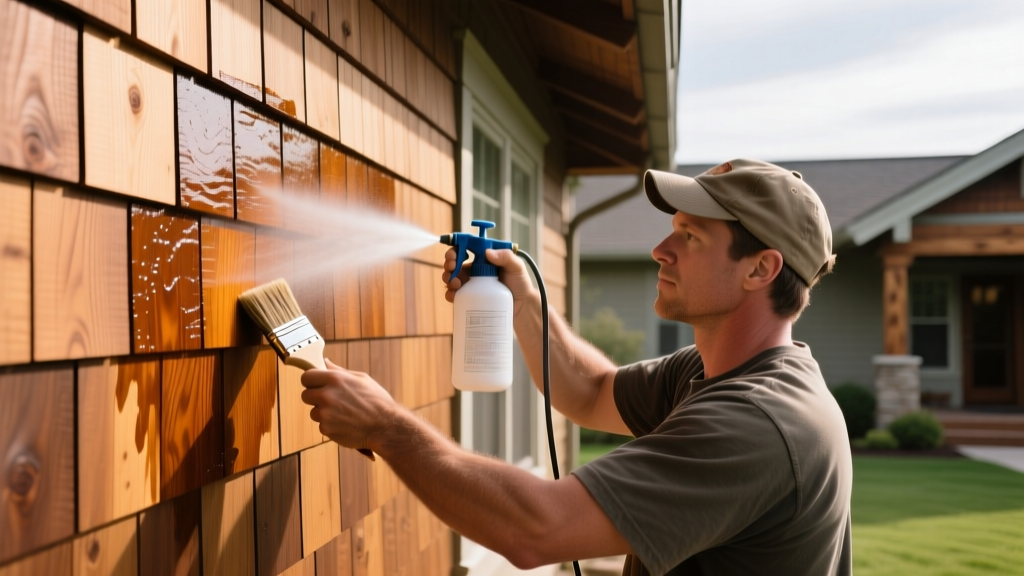
Field-Applied Coatings: Penetrating Oils vs. Film-Forming Stains
Selecting the correct field coating depends heavily on the specific types of wooden siding installed and the local climate. The Environmental Protection Agency regulates the active biocides in these coatings, but the binder chemistry dictates the physical performance.
Penetrating Alkyd-Oil Stains
Penetrating oils (e.g., Cabot Australian Timber Oil, Penofin) do not form a surface film. Instead, they soak into the wood's cellular cavities, repelling water from the inside while allowing the wood to breathe.
- Best For: Cedar shingles, shakes, and rough-sawn board-and-batten.
- Advantage: They never peel, blister, or flake. Maintenance involves a simple cleaning and reapplication without the need for scraping or sanding.
- Drawback: Lower UV resistance. Requires reapplication every 2 to 4 years depending on solar exposure.
- Application Specifics: Must be applied to bare, dry wood (MC below 15%). Applying oil over an existing film-forming stain will result in a sticky, non-drying surface.
Film-Forming Solid Acrylic Stains
Solid stains contain high levels of titanium dioxide (TiO2) and acrylic resins. They sit on the surface of the wood, hiding the grain but providing a thick, flexible shield against UV radiation and liquid water.
- Best For: Smooth-sawn clapboard, engineered wood, and previously painted surfaces where the grain is not a priority.
- Advantage: Superior UV protection; lifespan of 7 to 10 years.
- Drawback: If moisture gets trapped behind the film (via unsealed end-grains or interior vapor drive), the coating will blister and peel. Maintenance requires scraping, sanding, and re-priming bare spots.
Troubleshooting Siding Coating Failures
When preservation protocols fail, the symptoms usually point to a specific breakdown in the treatment chain. Use this diagnostic framework to identify the root cause before attempting a repair.
- Symptom: Coating peeling in large, continuous sheets, exposing bare wood.
Cause: Moisture trapped behind the film (high interior vapor drive or lack of back-priming) or application over mill glaze.
Fix: Strip all coating down to bare wood using a chemical stripper or infrared heat gun. Sand to open pores. Re-prime with an oil-based bonding primer and top with a breathable solid stain. - Symptom: Dark brown or yellowish stains bleeding through the topcoat, localized around knots or sapwood.
Cause: Tannin or resin bleed due to the use of a water-based primer on cedar, redwood, or pine.
Fix: Spot-prime the stained areas with a shellac-based primer (e.g., Zinsser B-I-N) to permanently seal the extractives, then repaint the affected section. - Symptom: Black, gray, or pinkish biological growth on the shaded side of the house.
Cause: Mildew and algae feeding on the linseed oil or natural sugars in the wood. Common in penetrating oils that lack modern mildewcides.
Fix: Wash with a solution of 1 part sodium hypochlorite (bleach) to 3 parts water, combined with a non-ammonia surfactant. Rinse thoroughly. For future applications, select a stain containing zinc pyrithione or IPBC (3-Iodo-2-propynyl butylcarbamate) as an active mildewcide. - Symptom: "Picture framing" (peeling exclusively at the edges and joints of the boards).
Cause: Unsealed end-grain wicking moisture into the board ends, causing localized swelling that breaks the film's adhesion.
Fix: Scrape the edges, apply a heavy bead of paintable exterior elastomeric caulk to the end-joints, and spot-prime with an alkyd primer before topcoating.
Maintenance Schedules by Wood Species
The natural durability of the wood species drastically alters the required maintenance frequency. While engineered woods rely entirely on their factory-applied zinc borate and resin treatments, natural woods rely on their inherent extractives.
| Wood Species / Type | Natural Decay Resistance | Recommended Re-Coating Interval (Penetrating Oil) | Recommended Re-Coating Interval (Solid Stain) |
|---|---|---|---|
| Western Red Cedar | High (Heartwood) | 3 - 5 Years | 8 - 12 Years |
| Alaskan Yellow Cedar | Very High | 4 - 6 Years | 10 - 15 Years |
| Redwood | High (Heartwood) | 3 - 5 Years | 8 - 12 Years |
| Spruce / Pine / Fir (SPF) | Low (Requires Preservative) | 2 - 3 Years | 5 - 7 Years |
| Engineered Wood (OSB Core) | N/A (Relies on Factory Treatment) | Not Recommended | 7 - 10 Years (Acrylic Latex Only) |
Proper preservation of exterior wood is not a one-time application but a calculated system of moisture management, chemical protection, and profile-specific coating selection. By matching the treatment protocol to the exact physical and biological characteristics of the siding, builders can extend the functional lifespan of wood cladding well beyond the industry average.
Written by
James ThorntonJames Thornton is a construction industry veteran with 25 years of hands-on experience in wood framing, lumber grading, and residential building codes. He started as a framing carpenter in rural Oregon, earned his ICC Residential Building Inspector certification, and eventually became a senior plan reviewer for the City of Portland Bureau of Development Services. James holds a B.S. in Wood Science & Technology from Oregon State University and is a certified lumber grader through the West Coast Lumber Inspection Bureau (WCLIB). He has inspected over 3,000 residential construction sites and authored the city's internal guide on advanced framing techniques (2x6 at 24" O.C.). James lives in Bend, OR, where he builds custom timber-frame cabins and competes in lumberjack sports.
More from James Thornton
View all
Insulation
Best Home Insulation Materials: Complete 2026 Guide
Compare top home insulation materials for 2026. Find R-values, installed costs per square foot, and best uses for fiberglass, spray foam, and mineral wool.
Aug 4, 2026

Sustainable Building
Certify Your Green Building Material for LEED and WELL
Step-by-step guide to certifying a green building material for LEED v5 and WELL v2. Master EPDs, HPDs, and VOC limits for 2026 project specifications.
Aug 4, 2026

Stone & Masonry
Veneer Stacked Stone Panels: Interior Design & Style Showcase
Discover how veneer stacked stone panels transform interiors. Explore modern design profiles, material pairings, and technical installation specs.
Aug 4, 2026