Best Way to Mop Timber Floors: Cleaning Cost & Quantity Guide
Calculate the exact cost and solution quantities for timber floor maintenance. Discover the best way to mop timber floors without causing costly water damage.
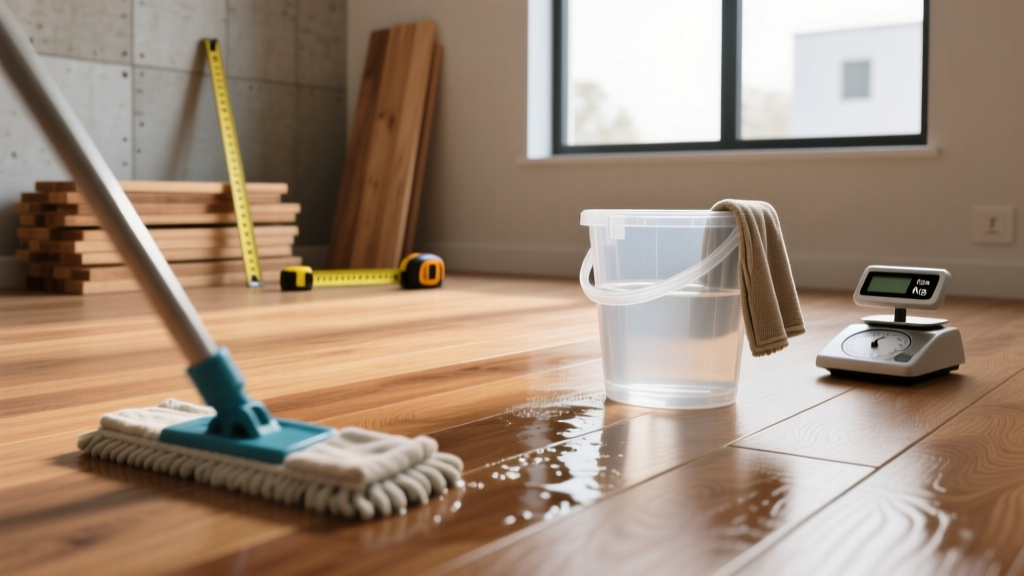
The True Cost of Timber Floor Maintenance
When evaluating the best way to mop timber floors, most homeowners focus solely on aesthetics and immediate cleanliness. However, from a building materials and cost estimation perspective, the mopping method directly dictates the long-term depreciation of the timber asset. Incorrect mopping techniques—specifically those involving excess moisture or alkaline chemicals—accelerate the breakdown of polyurethane finishes and hardwax oils, leading to premature refinishing costs that range from $1.50 to $7.50 per square foot. This guide provides a quantitative framework for calculating cleaning solution quantities, comparing the lifecycle costs of different mopping methods, and protecting your timber investment in 2026.
Finish Identification: The Critical First Step
Before calculating chemical quantities, you must identify the timber finish. The best way to mop timber floors changes entirely based on the topcoat. Using a standard polyurethane cleaner on a hardwax oil floor will strip the lipids, resulting in a $3.00+ per square foot re-oiling expense.
Finish Types and Required pH Levels
- Polyurethane (Water-based or Oil-based): Requires pH-neutral cleaners (pH 7.0 to 8.5). Examples: Bona Hardwood Floor Cleaner, Black Diamond.
- Hardwax Oil (Rubio Monocoat, Osmo): Requires specialized lipid-replenishing soaps (pH 8.0 to 9.5). Examples: Osmo Wash and Care, Rubio Monocoat Soap.
- Penetrating Oil / Wax: Requires paste wax maintenance or specific mineral spirit-based cleaners; water-based mopping is strictly prohibited.
Cleaning Solution Quantity Calculator
Over-diluting cleaning solutions wastes capital, while under-diluting leaves sticky residues that attract abrasive grit, accelerating micro-scratches. Use the following formula to estimate your annual chemical expenditure based on your home's square footage.
The Dilution Formula
Total Ounces Needed = (Cleanable Square Footage / Coverage Rate per Ounce) x Frequency of Mopping
To use this calculator, subtract the area covered by fixed cabinetry, large rugs, and non-timber transitions from your total floor plan area. Most residential spaces have a 15% deduction for these fixed elements.
| Product (2026 Formulations) | Finish Compatibility | Coverage (Sq Ft / Oz) | Cost per Gallon (Ready-to-Use Equivalent) |
|---|---|---|---|
| Bona Hardwood Floor Cleaner (WM710011612) | Polyurethane | 15 - 20 sq ft | ~$40.00 |
| Osmo Wash and Care Concentrate | Hardwax Oil | 40 - 50 sq ft (diluted) | ~$65.00 |
| Black Diamond Wood & Laminate Cleaner | Polyurethane | 18 - 22 sq ft | ~$32.00 |
| Rubio Monocoat Soap Concentrate | Hardwax Oil | 35 - 45 sq ft (diluted) | ~$85.00 |
Step-by-Step Damp Mopping Protocol
The National Wood Flooring Association (NWFA) strictly advises against wet mopping. The industry standard for the best way to mop timber floors is the 'damp microfiber' technique, which limits moisture penetration to the surface level, evaporating within 60 to 90 seconds.
- Dry Extraction (Crucial): Vacuum with a hard-floor setting (beater bar disabled) or use a dry electrostatic dust mop. Removing abrasive silica dust prevents the mop from grinding grit into the finish.
- Spray Application: Mist the pH-neutral cleaner directly onto the microfiber pad or the floor in a 3x3 foot grid. Never pour liquid directly from the bottle onto the timber.
- Directional Agitation: Mop strictly parallel to the timber grain. This pushes dirt out of the microscopic grain valleys rather than trapping it.
- Pad Rotation: Swap the microfiber pad every 200 square feet. A saturated pad merely redistributes suspended soils and excess moisture.
Cost Comparison Matrix: Mopping Methods
Choosing the wrong tool introduces hidden costs. Below is a 5-year lifecycle cost analysis for a 1,000-square-foot timber floor area, factoring in tool replacement, chemical usage, and the statistical probability of moisture-induced refinishing.
| Method | Initial Tool Cost | 5-Year Supply Cost | Moisture Risk Profile | Est. 5-Year Total Cost |
|---|---|---|---|---|
| Damp Microfiber Spray Mop | $35 - $50 | $180 (Chemicals + Pads) | Very Low (<1%) | $215 - $230 |
| Traditional String Mop & Bucket | $20 - $30 | $120 (Chemicals) | High (40% chance of recoat) | $1,640+ (Includes $1,500 screen/recoat) |
| Electric Spin Scrubber (Wet) | $120 - $180 | $150 (Pads + Chemicals) | Moderate (15% chance of recoat) | $495 - $555 |
| Steam Mop | $60 - $120 | $0 (Water only) | Extreme (Void warranty, high delamination) | $4,000+ (Includes full sand/refinish) |
Estimating Refinishing Costs: When Mopping Goes Wrong
If improper mopping causes water ingress, the timber fibers swell, causing 'cupping' (edges higher than the center) or 'crowning' (center higher than edges). According to industry data and expert flooring guides, once moisture breaches the finish, chemical cleaners cannot reverse the physical deformation. You must budget for remediation:
- Screen and Recoat (Abrasion and Topcoat): $1.50 to $2.50 per square foot. Viable only if the moisture damage is strictly cosmetic (e.g., water spots or minor hazing) and the wood substrate has not deformed.
- Full Sand and Refinish: $4.50 to $7.50 per square foot in 2026. Required when cupping exceeds 1/16th of an inch. This process removes 1/32nd of the timber surface, reducing the total lifespan of solid 3/4-inch oak by approximately 15 years.
- Board Replacement: $15.00 to $25.00 per square foot. Necessary for engineered timber that has delaminated or solid timber that has suffered black-stage water staining (indicating deep fungal or tannin reaction).
Frequently Asked Questions: Cost & Chemistry
Is vinegar a cost-effective alternative to commercial timber cleaners?
No. While white vinegar costs pennies per gallon, its acetic acid content (pH 2.5 to 3.0) actively etches polyurethane finishes over time. This chemical abrasion dulls the sheen and degrades the UV inhibitors in the topcoat. The $20 saved on commercial cleaners annually will result in a premature $1,500+ screen-and-recoat job within 3 to 4 years. Always use EPA Safer Choice certified pH-neutral alternatives.
How do I calculate the exact dilution ratio for concentrates?
Check the manufacturer's Technical Data Sheet (TDS). For example, Osmo Wash and Care requires a 1:40 dilution ratio (1 part soap to 40 parts water) for routine maintenance. If your spray bottle holds 32 ounces, you will add 0.8 ounces of concentrate and 31.2 ounces of distilled water. Using tap water introduces calcium and magnesium, which leave micro-scratches and cloudy mineral deposits on dark timber species like walnut.
Does timber species affect mopping frequency and cost?
Yes. Open-grain species like Red Oak and Ash have deeper microscopic valleys that trap dirt, requiring slightly more aggressive agitation and 10% more chemical volume per square foot. Closed-grain species like Maple and Hickory show water spots and streaks much faster, requiring more frequent dry-dusting to maintain appearance, though their chemical consumption remains lower.